










We are living through the most expensive revolution in history. There are huge opportunities and risks embedded within it. That is what this article is about.
Artificial intelligence is supposed to make everything cheaper in our country.
But before AI can save everyone money, we first need more computer chips, more data centers, more electricity, more power plants, more transmission lines, more cooling systems, more programmers, more engineers and more people who can explain to everybody else what the AI is supposed to do.
And everybody wants these things at the same time.
This is not complicated economics. When enormous amounts of money chase a limited supply of anything, prices go up. If ten people want the last hotel room, you don’t get a discount. You get an auction.
That’s essentially what’s happening with AI infrastructure.
Microsoft, Amazon, Google, Meta and the rest of Big Tech are engaged in an arms race. Nobody wants to wake up five years from now and discover that a competitor owns the technology that just changed the world. So they’re spending enormous amounts of money today to make certain they’re still standing tomorrow.
That means more demand for Nvidia’s chips. More demand for electricity. More data centers. More copper. More natural gas. More nuclear power. More transformers. More cooling equipment. More land near reliable power.
In other words, before AI becomes the world’s great cost-cutting machine, we first have to build it.
And building it is inflationary.
But here is where the story gets interesting.
We aren’t spending all this money so AI can consume more resources forever. We’re spending it because AI promises to eventually help businesses accomplish more work with fewer resources, fewer hours and, in some cases, fewer people.
So today’s AI boom contains the seeds of tomorrow’s economic contradiction.
First, AI creates shortages by demanding enormous resources to build it. Then AI eliminates costs by making almost everything more productive and abundant.
First comes the spending boom. Then comes the productivity boom.
And somewhere between those two worlds, inflation could turn into deflation.
For traders, that transition may be far more important than the latest AI headline, earnings report or prediction about which chatbot is smartest.
Because fortunes aren’t made simply by knowing where the economy is today. They’re made by recognizing where it’s going next.
Now we get to the part that should make every trader sit up straight. The AI boom isn’t being powered primarily by profits. It’s being powered by promises. Companies at the center of the AI revolution are spending breathtaking amounts of money today because investors believe they will make breathtaking amounts of money tomorrow.
OpenAI and Anthropic have attracted enormous amounts of capital while building businesses that have yet to demonstrate sustained annual profitability. Apparently, profits are something we’ll get around to later. Right now, growth is the product. And investors are willing to pay dearly for it. In 2026 alone, OpenAI and Anthropic announced financing rounds totaling $187 billion, while investors valued the two companies at a combined $1.817 trillion following those respective rounds.
Herein lies the paradox. Everyone recognizes the power of AI. Everyone sees it potential. But neither Anthropic or OpenAI have earned their first dollar of profit.
OpenAI is telling the world that their valuation is $852 billion. Anthropic is telling everyone that their valuation is $965 billion. That is a combined $1.8 trillion valuation for two companies which are currently losing money.
If a company has no meaningful earnings, you cannot value it conventionally with a P/E ratio. There is no “E” in the equation. So investors move further up the income statement and value the company primarily on revenue, growth, gross margins, future cash-flow potential, and strategic position.
The simplest framework is:
Valuation = Annual Revenue × Revenue Multiple
Suppose an AI company generates $25 billion in annual revenue but loses money. Investors might decide that extraordinary growth deserves a 20× revenue multiple:
$25B × 20 = $500 billion valuation.
But notice what just happened. We didn’t calculate what the business is worth in any traditional sense. We calculated what investors are willing to pay for its future potential.
This is where things get interesting
With a mature company, you might ask:
How much money does this business earn for its owners?
With OpenAI or Anthropic, the question becomes:
How much money could this business eventually earn if its enormous growth continues and its costs eventually become manageable?
That’s an enormous difference.
Investors therefore build a model something like this:
Revenue today → future revenue → mature margins → future earnings → future cash flow → discount that value back to today.
Imagine a company doing $25 billion in revenue today growing to $100 billion several years from now. Suppose investors believe it eventually produces a 25% free-cash-flow margin.
That would mean:
$100B revenue × 25% = $25B annual free cash flow.
If a mature technology company producing $25 billion in cash flow were eventually worth 25× that cash flow, you’d have:
$25B × 25 = $625 billion.
But that’s the future valuation. You then have to discount $625 billion back to today’s dollars and account for the probability that the company never gets there.
And that’s where the assumptions become everything.
Change future margins from 25% to 10%. Change growth from 50% to 20%. Assume AI inference remains extremely expensive. Assume competition drives model pricing toward commodity levels. Suddenly that $625 billion theoretical destination can collapse dramatically.
The uncomfortable part
These valuations contain an extraordinary amount of faith about the future.
Investors are effectively making several enormous bets simultaneously:
-
Revenue continues growing extremely rapidly.
-
Customers remain willing to pay for AI.
-
Gross margins eventually become attractive.
-
Computing costs decline relative to revenue.
-
Competition doesn’t destroy pricing power.
-
Capital expenditures eventually normalize.
-
The company develops a durable competitive moat.
-
Future cash flows become enormous enough to justify today’s valuation.
This is why revenue growth alone doesn’t answer the valuation question.
A company could eventually generate $100 billion in revenue and still be a terrible investment if it requires $110 billion to generate it.
That leads to what I think is the most important equation when examining the AI boom:
How much capital must be consumed to create $1 of sustainable free cash flow?
That’s a much more revealing question than “How fast is AI revenue growing?”
Because ultimately, whether we’re talking about a railroad in 1880, an automobile company in 1920, a dot-com company in 1999, or an AI laboratory in 2026, the economic law doesn’t change.
Eventually somebody has to make money.
And the higher today’s valuation becomes, the more spectacular tomorrow’s profits have to be to justify it.
Earlier this week, Jensen Huang, founder and CEO of Nvidia, announced something that ought to make every investor sit up and check whether we’ve accidentally wandered into a new chapter of financial history.
He helped persuade six of the biggest financial firms on Earth, Apollo, BlackRock, Blackstone, Brookfield, Goldman Sachs and KKR, to help raise more than $500 billion to finance AI infrastructure. In plain English, Wall Street is being recruited to provide the money so the AI industry can keep building data centers and buying mountains of NVIDIA chips. The increasingly circular nature of AI financing already makes your head spin. Now we’re apparently going to finance the machines that finance the machines.
Then Huang explained the logic:
“This is really the first time that technology chips have become an investable asset class.”
And suddenly you understand the pitch. Huang’s argument is that GPUs aren’t merely computer chips anymore. They’re productive financial assets. They generate revenue. They can serve many different customers. And, according to the investment thesis, they can remain economically useful for years. If that’s true, a warehouse stuffed with GPUs starts looking less like an expense and more like infrastructure.
And once Wall Street decides something is an asset, you know what comes next. Collateral. Loans. Leverage. Securitization. Why pay cash for $10 billion worth of GPUs when somebody can lend you the money against the GPUs themselves?
Which brings us to the wonderfully reassuring phrase every investor loves hearing: “It’s different this time.”
We’ve seen versions of this movie before. Houses weren’t merely places to live in 2008. They became collateral supporting an enormous financial machine because everyone agreed they would retain their value. Now we’re contemplating whether rapidly evolving computer hardware can perform a similar trick.
The critical question isn’t whether GPUs generate revenue. They clearly can. The question is what happens to the collateral value of today’s $40,000 GPU when tomorrow’s $40,000 GPU performs twice as much work for half the cost.
Because a house doesn’t usually become technologically obsolete when somebody builds a better house across the street. But a computer chip just might.
The machine works something like this. Investors believe AI will become enormous, so they give AI companies enormous amounts of money. Those companies spend that money buying chips, computing power and data-center capacity from companies such as Microsoft, Amazon, Google and Oracle. Big Tech sees this exploding demand and decides it needs to build even more.
So hundreds of billions more get poured into chips, electricity and data centers. Nvidia sells more chips. Cloud companies sell more computing power. Data-center companies build more capacity. Wall Street looks at all this booming business and concludes, “See? We told you AI was enormous.”
Technology stocks rise. Higher stock prices attract more money. Higher private valuations attract more investors. And the whole machine spins faster.
It’s a beautiful arrangement, as long as it keeps spinning faster.
Because here is the part Wall Street doesn’t put on the brochure. Much of today’s AI spending is based on expectations about tomorrow’s AI demand. Investors aren’t paying extraordinary valuations because of what these businesses earn today. They’re paying for what they believe these businesses could earn years from now.
Suppose investors expect AI revenues to grow 60%, but they get 50%. That’s fantastic growth, but it’s also a disappointment. Then growth falls to 40%, then 30%. The business is still growing rapidly, yet Wall Street suddenly has a problem.
A company can be doing wonderfully while its stock gets slaughtered. Why? Because the stock wasn’t priced for wonderful. It was priced for extraordinary.
This is where the comparison with the housing bubble becomes useful. The housing machine in 2007 didn’t initially break because houses suddenly became worthless. It began breaking when home prices stopped rising fast enough to support the borrowing that had been built on top of them. The rate of growth changed before the headlines did.
The same question needs to be asked about AI. Don’t simply ask whether AI is growing. Ask whether AI is growing fast enough to justify the enormous amount of money already betting that it will. That’s a very different question.
But there is another character walking onto this financial stage, and at first glance it appears to have absolutely nothing to do with artificial intelligence.
The United States government.
Let’s start with a number so obscene that if it appeared on a corporate balance sheet, somebody would probably be escorted from the building carrying a cardboard box.
Roughly $40 trillion.
That’s approximately what the United States government owes. And we’re now spending roughly $24 billion every week just on interest. We’re not paying off the debt. We’re paying an extraordinary amount of money for the privilege of continuing to owe it.
The federal deficit reached roughly $1.4 trillion during the first nine months of fiscal 2026. That’s around $155 billion of additional borrowing per month. Washington hasn’t discovered fiscal discipline. It has discovered a larger shovel.
This matters to the AI story because all these financial machines ultimately meet in the same place… The capital markets.
AI companies need capital. Big Tech needs capital for massive infrastructure projects. The United States government needs enormous amounts of capital to finance deficits and refinance existing debt. Everybody is standing at roughly the same financial well with increasingly large buckets.
And last week’s intervention in the Japanese yen offered traders a glimpse of just how interconnected that well has become. The United States took the extraordinary step of joining Japan in supporting the yen, the first coordinated U.S.-Japan intervention of its kind in decades. One important concern hanging over the market was that Japan, one of America’s largest foreign creditors, could otherwise be forced to liquidate some of its enormous Treasury holdings to obtain the resources needed to defend its currency.
Think about that for a moment.
America desperately needs buyers for an enormous and growing supply of government debt. Japan owns more than $1 trillion of that debt. If Japan becomes a major seller instead of a reliable holder, Treasury prices can come under pressure and yields can rise.
And higher Treasury yields don’t stay politely inside the bond market.
Higher government yields can mean higher borrowing costs throughout the economy. They can raise the discount rate investors use to value future corporate profits. And few investments depend more heavily on enormous profits arriving far into the future than today’s richly valued AI companies.
Suddenly Japan, the yen, Treasury auctions, federal deficits and artificial intelligence don’t look quite so disconnected.
They’re all competing inside the same global price for money.
America’s debt problem makes this especially important. When you owe roughly $40 trillion and continue running enormous deficits, interest rates aren’t merely something traders discuss after a Federal Reserve meeting. The price of money increasingly determines how expensive it is for Washington to keep financing itself.
Higher rates mean higher interest expense. Higher interest expense contributes to larger deficits. Larger deficits require more borrowing. More borrowing means more Treasury issuance. And more Treasury supply can put additional upward pressure on yields if demand doesn’t keep pace.
Congratulations.
We’ve invented a financial hamster wheel powered by Treasury auctions.
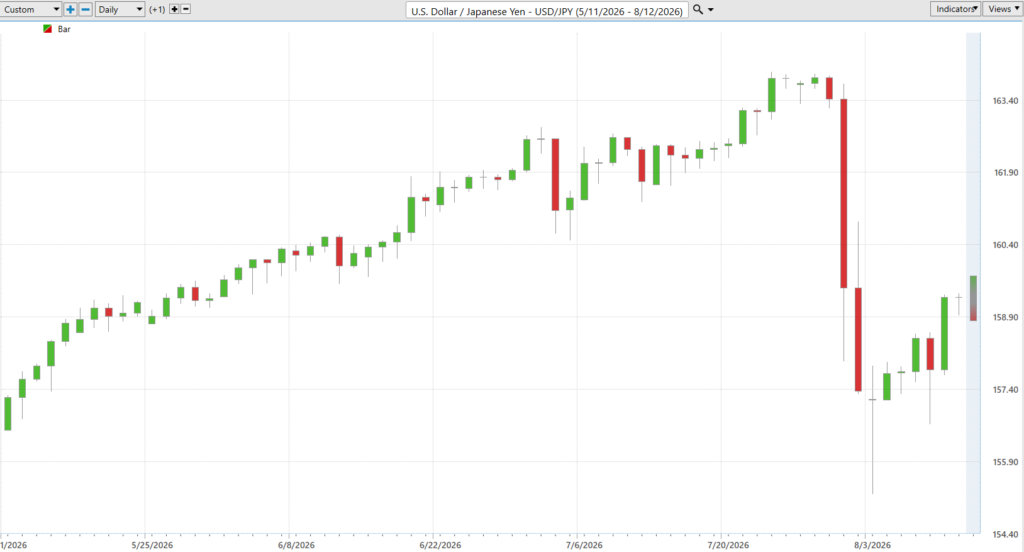
The violent move in USD/JPY is more than a currency story. The Dollar fell against the yen by 5.3% over a three day time frame. Japan recently intervened to support the yen, and the United States took the highly unusual step of joining that effort. One important reason this matters to Washington is that Japan is the largest foreign holder of U.S. government debt, holding about $1.14 trillion in Treasuries as of May, and defending the yen by selling large quantities of dollar assets could put additional pressure on the Treasury market. If Japan becomes a major Treasury seller, bond prices will fall, yields will rise, and America’s already enormous borrowing costs will become even more painful. When the United States feels compelled to help defend another country’s currency partly because that country is such an important creditor, traders should pay attention, because the yen and the Treasury market are suddenly characters in the same financial drama.
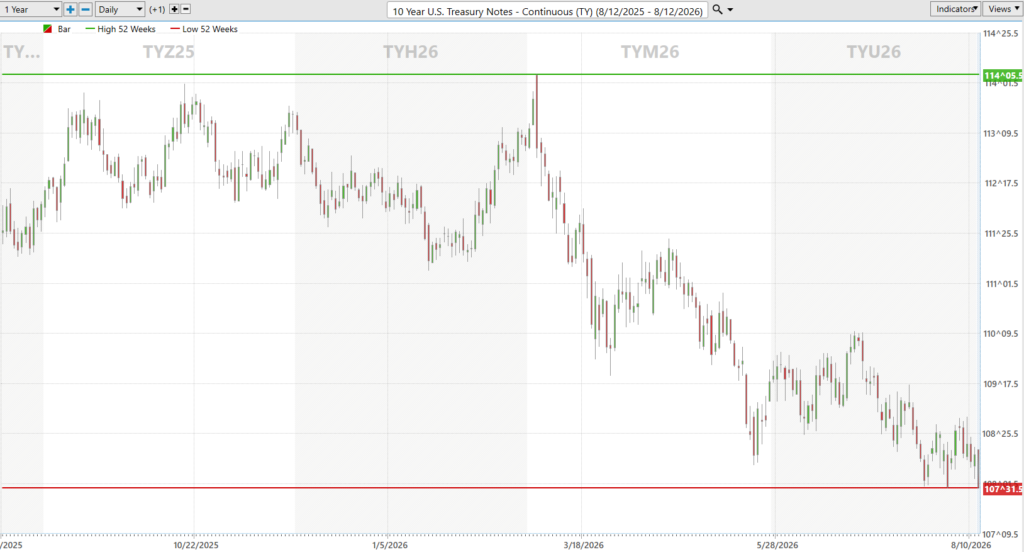
Look at what has happened to 10-Year Treasury Note futures ($TY) over the past year. Prices have fallen from near their 52-week highs to new 52-week lows, which means many investors who bought longer-term Treasuries at higher prices are now sitting on mark-to-market losses. Yes, owners of actual Treasury notes still collect their coupon payments, but income isn’t the same thing as total return. Collect 4% in interest while your bond falls 6% in market value, and the government is paying you with one hand while the bond market picks your pocket with the other.
More important for traders, falling Treasury prices generally mean rising yields, and rising yields mean the cost of money is going up. Treasuries help set the price of capital for mortgages, corporate debt, government borrowing and stock valuations, so when yields rise, the financial system feels it. And after years of painful performance in longer-duration Treasuries, investors are effectively demanding more compensation to lend Uncle Sam their money. For a government buried under enormous debt and still borrowing heavily, that’s not exactly a five-star Yelp review from its creditors.
The one-year 10-Year Treasury Note futures chart tells a remarkably simple story: since the escalation of the Middle East conflict, Treasury prices have traveled from near the top of their 52-week range to new 52-week lows on the chart. Remember, Treasury prices and yields generally move in opposite directions, so falling TY futures prices signal rising yields and therefore a rising cost of money. That matters because Treasury yields help establish the benchmark price of capital throughout the financial system, affecting mortgages, corporate borrowing, stock valuations, government financing and the discount rate applied to future profits. When the cost of money rises sharply while markets are simultaneously trying to finance an historic AI infrastructure boom and Washington is issuing enormous amounts of debt, that is a warning light on the financial dashboard.
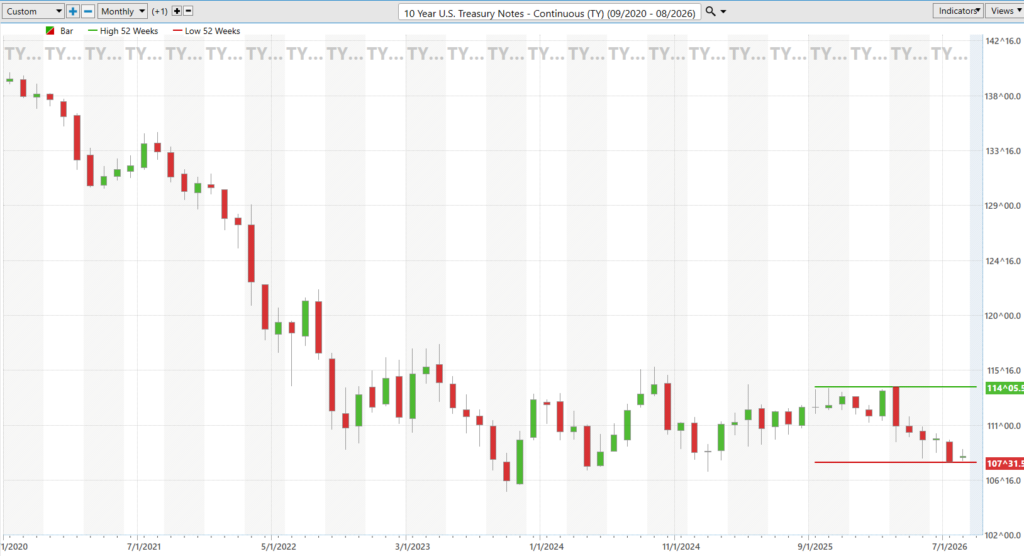
Now pull the camera back six years and the picture gets downright ugly. $TY has fallen from roughly 140 in 2020 to around 108 today, a brutal repricing for something investors traditionally regard as the safest neighborhood in finance. Investors who locked themselves into longer-term Treasuries when yields were extremely low may still receive every promised coupon and get par back at maturity, but that doesn’t erase the economic damage of watching newer bonds offer substantially higher yields while their older bonds fall in market value. For much of the past six years, owning long-duration government debt has been less “safe haven” and more “comfortable chair on a slowly sinking ship.” Treasury prices and yields move inversely, and longer-duration bonds are particularly sensitive to rising rates.
And here’s the part Washington shouldn’t frame for the family room. When investors demand substantially higher yields to lend Uncle Sam money, they’re demanding more compensation for tying up their capital, amid inflation, enormous Treasury issuance, federal debt and other risks. The 10-year yield is currently around 4.7%, with recent pressure linked in part to inflation concerns and growing Treasury supply. That doesn’t mean the market believes America is about to default, but this six-year chart certainly isn’t a standing ovation for U.S. fiscal management. When the world’s benchmark borrower has to pay dramatically more for money, that’s the bond market’s polite way of saying: “We’d like a bigger tip for taking this ride.”
This matters because U.S. Treasuries are supposed to represent the world’s benchmark “risk-free” asset, yet investors have repeatedly demanded a higher return to own America’s debt as federal borrowing has exploded. There are several forces behind that repricing, including inflation and Federal Reserve policy, so it would be too simplistic to blame Washington’s creditworthiness alone, but the market message deserves respect: when the government must pay substantially more to attract capital, that is not exactly a standing ovation for fiscal policy. The United States needs the world to keep financing its debt, and this chart is a six-year reminder that lenders increasingly care about the price.
America desperately needs buyers for an enormous and growing supply of government debt. Japan owns more than $1 trillion of that debt. If Japan becomes a major seller instead of a reliable holder, Treasury prices can come under pressure and yields can rise.
Now put the AI boom back into the picture. The AI investment thesis depends heavily on enormous amounts of capital remaining available for projects whose biggest profits may arrive years from now. The federal government simultaneously needs enormous amounts of capital simply to finance itself.
If global capital becomes more expensive, both machines feel it.
That’s why traders should pay attention when seemingly unrelated events begin colliding. A yen crisis can affect Treasury demand. Treasury demand can affect interest rates. Interest rates can affect technology valuations. Technology valuations can affect AI funding, which can affect data-center spending, chip demand and eventually the entire AI money machine.
If AI growth slows, valuations can slow. If valuations slow, investors may become less willing to write bigger checks. If the checks get smaller, AI companies may spend less. And if AI companies spend less, Big Tech may eventually build fewer data centers and buy fewer chips.
Then the beautiful money machine begins running backward.
Lower expectations lead to less investment. Less investment leads to less spending. Less spending creates lower expectations. And the cycle that looked unstoppable on the way up can become remarkably unpleasant on the way down.
Mike Tyson famously put the problem more efficiently: “Everyone has a plan until they get punched in the mouth.”
Right now, Wall Street has a magnificent plan. AI grows exponentially. Investors keep providing capital. Big Tech keeps spending. Washington keeps borrowing. Foreign investors keep buying Treasuries. Interest rates remain manageable. And everybody lives happily ever after.
The question traders need to ask is simple: Where does the punch come from?
It could be slowing AI growth. It could be higher interest rates. It could be weaker Treasury demand. It could be a currency crisis somewhere nobody is currently watching. Or it could be something completely unexpected. That’s the risk hiding underneath the AI boom. AI doesn’t have to fail. It doesn’t even have to stop growing.
It merely has to disappoint expectations at the same moment the world’s supply of cheap capital becomes harder to find.
And when trillions of dollars are riding on extraordinary expectations, ordinary success can become an extraordinary problem.
Here is the uncomfortable part of the AI boom: nothing has to go terribly wrong for something to go terribly wrong. OpenAI doesn’t have to disappear. Nvidia doesn’t have to stop selling chips. Microsoft doesn’t have to abandon artificial intelligence. AI simply has to grow more slowly than investors have already assumed.
That distinction matters because Wall Street doesn’t price companies based only on whether they’re growing. It prices them based on how fast they’re expected to grow next. Imagine AI revenues rising 60%, then 50%, then 40%, then 30%. Those are extraordinary numbers for almost any industry in the world.
But there is a problem. The direction is still up. The speed is going down. And when valuations have been built around extraordinary growth, deceleration can be enough to change everything. Investors begin lowering their estimates of future profits. The price they’re willing to pay today for those profits falls. Companies that looked inexpensive under yesterday’s assumptions can suddenly look very expensive under tomorrow’s.
This is where the comparison with the housing market before the financial crisis becomes important. Housing didn’t initially break because Americans stopped wanting houses. Home prices didn’t suddenly go from record highs to zero. The financial machinery underneath housing began breaking because prices stopped rising fast enough to support the enormous amount of borrowing built on top of them.
AI may eventually confront the same mathematical problem. The technology can work. Customers can keep coming. Revenues can keep rising. But if the financial structure surrounding AI requires acceleration, growth alone isn’t enough.
That is the difference between a technological revolution and an investment bubble.
The Internet provides a useful historical reminder. The Internet unquestionably changed the world, but that didn’t prevent investors from paying extraordinary prices for technology companies in the late 1990s. When expectations finally collided with economics, the technology survived. Many of the investments didn’t.
AI could produce a similar contradiction on a much larger scale because the infrastructure spending behind it is enormous. Data centers are being built. Power contracts are being signed. Chips are being ordered. Debt is being issued and capital is being committed today against assumptions about demand years into the future.
And those assumptions eventually have to meet reality.
Suppose AI growth begins slowing. Investors become less willing to fund private AI companies at dramatically higher valuations. The cost of capital rises. Companies begin asking questions they didn’t bother asking during the boom.
How much money are we actually making from all this spending?
That’s when the conversation inside corporate America changes. Building the next data center is no longer automatically viewed as evidence that management understands the future. Spending another $20 billion isn’t necessarily considered visionary.
Investors begin demanding something considerably less exciting: A return on their money.
That shift could travel quickly through the AI ecosystem. Less funding for AI companies means less money available for computing contracts. Slower computing demand means Big Tech needs fewer new data centers. Fewer data centers mean fewer chips, less electrical equipment, less construction and eventually less demand throughout the enormous supply chain built around AI.
The cycle begins reversing.
Slower growth leads to lower expectations. Lower expectations lead to lower valuations. Lower valuations make capital harder to raise. Less capital produces less spending. Less spending creates even lower expectations.
Notice what’s missing from that sequence.
AI never failed.
In fact, AI could be producing more revenue, serving more customers and performing more useful work than ever before. The problem is that Wall Street may have already priced in something even better.
That is why traders should be careful with the word “bubble.” Calling the AI trade a bubble can sound like saying artificial intelligence is fake, useless or destined to disappear. That’s not the argument.
The technology can be revolutionary and the price can still be wrong.
And there may be one signal that tells us when Wall Street finally recognizes the difference. Watch what happens when a major technology company announces that it is reducing AI capital spending.
Today, that announcement could frighten investors. Less AI spending suggests management is falling behind in the race. The stock might be punished.
But imagine the opposite reaction. A company announces it is cutting billions from planned AI spending, and the stock goes up.
That would tell us something profound has changed. Investors would no longer be rewarding companies simply for spending more money on AI. They would be rewarding them for showing financial discipline and demanding returns.
The market would have stopped asking, “How much are you spending on AI?”
It would have started asking, “How much money are you making from it?”
That may be the moment everything changes. Because the greatest danger to the AI trade isn’t necessarily that artificial intelligence disappoints us. It’s that artificial intelligence succeeds, but not fast enough to satisfy Wall Street.
Here is where the story turns upside down. We are spending staggering amounts of money building AI because electricity is scarce, chips are scarce, data centers are scarce and the people who know how to put all this together are scarce. That is why AI is inflationary today. But the entire reason we’re building AI is to eventually eliminate costs somewhere else.
Think about what businesses actually want from artificial intelligence. They don’t want a shiny new chatbot so the CEO has something interesting to discuss on television. They want more work completed in less time, by fewer people, at a lower cost. AI is ultimately a productivity machine.
A company that once needed 100 people to perform a collection of tasks may eventually need 70. Then perhaps 50. A software project that once required six months may take six weeks. Research that once required a team of analysts may increasingly be completed by a handful of people working with machines.
That sounds wonderful if you’re looking at the corporate income statement. Labor costs can fall, productivity can rise and companies can produce more without increasing their workforce at the same rate. The same employee equipped with AI may be able to accomplish several times as much work. And this is where today’s inflationary AI story can eventually become tomorrow’s deflationary story.
Consider what businesses actually spend money on. They don’t simply buy steel, electricity, computers and office buildings. They also spend enormous amounts of money paying people to think. They pay programmers to write code, lawyers to review contracts, analysts to study numbers, marketers to create advertising, accountants to prepare reports and researchers to gather information.
Traditionally, every additional hour of that work required another hour of someone’s time. And skilled human time can be expensive. If you wanted twice as much analysis, you generally needed more analysts or more hours. If you wanted twice as much software written, you generally needed more programmers or more time.
AI attacks one of the largest costs in the modern economy: the cost of paying people to think, analyze, create, and solve problems.
That’s what I mean when I say AI attacks the cost of intelligence. A task that once required a skilled employee several hours might eventually take one person working with AI several minutes. The company can produce more analysis, more software, more research without adding the same amount of labor expense. Intelligence doesn’t become free, but producing and distributing certain forms of it can become dramatically cheaper.
And that distinction is important. AI isn’t going to magically make electricity, food, copper or houses cost zero. But it can reduce the amount of human time and expertise embedded in producing many goods and services. The cheaper AI makes intelligence to produce and distribute, the cheaper many of the products and services built with that intelligence can become.
Now follow the economics. Productivity rises. The labor required for certain tasks falls. Production costs decline. Companies compete using those lower costs, putting pressure on prices and wages in areas where AI can substitute effectively for human work.
That is deflationary pressure.
But there is another side to this story that Wall Street may eventually have to confront. Workers aren’t merely expenses on corporate income statements. They’re also customers. They use their paychecks to buy houses, cars, vacations, restaurant meals, clothing and practically everything else companies are trying to sell. If automation meaningfully reduces employment or wage growth in affected industries, the consequences eventually reach consumer demand.
This creates a strange economic possibility. AI could allow businesses to produce dramatically more while requiring fewer human labor hours to produce it. Supply becomes cheaper and easier to create at the same time that income growth for some workers could weaken. We could become extraordinarily good at producing things while disrupting part of the mechanism consumers use to pay for them.
None of this means mass unemployment is inevitable. Previous technological revolutions destroyed certain jobs while creating entirely new industries and occupations, and AI could do the same. The important point for traders is that the transition itself could be enormously disruptive. Markets will have to determine who benefits, who gets replaced, who gains pricing power and who loses it.
Today we’re worried about finding enough electricity to power AI. Tomorrow we may be worried about what happens when AI allows companies to accomplish the same amount of work with dramatically fewer labor hours. Today we’re worried about the cost of building data centers. Tomorrow we may be worried about the industries whose pricing power AI destroys.
Today we’re worried about inflation. Tomorrow we may be worried about deflation.
And somewhere between those two worlds sits the part of this story that should matter most to traders. Markets have spent years learning how to price inflation, higher interest rates, scarce labor, expensive energy and an enormous capital-spending boom. They may eventually have to price something completely different: exploding productivity, falling costs, labor displacement, weaker pricing power and declining inflation.
Some companies will become dramatically more profitable because AI lowers their costs. Others will discover that AI lowers the price customers are willing to pay for what they sell. Some workers will become vastly more productive. Others may discover that the machine has become their cheapest competitor.
That is the AI paradox.
We are spending trillions building a technology because we believe it will eventually allow us to spend dramatically less producing many things. First comes the inflationary arms race. Then comes the productivity revolution. And if AI succeeds anywhere close to what its biggest believers expect, the greatest economic surprise may not be how expensive artificial intelligence becomes, but how many things artificial intelligence makes cheaper.
Here is what makes the AI trade so deliciously uncomfortable. America is spending staggering amounts of money trying to build the world’s most powerful artificial intelligence, while China is demonstrating that increasingly capable AI can be built and delivered more efficiently and cheaply. America is betting on scale. China is threatening that bet with efficiency.
Think about what America is doing. We need more chips, more electricity, more data centers, more cooling systems, more transmission capacity, more engineers and enormous amounts of capital. Everybody wants these scarce resources at the same time, so prices rise. That makes the first stage of the AI revolution inflationary.
And we’re not talking about pocket change. The American AI buildout involves hundreds of billions of dollars in annual capital spending and potentially trillions over time. The financial assumption underneath all this spending is straightforward: AI will become valuable enough, fast enough, to justify the enormous cost of building it.
Then China walks into the room and ruins an otherwise perfectly good slide deck.
Chinese labs including DeepSeek, Moonshot and Z.ai have demonstrated that highly capable AI can increasingly be produced and offered at dramatically lower costs. They do not need to conclusively beat every American model on every benchmark for this to matter. They simply need to become good enough at a price low enough to force everybody else to compete.
That’s the threat.
Imagine America spends trillions building the world’s greatest hamburger factory because everyone assumes hamburgers will sell for $20. Then China opens across the street selling a pretty good hamburger for $3. America’s hamburger isn’t suddenly bad. The economics of the hamburger factory are.
That’s what traders should be watching with AI.
OpenAI, Anthropic and America’s enormous AI ecosystem are being supported by expectations of tremendous future revenues and profits. Those expectations help justify massive spending on chips, electricity and data centers. But if Chinese competition drives the price of capable AI dramatically lower, revenue and margin assumptions can change long before demand for AI disappears.
AI can become more popular while simultaneously becoming less profitable.
And just as we’re spending extraordinary amounts of money building AI, China is demonstrating how quickly the cost of AI itself can fall.
That’s where the paradox becomes fascinating.
First, AI creates shortages by demanding enormous resources to build it. Then AI eliminates costs by making almost everything more productive.
America’s enormous buildout represents the inflationary side. Chips, electricity, data centers, skilled labor and capital become more expensive because everybody wants them now. But the machine we’re spending all this money building is specifically designed to reduce the amount of human time, labor and expertise required to accomplish work.
That’s the deflationary side.
AI attacks one of the largest costs in the modern economy: the cost of paying people to think, analyze, create and solve problems. Coding, research, analysis, customer service, advertising and countless other forms of knowledge work can potentially be produced faster and more cheaply. The better AI becomes, the lower the cost of producing many forms of intelligence can go.
And China may be accelerating that process.
That is what makes this much bigger than another argument about whether AI stocks are in a bubble. America may be spending trillions creating one of the most deflationary technologies ever invented while China is demonstrating how quickly the price of that technology itself can be driven lower.
Now imagine the sequence.
America spends trillions building AI. The buildout creates inflationary pressure. Treasury prices fall and capital becomes more expensive. Washington simultaneously needs enormous amounts of financing. Then Chinese competition makes capable AI dramatically cheaper.
Prices fall. Margins get squeezed. Revenue expectations come down. Investors question valuations. Companies begin questioning enormous capital expenditures. And eventually the AI technology everybody spent fortunes building begins doing exactly what it was supposed to do: lowering costs throughout the economy.
That is the AI Trade Paradox.
The question isn’t whether AI succeeds.
The question is whether America can earn an adequate return on the trillions being invested before competition and AI itself drive down the price of the intelligence we’re spending all that money to create.
Or put more simply:
America is spending trillions making artificial intelligence more powerful.
China may be making it cheaper faster than America can make it profitable.
And somewhere between those two forces lies either an extraordinary trading opportunity or financial chaos.
So where does all of this leave the trader? Perhaps with a more complicated answer than Wall Street would prefer. The AI trade may be simultaneously creating an inflationary investment boom, an enormous financial bubble risk and the foundations of a future deflationary economy. The mistake would be assuming these forces cannot exist at the same time.
If Chinese competition drives AI prices lower, American companies face a difficult choice. They can lower prices and sacrifice margins, or maintain prices and risk losing customers. Either way, the extraordinary revenue and profit assumptions supporting today’s extraordinary valuations become harder to defend.
And this is where traders need to stop thinking about AI as one giant trade.
There may actually be three different AI trades.
The first is the inflationary buildout. Money floods into chips, electricity, data centers, utilities, power generation, cooling systems, networking equipment and everything else required to build the machine. Scarcity becomes valuable, and companies controlling scarce resources can become some of the biggest beneficiaries.
The second is the deceleration trade. AI continues growing, but it stops growing fast enough to satisfy expectations. Capital spending slows, valuations compress and investors begin demanding returns rather than promises. Companies that were rewarded for spending more may suddenly be punished for failing to produce enough profit from that spending.
The third is the deflationary productivity trade.
That is where inflation can become deflation.
That would represent an enormous psychological change.
Artificial intelligence may be the most important economic force traders will confront in our lifetime. But as we’ve seen, the opportunity is not nearly as simple as buying anything with the letters “AI” attached to it.
You don’t need another opinion about what AI might do five years from now. You need a disciplined way to forecast what the markets are doing now, where money is flowing, which trends are strengthening and which trends are beginning to weaken. Because when an enormous economic transition begins, the market rarely sends you an engraved invitation.
That’s where VantagePoint AI can become an enormously valuable part of your decision-making process. Its dual-patented artificial intelligence analyzes relationships between markets to help traders identify trends, anticipate potential changes in direction and evaluate opportunities through data rather than fear, greed, hope or headlines.
This matters enormously in the environment we’ve just described. Treasury yields can affect technology valuations. Currency movements can affect capital flows. Energy prices can affect data-center economics. Semiconductor stocks can influence technology indexes, while changes in those indexes can ripple through thousands of individual stocks.
Nothing trades in a vacuum.
VantagePoint’s patented global intermarket analysis is designed around that reality. It examines relationships across markets and combines them with predictive indicators designed to help traders evaluate where a trend may be headed. Instead of simply asking what happened yesterday, traders can focus on whether the probabilities suggest a trend is strengthening, weakening or potentially changing direction.
The VantagePoint AI Predictive Blue Line helps traders evaluate the direction of the expected trend. The Neural Index provides another layer of short-term confirmation. The Daily Range Forecast helps identify anticipated trading ranges, giving traders additional information for planning entries, exits and risk management.
Used together, these tools can help answer the questions every trader eventually has to answer:
What should I trade?
Which direction should I trade it?
When should I enter?
When should I exit?
Where should I manage risk?
Talking head predictions encourage traders to become attached to a story. Predictive indicators give traders another way to evaluate whether the market itself continues confirming that story.
Your objective is to keep yourself on the right side of the right trend at the right time, while managing risk when the evidence changes.
If you’d like to see how traders use predictive artificial intelligence to identify opportunities, evaluate trends, understand intermarket relationships and approach risk with greater discipline, I invite you to attend our complimentary Learn How To Trade With VantagePoint AI Live Online Masterclass.
You’ll see the technology in action. You’ll learn how predictive indicators can help separate strengthening trends from weakening ones. And you’ll discover a more disciplined way to approach markets during a period when inflation, deflation, AI, interest rates, currencies and global capital are colliding in ways few traders have ever experienced.
Because the great opportunity in the AI trade may not simply be investing in artificial intelligence.
It may be using artificial intelligence to trade the enormous changes AI creates.
It’s not magic.
It’s machine learning.
THERE IS A SUBSTANTIAL RISK OF LOSS ASSOCIATED WITH TRADING. ONLY RISK CAPITAL SHOULD BE USED TO TRADE. TRADING STOCKS, FUTURES, OPTIONS, FOREX, AND ETFs IS NOT SUITABLE FOR EVERYONE.IMPORTANT NOTICE!
DISCLAIMER: STOCKS, FUTURES, OPTIONS, ETFs AND CURRENCY TRADING ALL HAVE LARGE POTENTIAL REWARDS, BUT THEY ALSO HAVE LARGE POTENTIAL RISK. YOU MUST BE AWARE OF THE RISKS AND BE WILLING TO ACCEPT THEM IN ORDER TO INVEST IN THESE MARKETS. DON’T TRADE WITH MONEY YOU CAN’T AFFORD TO LOSE. THIS ARTICLE AND WEBSITE IS NEITHER A SOLICITATION NOR AN OFFER TO BUY/SELL FUTURES, OPTIONS, STOCKS, OR CURRENCIES. NO REPRESENTATION IS BEING MADE THAT ANY ACCOUNT WILL OR IS LIKELY TO ACHIEVE PROFITS OR LOSSES SIMILAR TO THOSE DISCUSSED ON THIS ARTICLE OR WEBSITE. THE PAST PERFORMANCE OF ANY TRADING SYSTEM OR METHODOLOGY IS NOT NECESSARILY INDICATIVE OF FUTURE RESULTS. CFTC RULE 4.41 – HYPOTHETICAL OR SIMULATED PERFORMANCE RESULTS HAVE CERTAIN LIMITATIONS. UNLIKE AN ACTUAL PERFORMANCE RECORD, SIMULATED RESULTS DO NOT REPRESENT ACTUAL TRADING. ALSO, SINCE THE TRADES HAVE NOT BEEN EXECUTED, THE RESULTS MAY HAVE UNDER-OR-OVER COMPENSATED FOR THE IMPACT, IF ANY, OF CERTAIN MARKET FACTORS, SUCH AS LACK OF LIQUIDITY. SIMULATED TRADING PROGRAMS IN GENERAL ARE ALSO SUBJECT TO THE FACT THAT THEY ARE DESIGNED WITH THE BENEFIT OF HINDSIGHT. NO REPRESENTATION IS BEING MADE THAT ANY ACCOUNT WILL OR IS LIKELY TO ACHIEVE PROFIT OR LOSSES SIMILAR TO THOSE SHOWN.