





If you judged the stock market solely by this year’s headlines, you’d probably assume Wall Street had been converted into an emergency shelter. Every morning delivered a fresh reason to panic. Wars expanded. Central bankers spoke in riddles. Inflation refused to leave quietly. Politicians held press conferences with the confidence of people explaining why the kitchen fire was actually good for the house. Financial television treated every market hiccup like the opening scene of a disaster movie.
And yet, something wonderfully inconvenient happened.
While millions of investors were doom-scrolling through the latest crisis, great companies kept doing what great companies always do. They sold more products, earned more money, attracted more customers, and watched their stock prices climb to new highs. The market, in its usual impolite fashion, ignored much of the drama and continued rewarding businesses that consistently created value.
That’s one of the market’s oldest habits. It has no obligation to agree with the prevailing mood. Investors may spend weeks debating interest rates, oil prices, elections, tariffs, or geopolitical flare-ups, but the market keeps asking a much simpler question:
Where is capital earning the best return?
That is the purpose of this article. It is an examination of what the market’s biggest winners can teach us. Every year the headlines change. Every year the fears are different. Every year a new group of companies quietly rises above the noise.
The names change.
The lesson doesn’t.
The market publishes its ‘scoreboard’ every trading day. Most investors spend their time arguing with it.
The successful ones begin by reading it. There is a powerful lesson to be learned there.
Walk into any sports arena and you’ll find one thing nobody argues with for very long: the scoreboard. Fans complain about the referee. Coaches second-guess the play calling. Television commentators spend hours explaining why the losing team “really deserved to win.”
None of it matters.
When the final buzzer sounds, the score settles the argument.
The stock market works exactly the same way.
Every trading day, millions of investors/traders express opinions with real money. Hedge funds. Pension funds. Mutual funds. Institutions. Individual investors. Every buy order collides with a sell order, and by the closing bell the market has rendered its verdict.
That verdict is called performance.
Here’s where many traders go off the rails. They become obsessed with why a stock should rise. They fall in love with stories, analyst reports, economic forecasts, and valuation models. Meanwhile, the market has already revealed where money is flowing.
They simply weren’t paying attention.
Performance is the one measurement that forces every theory to face reality. It doesn’t reward confidence, credentials, or clever predictions. It answers one question:
Who’s winning?
Wall Street has never suffered from a shortage of ideas. Traders can choose from an endless menu of analytical frameworks. Some begin with balance sheets and cash flow statements. Others focus on chart patterns, interest rates, valuation models, or technical indicators. Increasingly, sophisticated investors rely on VantagePoint’s patented artificial intelligence and quantitative models to improve decision making.
Every approach has value. The problem is that traders often overwhelm themselves before they identify where the greatest opportunities exist. Thousands of publicly traded companies compete for attention every day. Analyzing all of them in depth is neither practical nor efficient.
But performance is a powerful starting point. Markets have already completed the first stage of the screening process. Every earnings report, product launch, analyst upgrade, geopolitical event, and economic development has been filtered through millions of investment decisions. The result appears in one objective measurement:
Price performance.
No single metric tells the entire story. But price performance reveals where capital is already expressing confidence.
The reason this is critical to comprehend is that headlines try to explain yesterday. Performance shows you where the money is being made today. VantagePoint shows you where trends are forecasting for tomorrow.
Open any financial news website on a busy morning and you’ll find no shortage of explanations. One article blames the market’s move on interest rates. Another points to geopolitical tensions. A third insists inflation was the deciding factor. By lunchtime, a completely different narrative has taken over. Headlines provide context, but they almost always explain what has already happened.
The market works differently.
Every trade represents an expectation about the future, not the past. Long before a company’s success becomes obvious in the headlines, institutions begin building positions, investors start accumulating shares, and the stock quietly separates itself from the crowd.
Price moves first. The explanation usually arrives later.
Stocks making new highs are sending an important message. They’re attracting capital despite uncertainty, despite negative headlines, and despite every reason investors can find to remain cautious. Leadership doesn’t eliminate risk, but it does reveal where the market sees opportunity.
One of the market’s greatest lessons is remarkably simple.
Headlines tell you where attention is focused.
Performance tells you where money has moved.
Every year, thousands of investors devote enormous energy to discovering the next great stock. They pore over earnings reports, memorize valuation ratios, debate economic forecasts, and stare at charts with the intensity of medieval monks searching for hidden messages.
Then something inconvenient happens.
Many of the year’s biggest winners were already among last year’s strongest performers.
That isn’t an accident.
Markets have a habit of rewarding success with more success.
Companies that grow revenue, expand earnings, gain market share, and consistently execute attract something every investor wants but cannot manufacture: confidence. Portfolio managers notice. Analysts raise estimates. Institutions add to positions. Momentum builds because successful businesses often continue doing the things that made them successful in the first place.
Of course, no stock rises forever. Leadership changes. Industries mature. Competition emerges. Every market champion eventually encounters gravity.
But investors may make an equally expensive mistake when they assume a stock making new highs has somehow become “too expensive.”
The market has buried more fortunes beneath the phrase, “I missed it,” than almost any other investing myth.
Strength is an invitation to ask: What does the market see that I don’t?
The winners of 2026 aren’t merely impressive performers.
They’re clues.
The first thing that jumps off this list isn’t the percentage gains. It’s the volatility that made those gains possible.
Most people hear the word volatility and immediately think danger. Professional traders hear the same word and think movement. And without movement, there is no opportunity.
Every stock on these lists has experienced an unusually large annual trading range relative to its current price. That’s the price of admission. Big winners don’t climb in a straight line. They surge, pull back, shake out weak hands, and then often make another run. That kind of price action is enough to scare inexperienced traders into looking somewhere else.
Seasoned traders do the opposite. They put them on their radar. They study how they behave. They learn what normal volatility looks like. They recognize that today’s market leaders often emerge from yesterday’s wild swings. Because the trader who understands volatility isn’t intimidated by it. They’re prepared to capitalize on it when opportunity knocks.
Technology
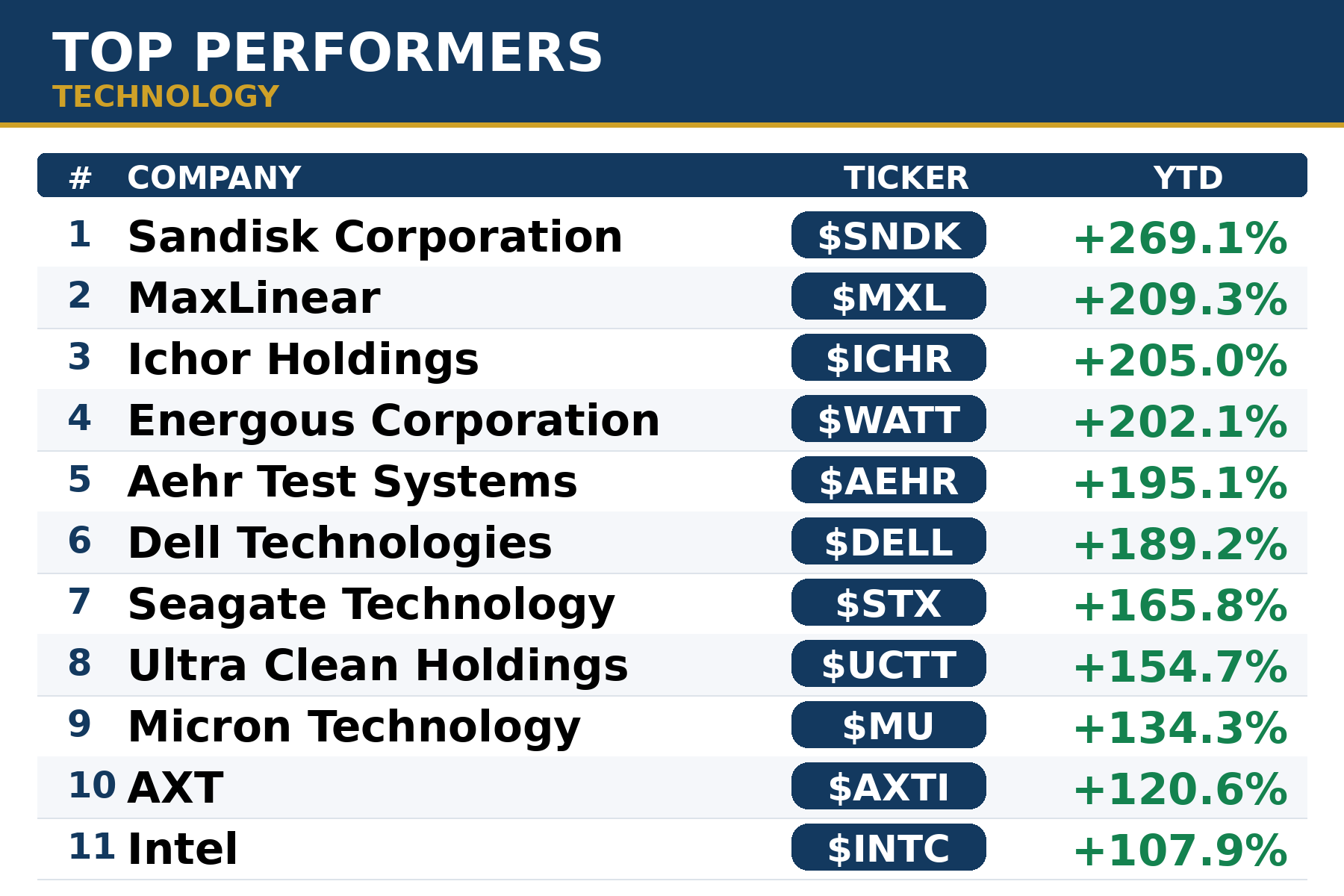
Technology entered the year carrying the weight of impossibly high expectations. Artificial intelligence continued to dominate boardrooms, earnings calls, and cocktail parties where people suddenly became experts in semiconductors after reading three headlines. Investors wrestled with lofty valuations, export restrictions, cybersecurity threats, and whether the biggest winners had already climbed too far. Then the war in the Middle East changed the conversation. As geopolitical tensions intensified, advanced computer chips were increasingly viewed not merely as commercial products but as strategic assets essential to national security. Governments accelerated efforts to secure semiconductor supply chains and expand domestic chip production, adding a powerful new catalyst to an already booming industry. The market quickly separated the companies building the digital infrastructure of the future from those merely adding “AI” to their press releases like parsley on mashed potatoes. Following performance made that distinction obvious long before the headlines fully explained why the sector’s leaders kept pulling away from the pack.
Financials
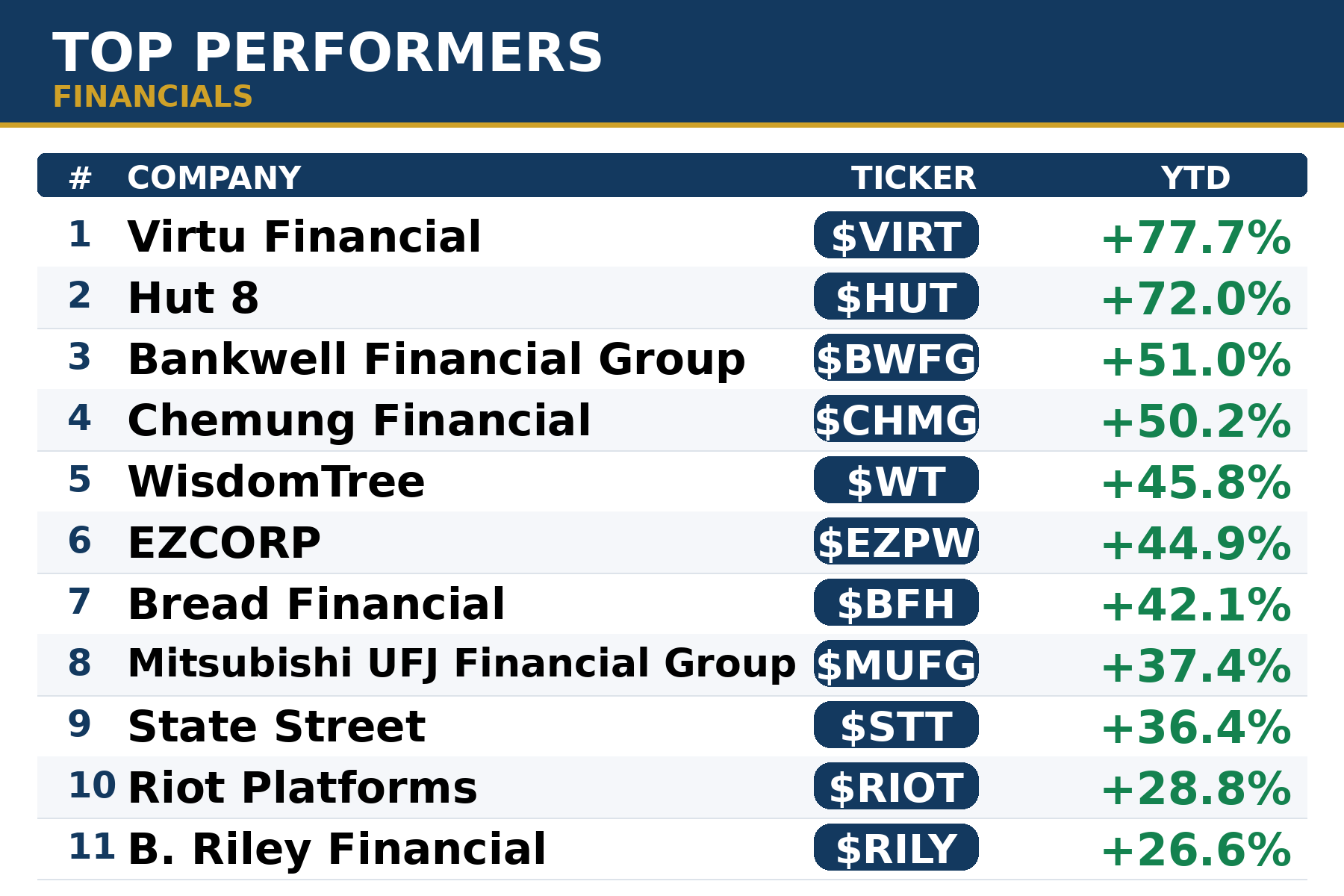
If there were an Olympic event for worrying, the financial sector would have taken home the gold this year. Banks spent months trying to decipher every syllable uttered by the Federal Reserve while investors obsessed over interest rates, loan growth, commercial real estate, consumer credit, and whether the economy was headed for a soft landing or a brick wall. Then came the usual parade of geopolitical surprises, tariff debates, and Washington drama. Yet through all of that, the strongest financial companies kept quietly attracting capital. That’s why performance matters. It ignores the endless debate and simply reveals which institutions investors trust to navigate uncertainty and continue making money regardless of the latest headline.
Industrials
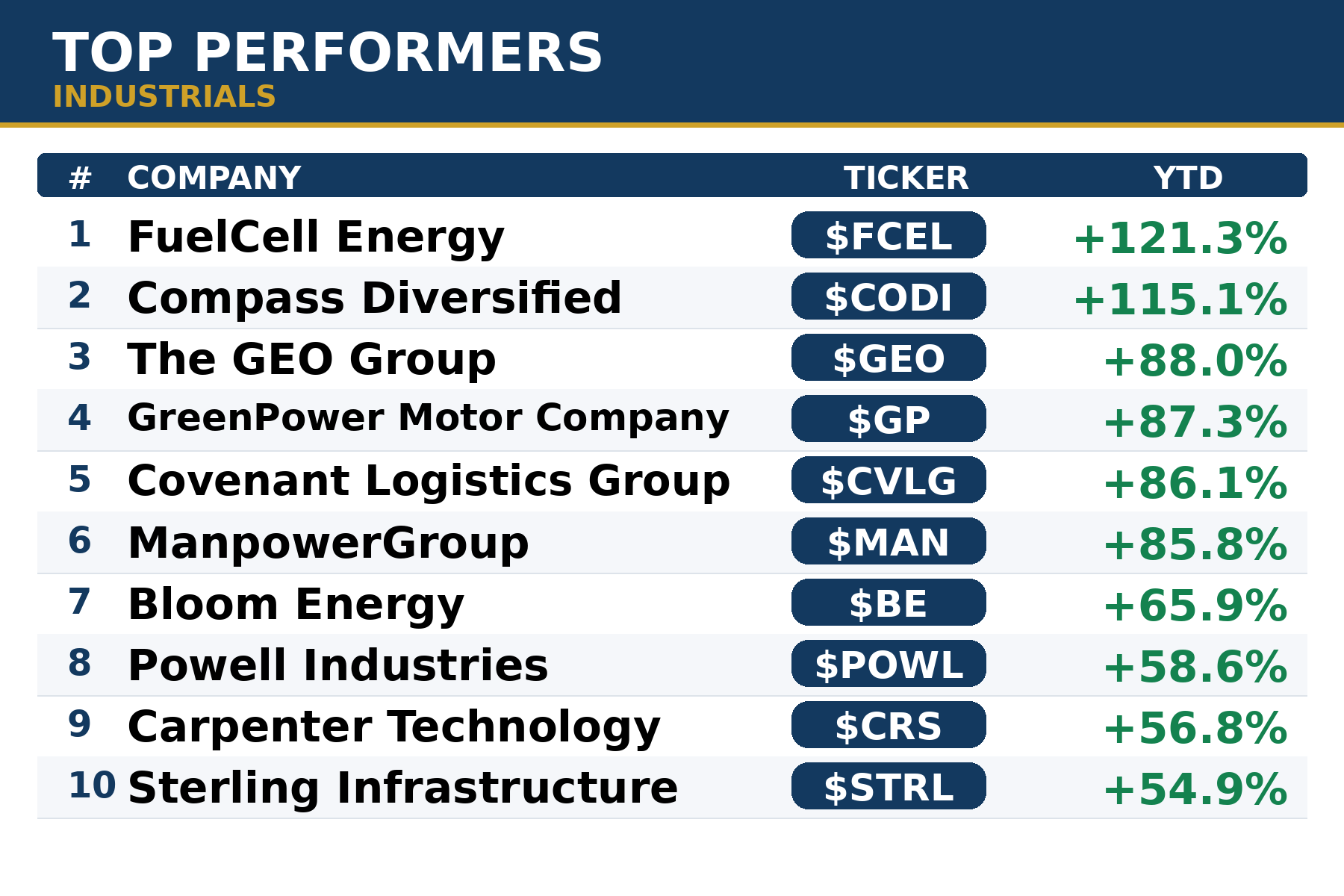
Industrial companies found themselves at the intersection of nearly every major economic force. Manufacturing activity fluctuated, supply chains continued adjusting after years of disruption, defense spending accelerated, infrastructure projects expanded, and businesses invested heavily in automation to offset labor shortages. Add uncertainty surrounding tariffs, global trade, and energy costs, and you had enough variables to keep economists employed for decades. Yet while experts debated every data release, the market steadily rewarded the industrial companies that continued winning contracts, improving productivity, and expanding profits. Performance made it obvious which businesses were executing and which were simply explaining.
Materials
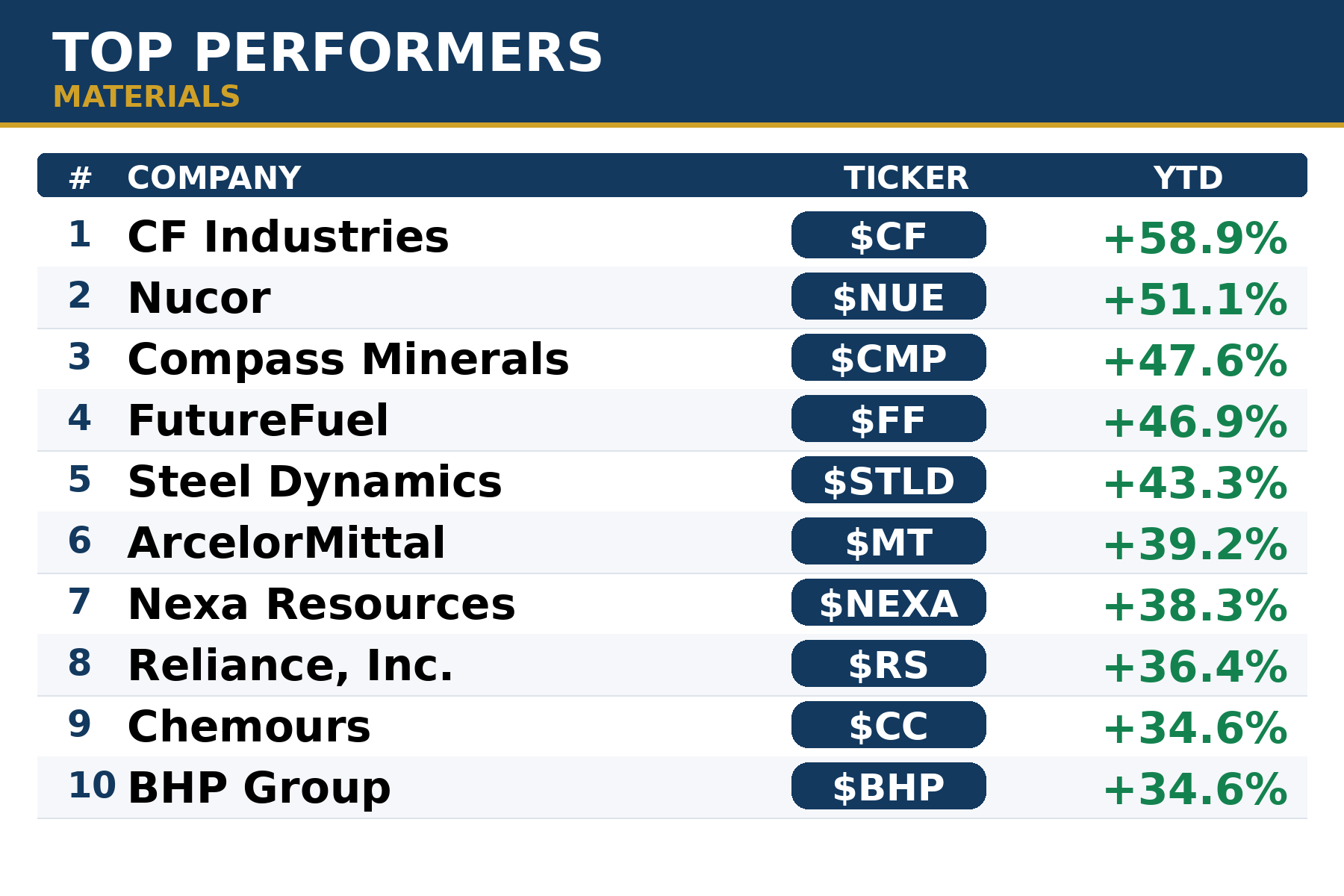
If any sector understands that the world never stands still, it’s materials. Companies producing metals, chemicals, fertilizers, construction products, and mining resources spent the year navigating shifting commodity prices, global demand, trade disputes, environmental regulations, and the enormous appetite for materials needed to build data centers, power grids, and artificial intelligence infrastructure. Throw in conflicts affecting global shipping routes and commodity markets, and predicting the future became about as reliable as forecasting next year’s weather with a dartboard. Fortunately, investors didn’t have to predict. Performance identified the companies benefiting from these powerful trends long before every explanation appeared in the headlines.
Energy
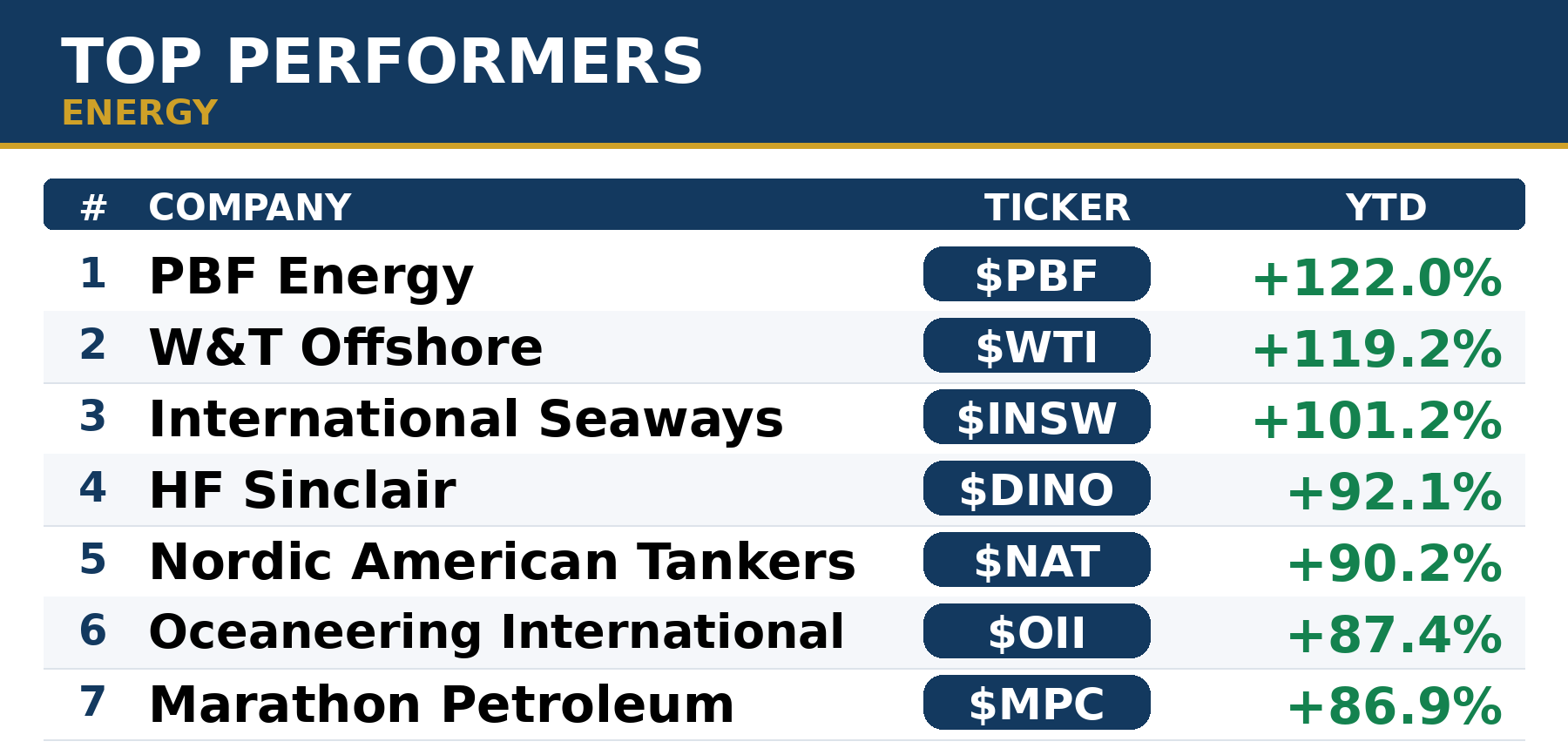
The energy sector spent much of the year living exactly where it always seems to live: at the intersection of economics and geopolitics. Wars in the Middle East, uncertainty surrounding the Strait of Hormuz, OPEC production decisions, shifting global demand, natural gas markets, refinery margins, and changing government policies all competed for investors’ attention. On any given day, a single headline could send oil prices sharply higher or lower. Yet beneath the daily drama, the market consistently rewarded companies with disciplined management, strong cash flow, efficient operations, and the ability to generate profits across a wide range of energy prices. The lesson is difficult to miss. Headlines explain volatility. Performance reveals leadership.
What can we learn from these metrics?
Walk into almost any investment seminar and ask a simple question: “Would you rather buy a stock making new highs or one that’s down 50%?”
Most people instinctively reach for the bargain. After all, we’re conditioned to love sales. We wait for discounts on cars, televisions, airline tickets, and groceries, so it feels natural to apply the same logic to stocks.
The market rarely cooperates. Some of the most expensive lessons in investing begin with the phrase, “It can’t go much lower.”
Weak stocks may continue getting weaker because something fundamental has changed. Customers disappear. Margins shrink. Competition intensifies. Management stumbles. Institutions quietly head for the exits.
The falling price isn’t creating the problem. It’s revealing one.
The opposite is equally true.
Many traders avoid the market’s strongest companies because they assume the opportunity has already passed. History suggests otherwise. Great market leaders often spend months, even years, climbing from one new high to the next as earnings improve, institutional ownership expands, and business momentum accelerates.
Strength attracts strength.
That doesn’t mean investors should chase every stock making new highs. It means they should stop treating strength as something to fear.
If improving fundamentals, expanding earnings, favorable intermarket relationships, and growing institutional demand all point in the same direction, then a rising stock price may not be the end of the story.
It may be the beginning.
Before anyone accuses me of suggesting that investing is as simple as buying whatever happens to be going up, let me disappoint both the critics and the television pundits. If performance were the only thing that mattered, we’d replace portfolio managers with dartboards and let golden retrievers run hedge funds.
Price performance is where an investigation can begin, but not where it ends.
Is revenue growing?
Are earnings accelerating?
Is management executing?
Is the sector strengthening?
Are institutions accumulating shares?
And perhaps most importantly, are the surrounding markets confirming the same story?
This is where modern technology changes the game.
VantagePoint’s patented artificial intelligence is invaluable because it helps organize an overwhelming amount of information that no individual trader could realistically process alone.
Markets are no longer isolated islands. Interest rates influence currencies. Currencies affect commodities. Commodities influence corporate profits. Bond markets shape equity valuations. Thousands of relationships tug on every stock every day.
The companies on these lists I’ve shown you didn’t accidentally become the biggest winners of 2026.
Performance provides the first clues.
Fundamentals can explain the business.
But global intermarket analysis reveals the forces that aren’t obvious.
VantagePoint Artificial intelligence helps identify subtle changes in trend and leadership before they become widely recognized by anyone.
The market doesn’t reward the best story.
It rewards those with discipline.
It rewards better decisions.
That’s why performance and patented artificial intelligence belong at the beginning of every process, not as an afterthought.
Build your decisions on evidence instead of emotion.
Again, this is where VantagePoint artificial intelligence changes the game.
Modern markets are simply too interconnected for any individual to monitor and forecast every intermarket relationship, every trend, every sector rotation, and every emerging opportunity.
And yet, VantagePoint AI was designed to do exactly that.
Rather than reacting to yesterday’s headlines, it helps traders forecast emerging leadership before it becomes obvious to everyone else.
There will always be another crisis.
Another war.
Another Federal Reserve meeting.
Another reason the headlines insist you should be afraid.
And while the world debates the news, another group of companies will quietly become the market’s biggest winners.
Your job isn’t to react to every headline.
Your job is to recognize where capital is flowing and have the discipline to pay attention to the data instead of the noise.
If you’d like to see how traders are using artificial intelligence to forecast trend changes, analyze intermarket relationships, and identify emerging market leaders before they become obvious, I invite you to join us for our free live Learn How to Trade with VantagePoint AI Masterclass.
Because successful trading is about consistently putting yourself on the right side of the right market at the right time.
It’s not magic.
It’s machine learning.
THERE IS A SUBSTANTIAL RISK OF LOSS ASSOCIATED WITH TRADING. ONLY RISK CAPITAL SHOULD BE USED TO TRADE. TRADING STOCKS, FUTURES, OPTIONS, FOREX, AND ETFs IS NOT SUITABLE FOR EVERYONE.IMPORTANT NOTICE!
DISCLAIMER: STOCKS, FUTURES, OPTIONS, ETFs AND CURRENCY TRADING ALL HAVE LARGE POTENTIAL REWARDS, BUT THEY ALSO HAVE LARGE POTENTIAL RISK. YOU MUST BE AWARE OF THE RISKS AND BE WILLING TO ACCEPT THEM IN ORDER TO INVEST IN THESE MARKETS. DON’T TRADE WITH MONEY YOU CAN’T AFFORD TO LOSE. THIS ARTICLE AND WEBSITE IS NEITHER A SOLICITATION NOR AN OFFER TO BUY/SELL FUTURES, OPTIONS, STOCKS, OR CURRENCIES. NO REPRESENTATION IS BEING MADE THAT ANY ACCOUNT WILL OR IS LIKELY TO ACHIEVE PROFITS OR LOSSES SIMILAR TO THOSE DISCUSSED ON THIS ARTICLE OR WEBSITE. THE PAST PERFORMANCE OF ANY TRADING SYSTEM OR METHODOLOGY IS NOT NECESSARILY INDICATIVE OF FUTURE RESULTS. CFTC RULE 4.41 – HYPOTHETICAL OR SIMULATED PERFORMANCE RESULTS HAVE CERTAIN LIMITATIONS. UNLIKE AN ACTUAL PERFORMANCE RECORD, SIMULATED RESULTS DO NOT REPRESENT ACTUAL TRADING. ALSO, SINCE THE TRADES HAVE NOT BEEN EXECUTED, THE RESULTS MAY HAVE UNDER-OR-OVER COMPENSATED FOR THE IMPACT, IF ANY, OF CERTAIN MARKET FACTORS, SUCH AS LACK OF LIQUIDITY. SIMULATED TRADING PROGRAMS IN GENERAL ARE ALSO SUBJECT TO THE FACT THAT THEY ARE DESIGNED WITH THE BENEFIT OF HINDSIGHT. NO REPRESENTATION IS BEING MADE THAT ANY ACCOUNT WILL OR IS LIKELY TO ACHIEVE PROFIT OR LOSSES SIMILAR TO THOSE SHOWN.