









Welcome to the Artificial Intelligence Outlook for Forex trading.
VIDEO TRANSCRIPT
US Dollar
VantagePoint A.I. Market Outlook
Okay, hello everyone, and welcome back. My name is Greg Ferman, and this is the VantagePoint AI Market Outlook for the week of June 29, 2026.
U.S. Dollar
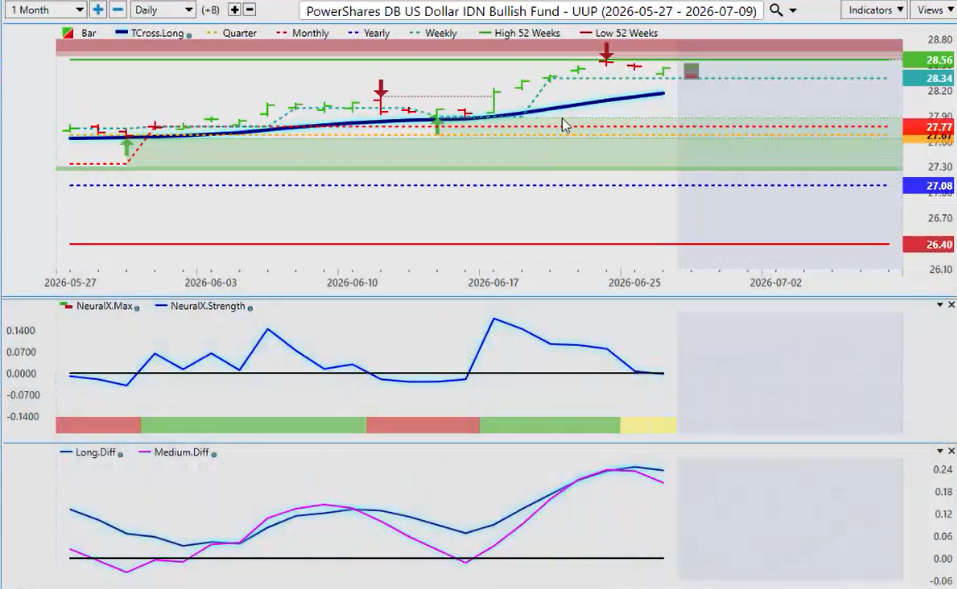
Now, to get started this week, we’ll begin where we always do, with that very important U.S. Dollar. We have put in a 52-week high on the UUP. When we look at the WisdomTree UDN, you can see we have not put in a 52-week high. It’s very interesting to see the difference between the two ETFs and how we measure U.S. Dollar strength.
Now, in my respectful opinion only, we do have a sell signal forming here. The MA Diff Cross, which measures our medium-term strength, is weakening against the longer-term strength. The one thing that is consistent between both of these ETFs is that the primary trend remains intact.
The way I would look at this is that we could have a retracement lower next week, but that’s all I believe it would be. Again, we’re above the T Cross Long. What we worked on last week was identifying when a medium-term crossover is producing a corrective signal versus the beginning of an entirely new trend.
If we move lower in the U.S. Dollar, I believe that would simply be a corrective move, not the start of a new bearish trend. We’re positive on the quarter, we’re positive on the month, and we’re positive on the year currently for the U.S. Dollar.
Gold
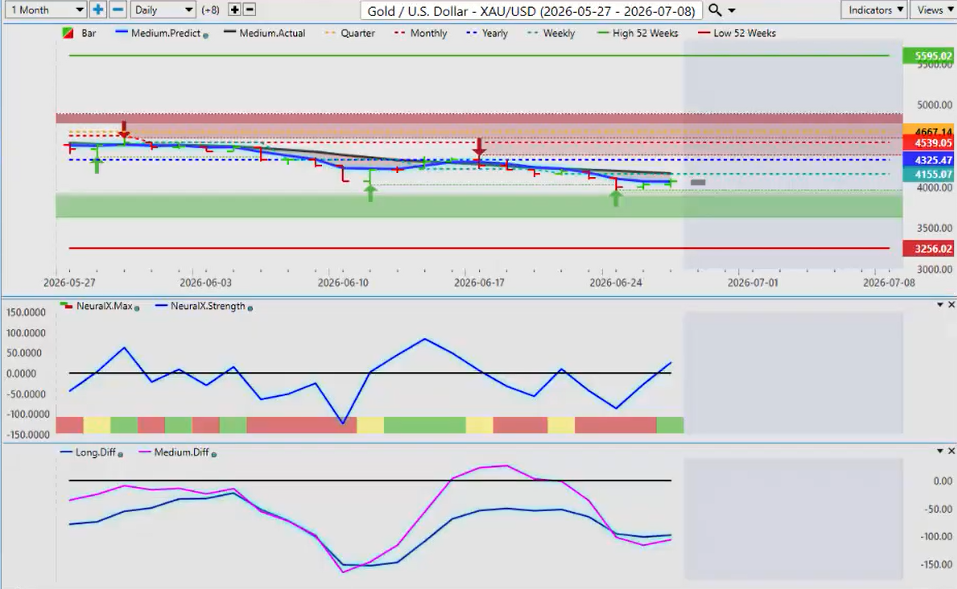
Now, this is obviously having a very negative effect on Gold. Gold has pushed below its yearly opening price. Once again, when we look at this market, we are now below the VP T Cross Long.
We’re below the monthly opening price and the calendar yearly opening price. However, one of the ways to validate some form of U.S. Dollar weakness ahead is that the Neural Index and the Neural Index Strength are both pointing higher. Again, my concern here is that we’re probably not likely to see additional significant strength in the U.S. Dollar until August or September.
The U.S. Dollar can still hold its ground just fine, which should keep Gold under pressure for a little while longer. However, the improving Neural Index is a warning sign of a corrective move back toward that critical T Cross Long at 4215.
S&P 500
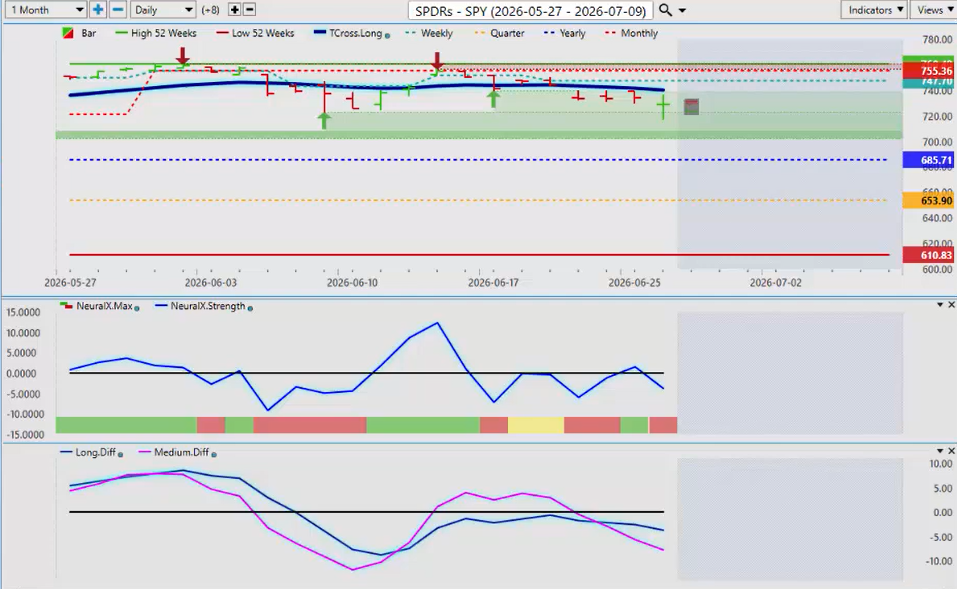
Now, the equity markets struggled at the end of the week. It was not a great week to be buying the stock indexes. Looking at the SPY, you can see that we’ve been below the T Cross Long since basically the beginning of the week.
We’ve had several retracements back to the T Cross Long, only for prices to slip again. The one thing we want to make sure we understand is what the primary trend is. The primary trend remains higher while we’re above the calendar yearly opening price of 685.71.
Again, we’ve got an MA Diff Cross that has crossed below the long-term Predicted Difference. That’s warning of a little bit more downside. However, if the U.S. Dollar weakens, we could see the SPY turn back higher.
This previous week simply was not a good week to be buying the major stock indexes as we moved into month-end.
Russell 2000
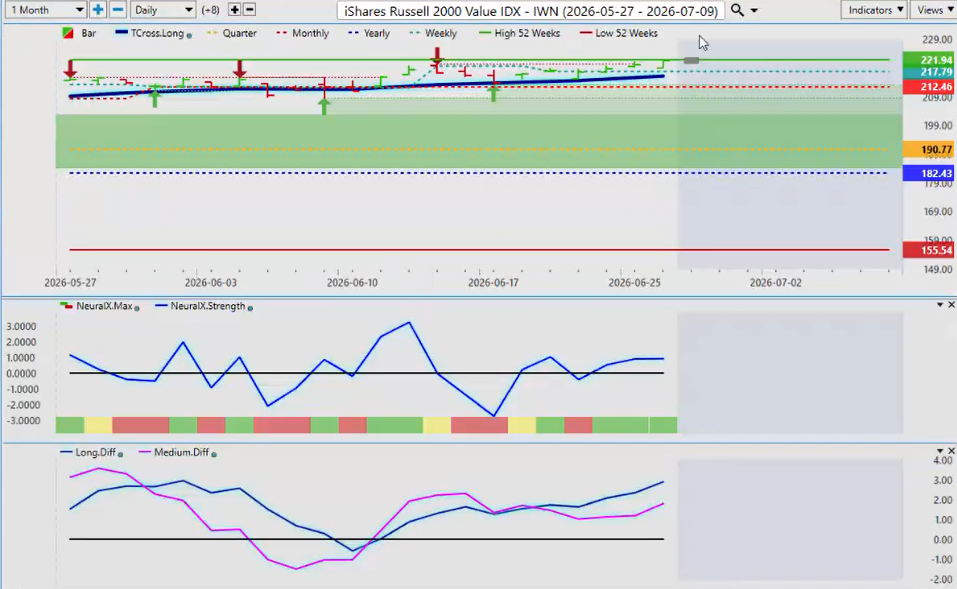
Now, when we look at the iShares Russell 2000, it’s actually done very well compared to the QQQ and the SPY. It put in a new 52-week high on June 15, retraced back down to our T Cross Long, and then rallied once again.
Of the major indexes, the Russell 2000 still looks like the strongest one. The MA Diff Cross continues supporting long positions. We’re above the zero line, Neural Index Strength looks constructive, and we’re trading above both our monthly opening price and our yearly opening price.
It’s becoming a little toppy up here, but that doesn’t necessarily mean we can’t continue moving higher.
I’ll pick up exactly where the previous document ended.
When we perform a comparative analysis with the QQQ, we can see that the NASDAQ remains highly correlated with the SPY, meaning the NASDAQ and the S&P 500 continue to trade in a very similar fashion.
NASDAQ
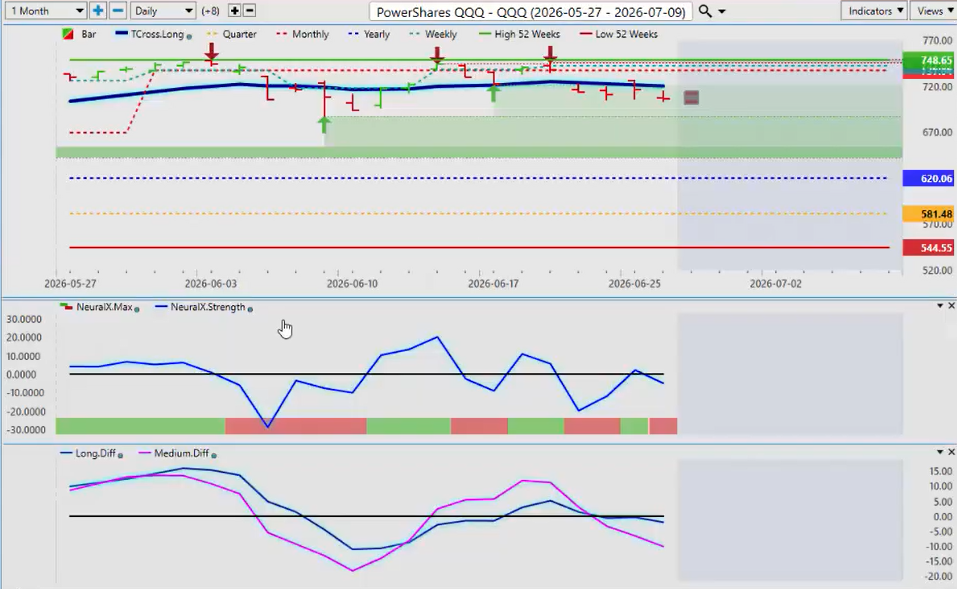
Looking at the QQQ, I see much the same picture that we see in the SPY. It simply wasn’t a good week to be buying these indexes. We’re failing near the highs, the Neural Index is pointing lower, and the medium-term crossover has now taken place beneath the longer-term crossover.
Always remember what the primary trend is. The primary trend remains higher while we’re well above the calendar yearly opening price around 620. We may see a corrective move lower here, but I do anticipate that the SPY, the QQQ, the Russell 2000, and the Dow will have a respectable month during July.
We simply have to get through that first week of the month.
DAX
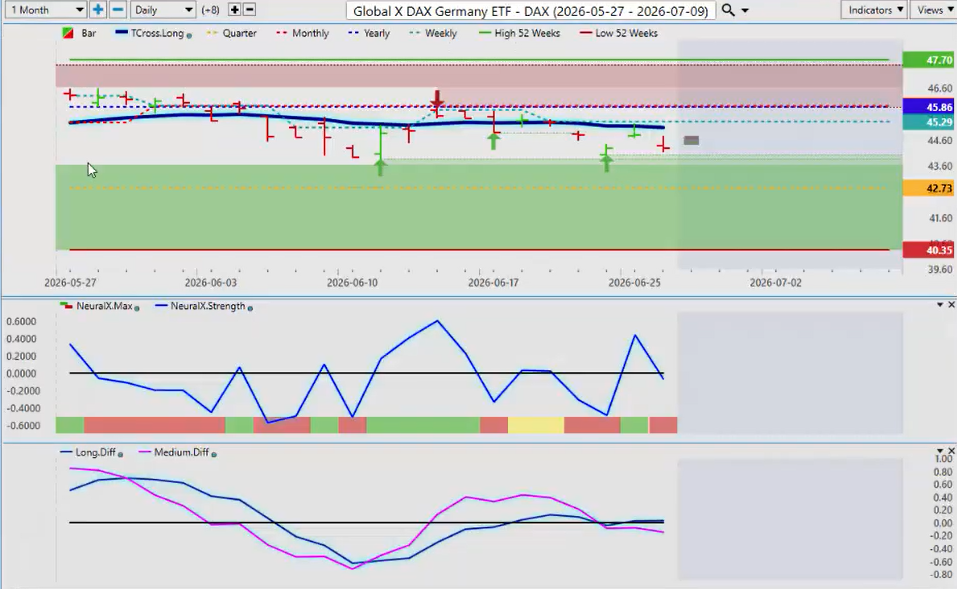
Now, when we look at the Global X DAX, we’re seeing essentially the same pattern. It’s following the S&P 500 and the NASDAQ almost identically. Here, we’ve got an MA Diff Cross that occurred right at the zero line, and that’s very consistent with what we’re seeing in the Euro currency.
That’s the correlation you want to watch. If the Euro is moving higher, the DAX is likely moving higher. If the Euro is moving lower, it tends to drag the DAX lower along with it.
For next week, our T Cross Long around 45.08 becomes the critical level to watch. Another way to trade this market is to place buy stops above 45.10. Once price clears the T Cross Long, you’ll already have a long position ready to participate in that move.
Volatility (VIXY)
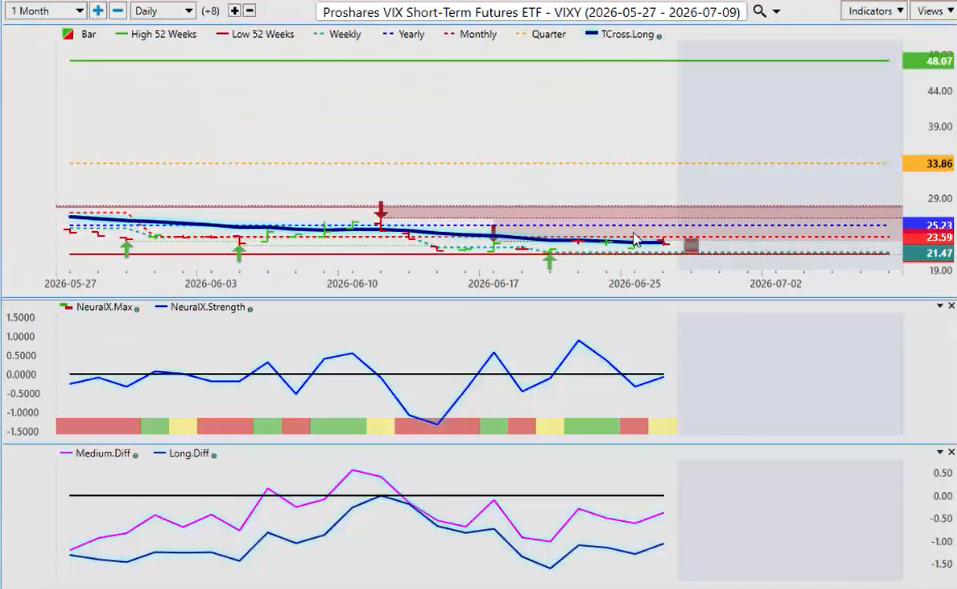
Now, when we look at the short-term VIX Futures ETF, we’ve seen a little bit of movement here. However, we still closed the week below that critical T Cross Long at 22.79. That remains the level to keep your eye on next week.
Our medium-term and long-term Predicted Differences continue to move higher, while the Neural Index is also pointing higher. However, the Neural Index itself is giving more of a cautionary signal. It’s not outright bullish, and it’s not outright bearish. It’s sitting in more of a transitional position.
We’ll continue to watch it closely. For now, there remains a slight bias that the short-term VIX Futures ETF could continue extending higher.
Bitcoin
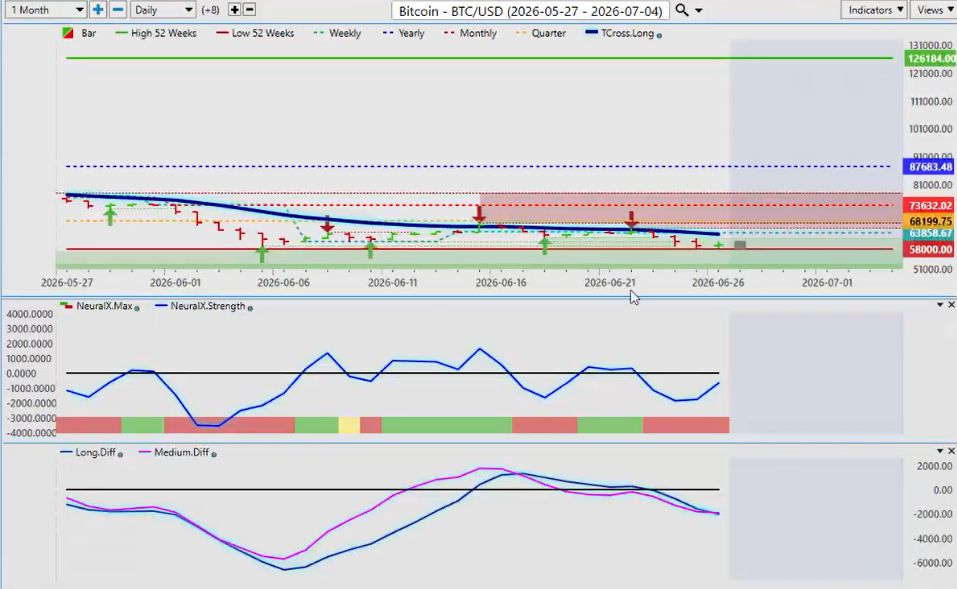
Now, when we look at Bitcoin, Bitcoin is once again making another new 52-week low, or at least matching the low that we hit on June 5.
Once again, in my respectful opinion only, this is perfectly normal for Bitcoin to be in a down year. I anticipate that it will start to show signs of life closer to August and September. Then, during October, November, and December, we could begin to see a rally that sets the stage for next year.
For now, the T Cross Long at 63,412 remains your key level. If we break below this 52-week low around 58,000, that could open the door to a move down toward the 49,000 to 52,000 area. I’ll address that possibility in more detail next week.
Again, we do have an MA Diff Cross, with the pink line crossing above the blue line, suggesting that Bitcoin can actually move higher from current levels.
Crude Oil ($USO)
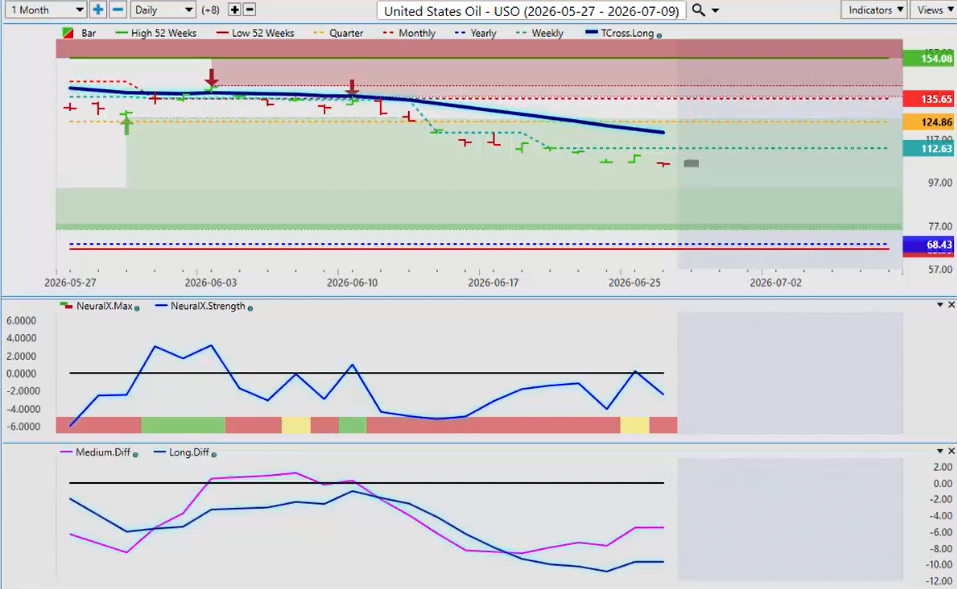
Now, looking at Crude Oil, I’ve basically stayed away from forecasting Crude Oil over the last several months because this has become a gambler’s paradise, so to speak, with everything surrounding the conflict involving the United States, Iran, Israel, Lebanon, and the various geopolitical developments taking place.
One day the conflict appears to be escalating. The next day it appears to be easing. Right now, it appears to be easing, and that’s pushing Crude Oil prices lower. However, that situation could reverse at any minute because we’re trading in a fundamentally driven environment.
If the United States and Iran come to an agreement, that should allow Crude Oil prices to move back toward more normal trading ranges. For now, your T Cross Long at 19.91 remains your primary retracement point.
Again, we do have an MA Diff Cross. Medium-term strength is beginning to move back to the upside.
Foreign Exchange Markets
Now, when we look at some of our major foreign exchange pairs, keep in mind that next week is a holiday-shortened trading week with July 4th in the United States, Canada Day, and I believe there may also be a holiday in the United Kingdom. Because of that, it’s likely to be a very choppy trading environment.
I don’t think I need to go through every individual currency pair, but the primary one you should be watching is the Euro.
Euro
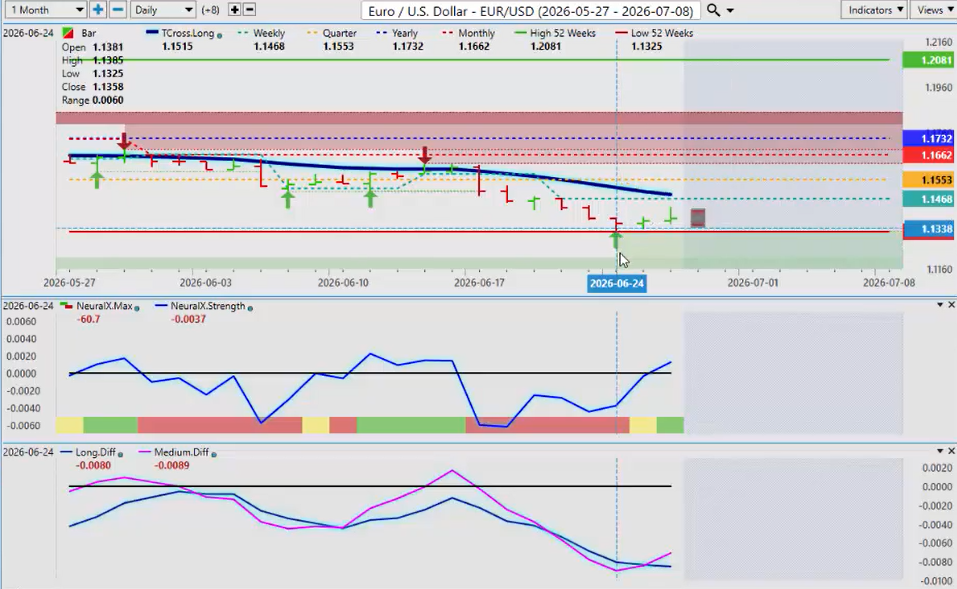
The Euro has put in a new 52-week low at 1.1380. However, we’re beginning to lift away from that low. Once again, we have an MA Diff Cross pointing to the upside.
I believe that move higher would simply be corrective in nature, bringing price back toward the T Cross Long at 1.1486. The real question is whether we can actually break above that T Cross Long.
The reason I only have one Predicted Moving Average on this chart is to reduce the confusion created by multiple moving averages and numerous crossover indicators. I want to keep things simple. We have a line in the sand. While price remains below that line, we’re looking at short positions. Once price moves above it, we begin looking for long opportunities.
However, we need to see a clean break above that T Cross Long at 1.1486 before we begin thinking about aggressively buying the Euro.
U.S. Dollar / Swiss Franc
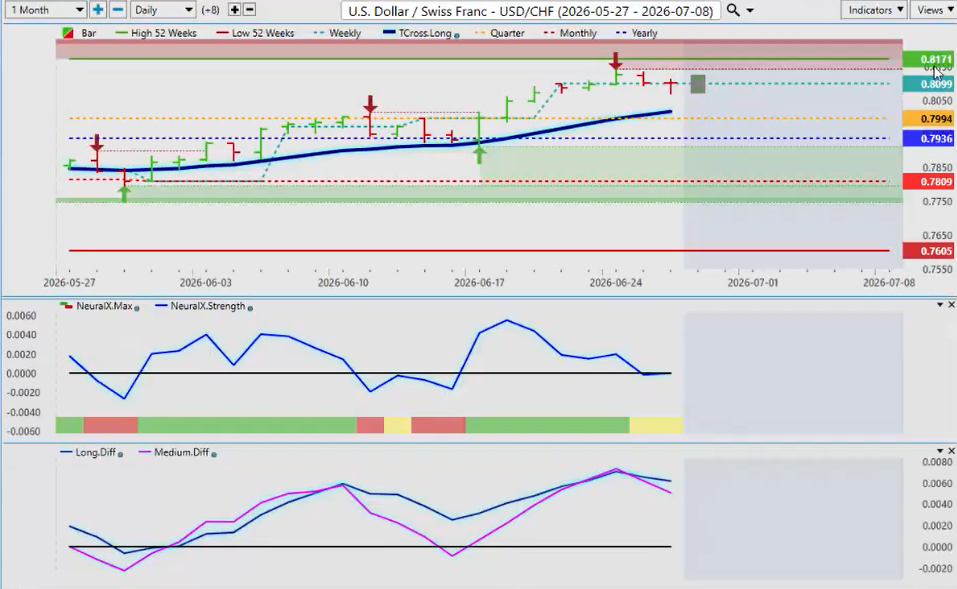
Its inverse counterpart is the U.S. Dollar / Swiss Franc.
The 52-week high there comes in around 0.8171. Again, we would need to break above that level, and this is also tied to the carry trade. At the same time, it’s another warning sign of at least some pending short-term weakness in the U.S. Dollar.
The U.S. Dollar has struggled against the Swiss Franc for essentially the last five years. Therefore, a retracement back down to the T Cross Long around 0.8160 would be perfectly normal.
The VantagePoint indicators continue to support a corrective move lower, but not the beginning of a new trend unless we break below 0.7936, which is the calendar yearly opening price.
British Pound
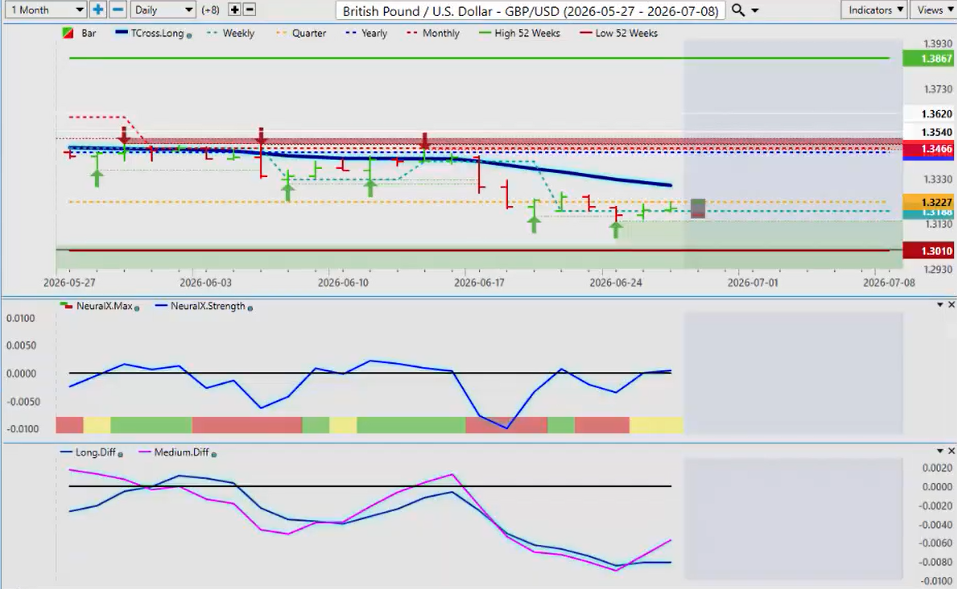
Now, let’s look at the British Pound. Once again, they’re getting another new prime minister, so it’s obviously having a very negative effect on the currency with the most recent prime minister resigning.
On a side note, we do have an MA Diff Cross pointing to the upside after the British Pound established a new 52-week low around 1.3010. Can we pull back higher? I think we can move back toward the T Cross Long on broad U.S. Dollar weakness, but I believe that would only be a short-term move.
We know that the first week of a new month, or the week surrounding the Non-Farm Payroll report, which is not next week but the week after, is typically when we begin expecting renewed U.S. Dollar strength.
I believe we can retrace higher next week, but traders need to be very careful around the 1.3300 area. We need a clean break to the upside before we’re willing to hold long positions. Even then, we would still have to contend with the calendar yearly opening price at 1.34448.
U.S. Dollar / Japanese Yen
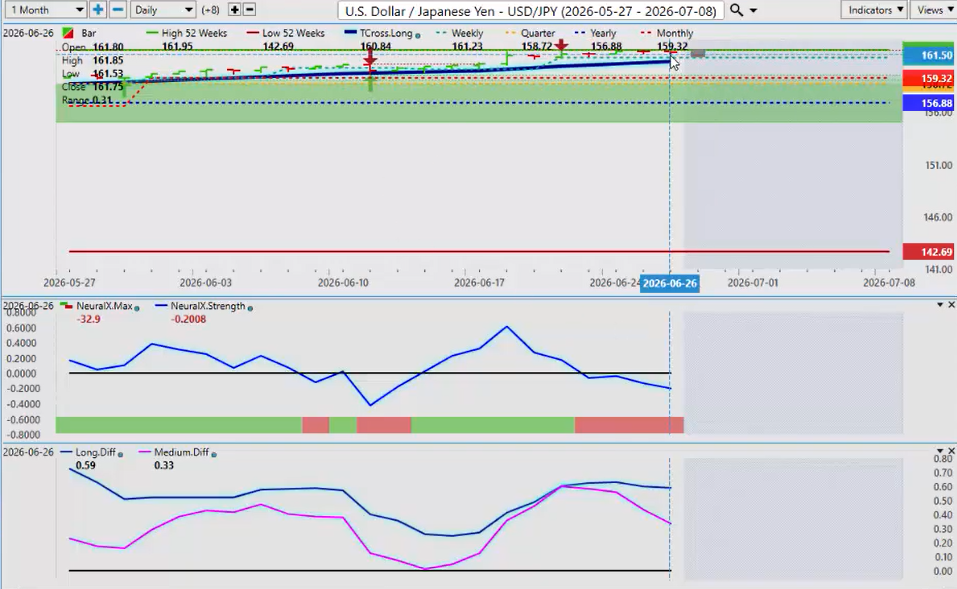
Now, when I look at the U.S. Dollar / Japanese Yen, the Bank of Japan continues attempting intervention and hiking interest rates. Again, in my respectful opinion only, I’m not going to waste my time trading this pair.
There’s simply too much volatility surrounding it, along with repeated threats of intervention. If Kevin Warsh changes his position and suddenly says, “No, I’m actually not looking at rate hikes,” this market could come apart at the seams in a matter of minutes.
My advice is to be very careful with anything involving the Japanese Yen, whether it’s Euro / Japanese Yen, Canadian Dollar / Japanese Yen, Australian Dollar / Japanese Yen, or New Zealand Dollar / Japanese Yen.
For now, that pink line, representing the strength of the medium-term crossover, continues to weaken, suggesting we’re moving lower. A natural retracement target would be the T Cross Long around 160.84.
U.S. Dollar / Canadian Dollar
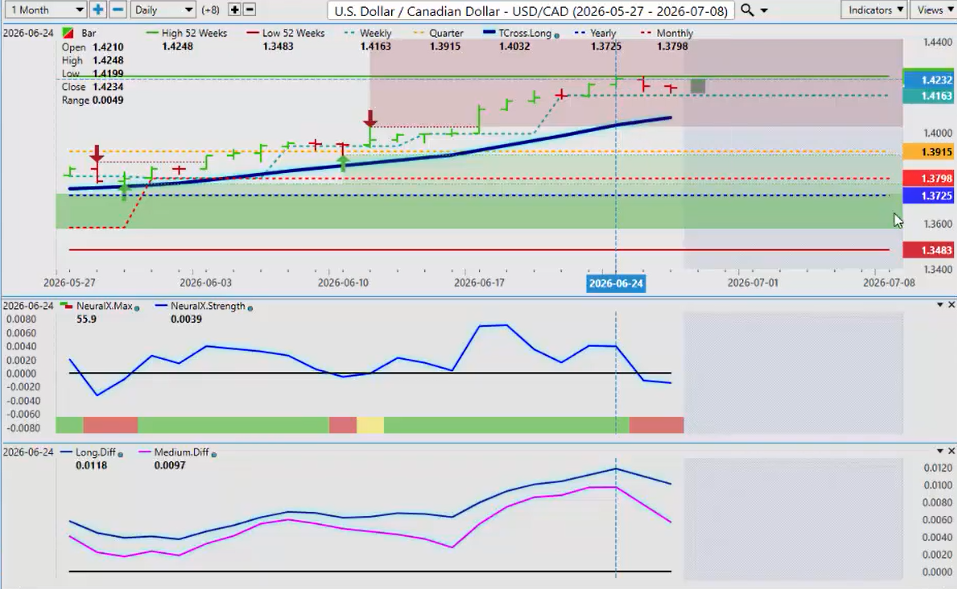
Now, when I look at the U.S. Dollar / Canadian Dollar, we’ve put in a new 52-week high around the 1.4248 area before backing away from it.
For next week, I believe we can retrace back toward the T Cross Long at 1.4066. Again, that would simply be corrective in nature, not the beginning of a new trend.
We’re still above the quarterly opening price, the monthly opening price, and the yearly opening price. Without getting into Fibonacci analysis, which I believe has very little relevance here, the Predicted Moving Average, along with the quarterly, monthly, and yearly opening prices, all provide very strong support underneath the market.
The Canadian economy is not performing particularly well right now. Therefore, a retracement back toward 1.4066 would be perfectly normal. Once we get there, we’ll reassess the market.
Australian Dollar
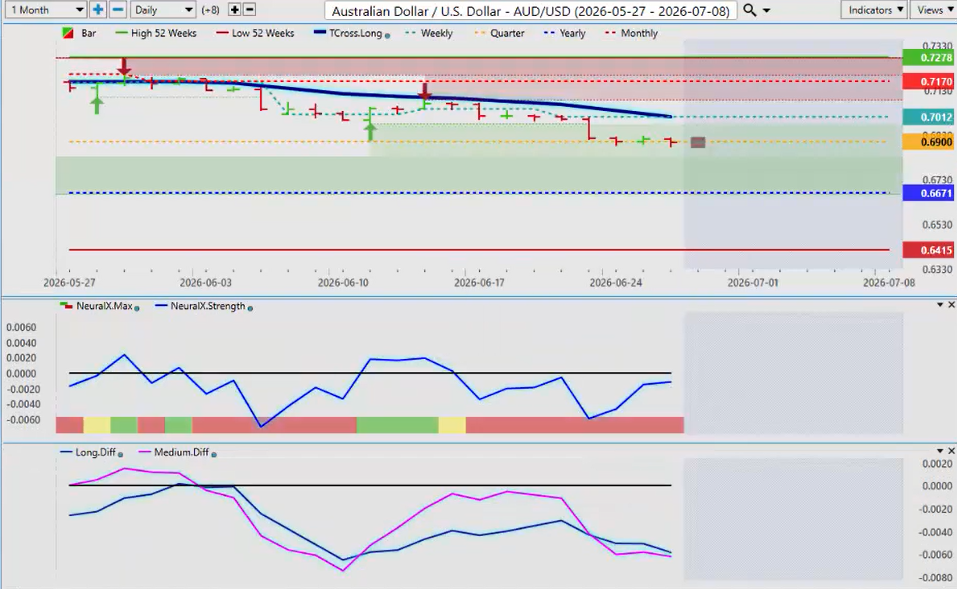
Now, let’s look at the Australian Dollar and the New Zealand Dollar. These two currencies continue to trade in a very similar fashion.
The Australian Dollar really took a beating last week, and I believe that was driven primarily by slightly softer economic data. Once again, the market has flip-flopped because the Reserve Bank of Australia (RBA) has shifted its messaging.
Not long ago, the market was hearing that interest rates would likely continue moving higher. Now we’re hearing that rates may remain on hold, and perhaps even move lower. You have to see the comic value in listening to these central banks as they continually change their narrative and, in my opinion, manipulate the markets.
I think Kevin Warsh is offering something new and refreshing. Rather than constantly telling the market what it wants to hear, he’s suggesting that policy should be driven by the underlying economics rather than endless forward guidance.
The RBA, on the other hand, continues to appear to be all over the map. I still believe the Australian Dollar remains a relatively high-yielding currency, as does the New Zealand Dollar, and even the U.S. Dollar.
For now, as long as we’re above 0.6671, which I believe we could retest over the next week and a half, perhaps two weeks, I would view that as a buying opportunity. Keep a very close eye on that 0.6671 level.
New Zealand Dollar
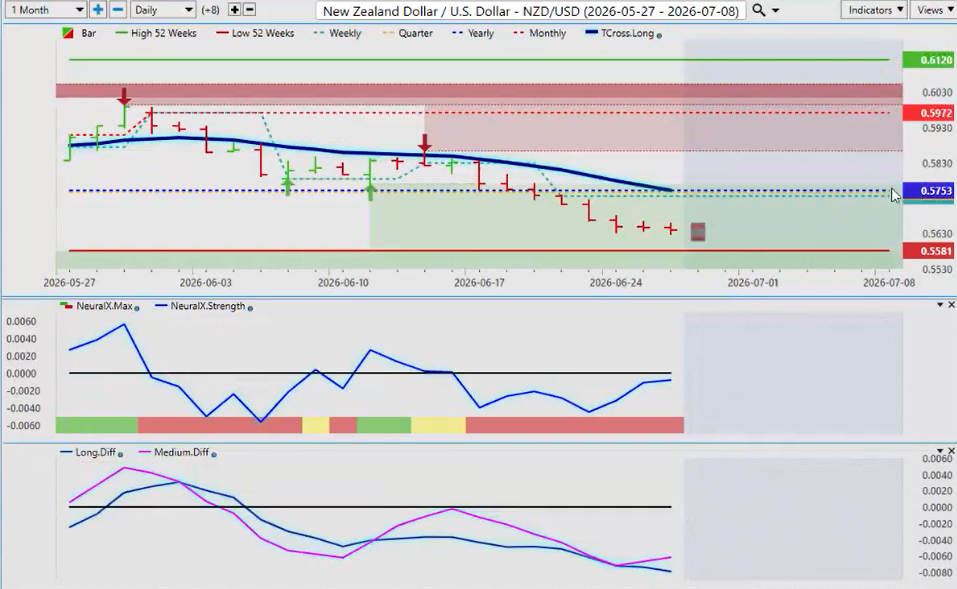
The same basic outlook applies to the New Zealand Dollar going forward. However, we have now broken below its yearly opening price at 0.5753.
That’s one of the reasons I believe the Australian Dollar could continue following this market lower. The one advantage the Australian Dollar still has working in its favor is the Australian Dollar / New Zealand Dollar cross.
Again, I believe the constant shifts in central bank policy continue creating unnecessary volatility. They’re causing havoc in the equity markets, in the commodity markets, and throughout the currency markets.
We have to look beyond that noise. We already know we have the potential for renewed U.S. Dollar strength beginning the week after next. That means this coming week could provide a decent opportunity for selling the U.S. Dollar on a short-term basis.
Above all, keep a very close eye on any announcements regarding the conflict involving the United States and Iran, along with anything coming from the world’s major central banks.
With that said, this is the VantagePoint AI Market Outlook for the week of June 29, 2026.


