







The ai stock spotlight this week is Energy Fuels ($UUUU)
When you look at $UUUU, Energy Fuels Inc., you’re not just looking at another mining stock. You’re looking at a company sitting squarely in the middle of a global strategic fight for control of the materials that power electric cars, wind turbines, phones, and defense equipment. Rare earth elements have become a national priority in the U.S., especially because most of the refining capacity today is overseas, largely in China. Investors are waking up to the idea that any company capable of building a secure domestic supply chain could see huge demand and support from both industry and government.
At the heart of Energy Fuels’ strategy is the White Mesa Mill in Utah, the only fully licensed conventional uranium mill in the United States. It’s not just a relic of the past nuclear fuel cycle. This mill is being transformed into a rare earth processing hub, capable of producing the key materials used to make powerful magnets. The company has already produced light rare earth oxides like neodymium praseodymium (NdPr) and has pilot-scaled production of heavy rare earths like dysprosium with exceptionally high purity, a material most of the world currently sources from abroad.
That capability is what has analysts and investors talking. A recent feasibility study suggests that White Mesa could be one of the largest producers of separated rare earth elements outside of China and do it at among the lowest costs globally. In a world where policymakers in Washington increasingly want to reduce dependence on foreign supply chains, those capabilities give Energy Fuels a unique position in a crowded sector. It’s the rare combination of real infrastructure and strategic relevance that differentiates $UUUU from other names simply chasing resource deposits.
The wider market is already showing signs of action. Rare earth stocks broadly have been strong performers early in 2026, with companies like Critical Metals Corp. (CRML) doubling and others such as MP Materials (MP) and USA Rare Earth (USAR) making notable gains as investors chase exposure to this theme of mineral sovereignty. That’s the idea that the U.S. needs its own secure sources of critical materials rather than relying on geopolitical rivals. This rising tide in the rare earth space naturally brings renewed focus on Energy Fuels as a potential beneficiary.
But this isn’t a story without risk. Energy Fuels is still unprofitable, and its rare earth ambitions require execution, further capital investment, and time before they mature into stable cash flows. Some analysts argue that the stock already prices in growth expectations stretching years into the future, meaning the company needs to deliver consistently to justify its valuation. Dependent on policy support, commodity prices, and global demand, the path ahead can be volatile even if the long-term potential is real.
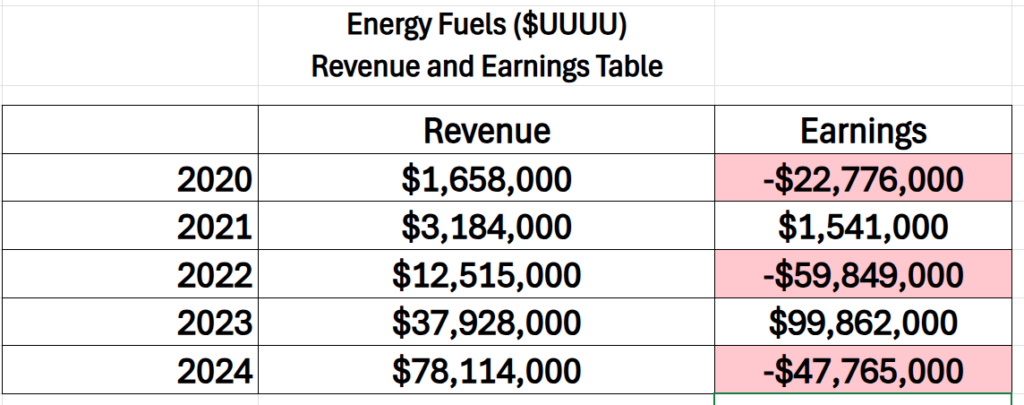
Finances are volatile. Look at this table and you can almost hear the gears grinding as Energy Fuels ($UUUU) forces its way uphill. In 2020 the company barely cleared $1.6 million in revenue and bled cash like a startup nobody believed in. Fast forward and the story changes fast. Revenues climb from $3 million to $12 million, then explode to nearly $38 million and over $78 million by 2024. That is not luck. That is a company deliberately stepping into bigger markets that require upfront spending, patience, and nerve. Earnings swing wildly along the way, from losses to profits and back again, because this is what happens when you build infrastructure before the payoff arrives. This table is not about smooth profits. It is about scale being built in real time. The revenue curve is the tell. Money is starting to flow through the business, even if it has not yet settled neatly at the bottom line. For traders and investors who understand how early-stage strategic plays develop, this is what the messy middle looks like right before the story gets simple.
From a trading perspective, the increasing interest in rare earth stocks feeds into a broader narrative of strategic resource plays dominating headlines in 2026. Investors are treating materials that were once obscure as the next big thematic trend, somewhat similar to how clean energy or semiconductor supply chains became key investment storylines in prior years. In that context, Energy Fuels is squarely in the conversation because it bridges the gap between uranium production and rare earth processing in a single company, a rare combination in the domestic market.
So, when you strip it down, $UUUU’s story for 2026 is simple to understand but complex in execution. A U.S.-based miner with a one-of-a-kind mill is trying to turn itself into a reliable source of materials the world needs for technology and national security. If it succeeds, it could help reshape the rare earth supply chain and justify investor enthusiasm. If it stumbles on capital needs or execution hurdles, the stock could reflect those growing pains. That duality, opportunity and risk intertwined, is exactly why Energy Fuels has become part of the rare earth conversation this year.
In this weekly stock study, we will look at and analyze the following indicators and metrics as are our guidelines which dictate our behavior on $UUUU.
- Wall Street Analysts’ Price Forecasts
- · 52-week high and low boundaries
- · Best Case – Worst Case Analysis
- · Vantagepoint A.I. Predictive Blue Line
- · Neural Network Forecast
- · Daily Range Forecast
- · Intermarket Analysis
- · Our trading suggestion
While our trading decisions are driven by the A.I. forecasts generated inside the VantagePoint A.I. platform, we still keep a close eye on the fundamentals. Not because they dictate our entries, but because they help frame the risk and reward of the opportunity. In markets like this, understanding what you own matters, even when the timing comes from the data.
Wall Street Analysts Forecasts
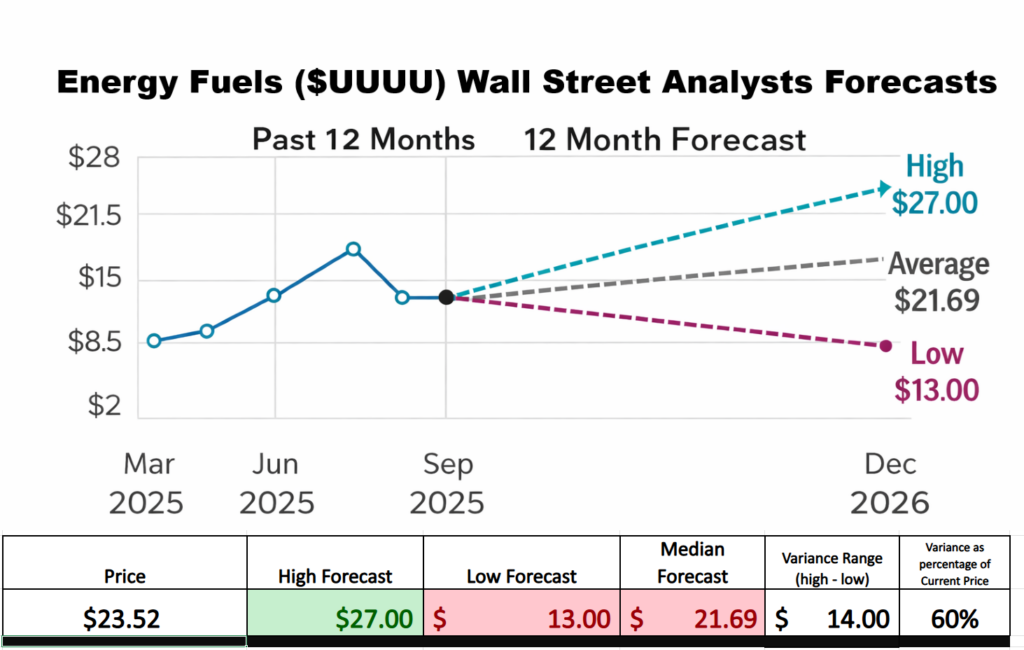
Wall Street analysts, bless their well-pressed suits and finely tuned spreadsheets, have once again gathered around Energy Fuels ($UUUU) to offer guidance. What they have produced is not consensus but a philosophical argument disguised as a forecast. One camp sees a future glowing at $27, another peers nervously down at $13, and the stock itself sits in the middle at $23.52, wondering who exactly is in charge here. This is not so much a prediction as it is a polite disagreement conducted with dollar signs.
When studying analyst forecasts, the most important number is not the high, the low, or even the average. It is the distance between them. That spread tells you how much uncertainty is sloshing around beneath the surface. In this case, the variance between the most optimistic and most pessimistic outlooks is a whopping 60% of the current price. That is not a rounding error. That is Wall Street quietly admitting it has no idea what kind of ride lies ahead, only that it is likely to be bumpy.
A 60 percent variance is the market equivalent of being told to expect turbulence, loose seatbelts, and possibly a beverage cart in free fall. It signals that expectations are wide, emotions are high, and volatility is not a risk but a feature. Whether $UUUU ends up rewarding the optimists or validating the pessimists, one thing is clear. Anyone stepping into this trade should be prepared for sharp moves, loud opinions, and the kind of price action that keeps analysts busy and investors awake.
52 Week High and Low Boundaries

Look at these charts and tell me this market is calm. $UUUU has carved out a 52-week range from $3.20 to $27.33, a swing of more than 100% relative to today’s price. That is volatility hiding in plain sight. Yes, the bias is up. You can see the stair steps higher, the expanding ranges, the surge toward the highs. But this is not a smooth escalator ride. This is a market that invites you in with momentum, then reminds you very quickly who is in charge.
Just when things feel comfortable, the floor gives way. Sharp pullbacks arrive without warning. Gains evaporate fast. This is the kind of chart that rewards confidence and punishes complacency. The trend points higher, but the path is violent. One week you feel like a genius riding strength, the next you are staring at a drawdown wondering what changed. Nothing changed. The volatility was always there. It was written into the price action from the start.
That is why position sizing is not optional here. It is survival. When volatility is extreme, leverage is not your friend, and oversized positions turn normal pullbacks into emotional disasters. Traders who respect the range, size appropriately, and expect sudden air pockets give themselves staying power. Traders who do not get shaken out at exactly the wrong moment. With $UUUU, the opportunity is real, but only for those disciplined enough to let volatility work for them instead of against them.
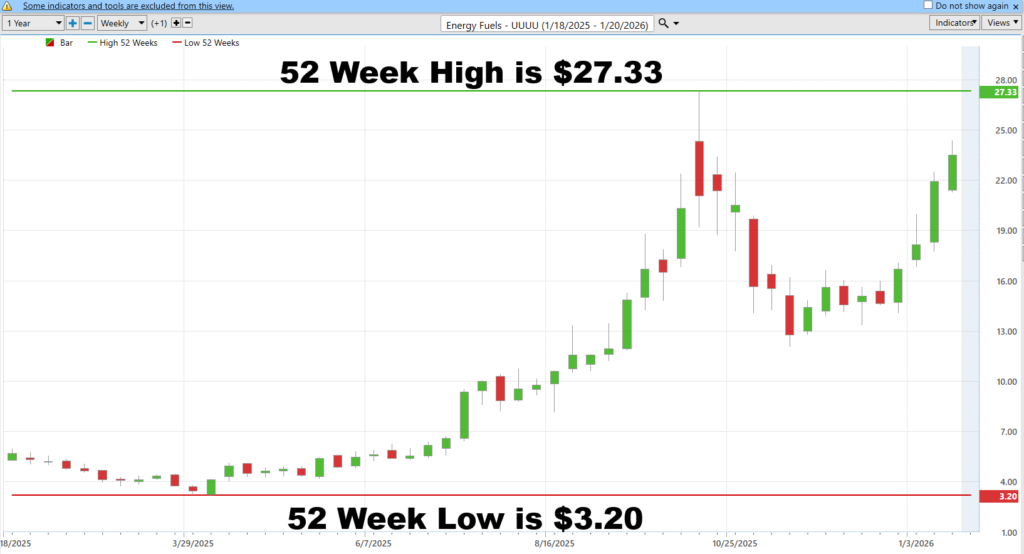
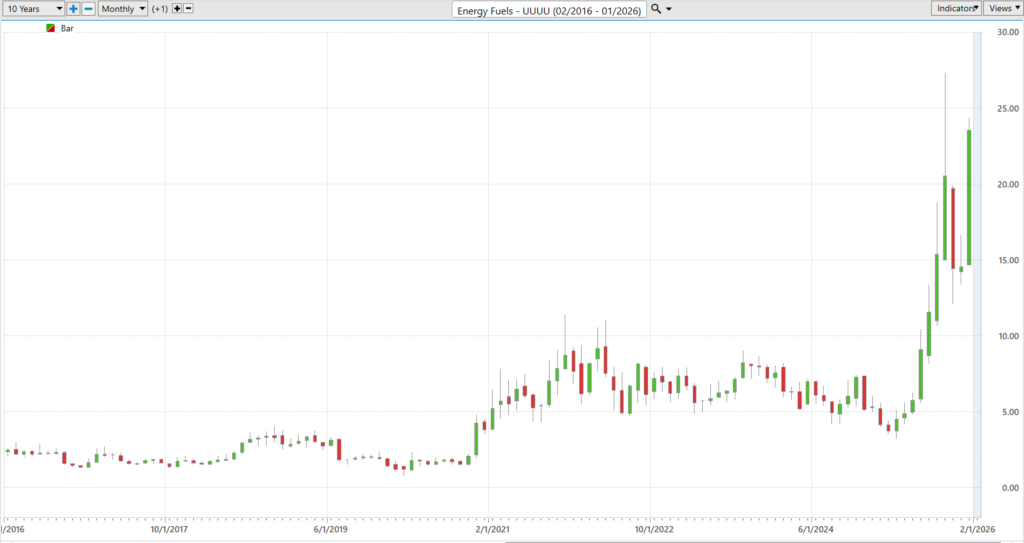
This chart tells the kind of story traders love and fear at the same time. About six months ago $UUUU snapped out of a long base and broke into new all time high territory with authority, the kind of move that does not ask for permission. Then, just as fast, it sold off hard, shaking loose anyone who mistook momentum for comfort. Now here we are again, price charging back toward those same highs, daring the market to decide whether that breakout was a fluke or the opening act. The structure is explosive, no question about it, but this is not a gentle trend. Volatility here cuts like a sword in both directions. If you are right, the upside can be swift and dramatic. If you are sloppy, the same force that drives the move higher will carve you up on the pullbacks.
The 10-year chart below displays this explosiveness very clearly.
Best-Case/ Worst-Case Scenario Analysis
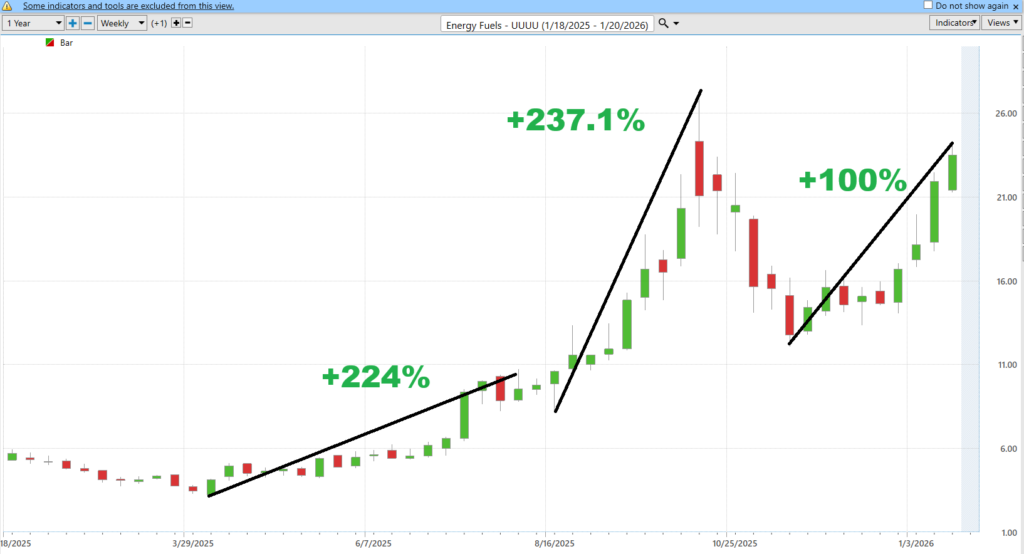
Volatility is often framed as something abstract and mathematical, but the best way to understand it is to start with what has already worked. The best-case chart shows $UUUU delivering uninterrupted advances of extraordinary size. We are talking about rallies of 100 percent, 224 percent, and even 237 percent without meaningful pullbacks. That is not noise. That is evidence of how aggressively this stock can trend once momentum takes hold. When conditions align, price does not creep higher. It accelerates. This is the upside potential that attracts capital and fuels conviction, and it sets a realistic ceiling for what strong trends in this name have historically looked like.
Only after understanding the upside does the downside deserve attention. The worst-case chart reveals the other side of the same coin. Sharp, uninterrupted declines of 19 percent, 21 percent, 22 percent, 46 percent, and 54 percent have occurred along the way. These drawdowns were not gradual or forgiving. They happened quickly and with enough force to test discipline and risk management. This is not a flaw in the analysis. It is the cost of admission for a stock capable of producing outsized gains.
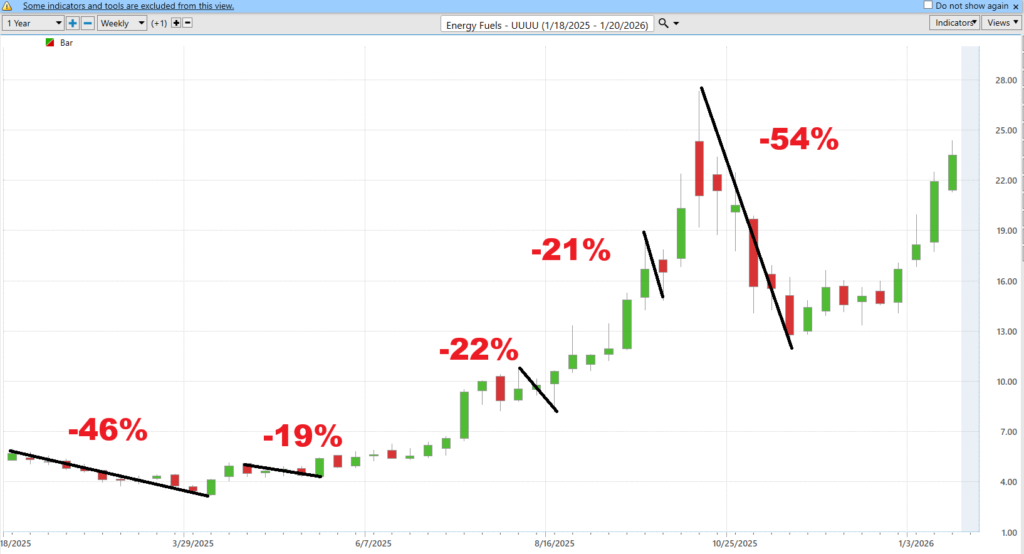
This is why volatility does not need to be modeled to be understood. The best way to anticipate it is to study the ride itself. Measure the largest uninterrupted rallies. Measure the deepest uninterrupted declines. That simple exercise replaces theory with experience and sets realistic expectations for what lies ahead. When a stock has already shown you both extremes, believing anything less moving forward is not conservative. It is being unprepared.
Next, we compare $UUUU to all of the broader stock market averages across multiple time frames.

The table makes the message unmistakable. Energy Fuels ($UUUU) has not merely beaten the market, it has left it behind across every meaningful time frame. Annual performance north of 300 percent, six-month gains exceeding 150 percent, and solid strength year to date, monthly, and weekly all point to sustained leadership rather than a one off spike. In contrast, the major benchmarks are struggling to gain traction. The Nasdaq Composite, S&P 500 Index, and Dow Jones Industrials show modest gains over longer horizons and weakness over shorter ones. This is what true relative strength looks like. Capital is not drifting into $UUUU by accident. It is being directed there deliberately.
There is another important signal embedded in this comparison. The Russell 2000 Index, often treated as a proxy for small cap risk appetite, is outperforming the Nasdaq, S&P, and Dow across multiple time frames. That matters. It suggests investors are willing to move beyond the perceived safety of mega caps and take exposure in smaller, higher beta names. In that context, $UUUU’s outsized gains are not occurring in isolation. They are part of a broader shift toward risk, momentum, and opportunity where leadership is being rewarded and laggards are being left behind.
VantagePoint A.I. Predictive Blue Line
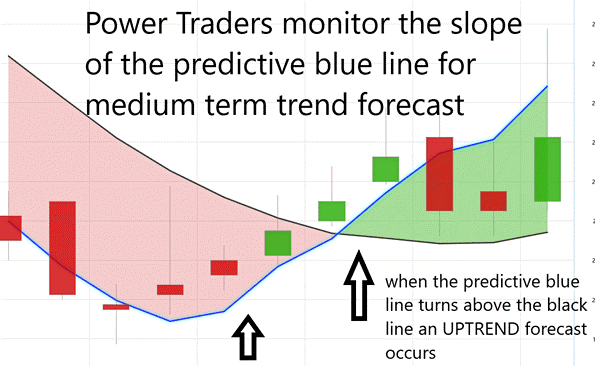
The logic behind trading the VantagePoint A.I. predictive blue line is deliberately simple. When the blue line turns up, it signals a forecasted shift in trend to the upside and serves as permission to look for long opportunities. As long as price remains above the rising blue line, the trend is considered intact. When price closes below it and the line rolls over, risk increases and discipline matters. The goal is not to predict tops or bottoms, but to stay aligned with the dominant direction the data is pointing toward, while letting price confirm that forecast in real time.
That framework matters because it removes emotion from decision making. You are not reacting to headlines, opinions, or analyst targets. You are responding to a measurable change in trend. The predictive blue line acts as a dynamic reference point, one that adapts as new data enters the system. It does not promise perfection, but it does provide structure. In volatile names, structure is often the difference between capturing a move and getting shaken out of it.
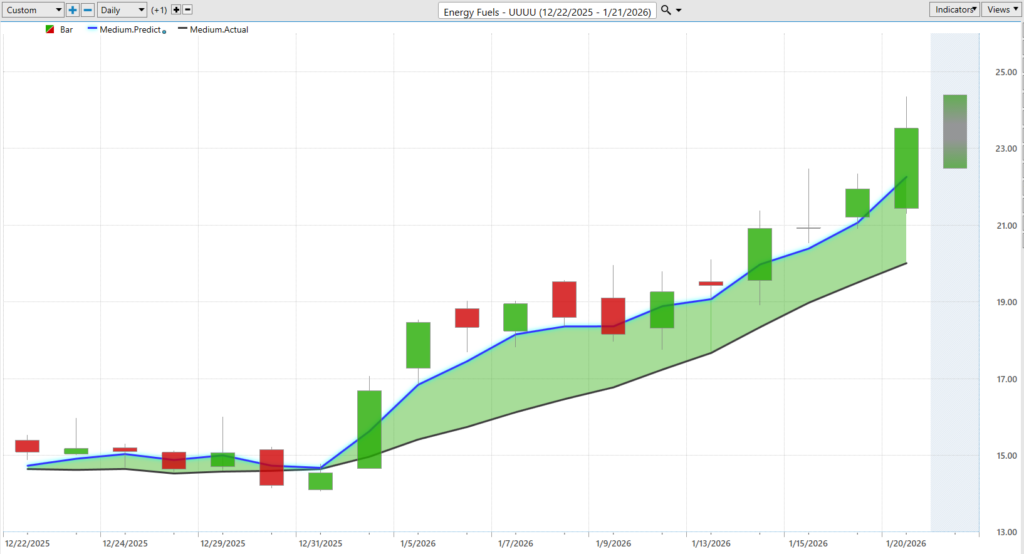
That context makes the recent action in $UUUU difficult to ignore. The most recent Up forecast occurred on 12/31/25. Since that signal, the stock has advanced roughly 60 percent in just a few short weeks. There were pauses along the way and moments of hesitation, but price respected the rising blue line throughout the move. This is exactly how the methodology is designed to work. Not by catching every tick, but by staying positioned while a meaningful trend unfolds and letting the numbers, not the noise, do the talking.
VantagePoint A.I. Neural Index (Machine Learning)
A neural network in trading is designed to do one thing well: recognize patterns in market behavior that are difficult for the human eye to consistently detect. It ingests vast amounts of historical price data, learns how markets tend to behave under similar conditions, and produces forward looking signals that adapt as new information arrives. The value is not in prediction for its own sake, but in structure. A neural network gives traders a repeatable framework for decision making, reducing emotional reactions and replacing guesswork with probabilities grounded in data.
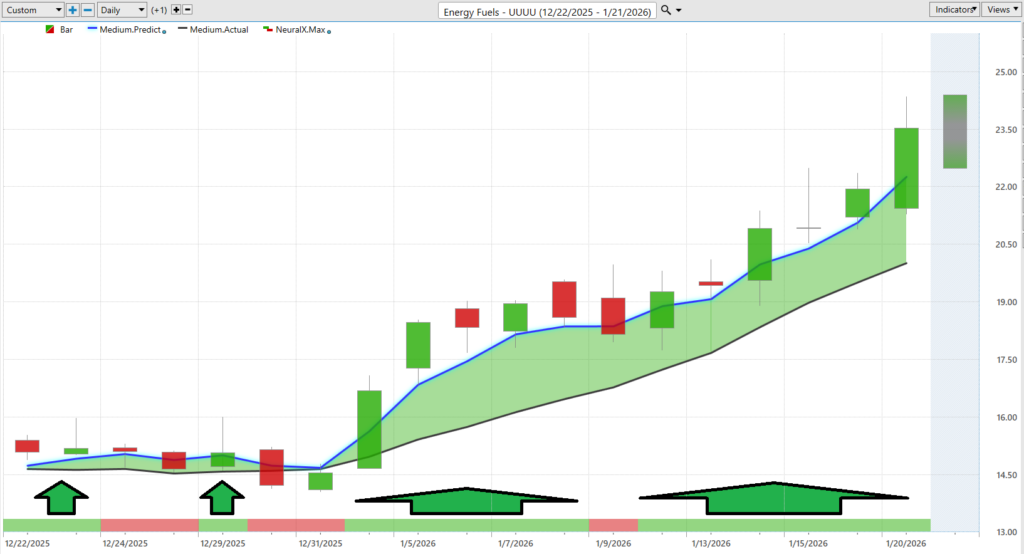
That framework becomes especially powerful when multiple forecasts align. In the attached chart, the predictive blue line establishes the directional bias, while the Neural Index confirms the strength and timing of that move. When both indicators point in the same direction, what we call the double confirmation setup, the probability of follow through increases materially. These moments are visible in the chart, highlighted where the Neural Index turns green while price remains above a rising predictive blue line. This alignment signals not just trend, but momentum working in the same direction.
Equally important is what happens when conditions temporarily change. When the Neural Index turns red, price often pulls back toward the predictive blue line rather than breaking the trend outright. Those pullbacks are not failures. They are opportunities. They allow traders to reposition within the dominant trend at more favorable levels, while the underlying forecast remains intact. This is how neural networks improve decision making, not by eliminating risk, but by clarifying when to press, when to wait, and when probabilities shift back in your favor.
VantagePoint A.I. Daily Range Forecast
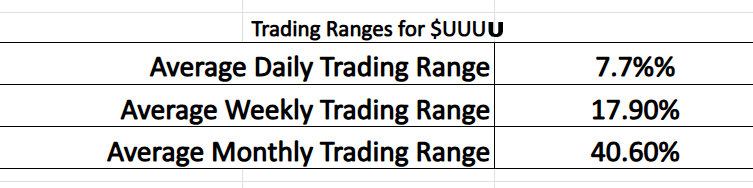
After all the charts have been admired, the indicators analyzed, and the theories politely argued over, every trader eventually asks the same blunt question. Where do I get in and where do I get out? The first graphic answers an uncomfortable truth. $UUUU does not move quietly. An average daily range of nearly eight percent, a weekly range pushing eighteen percent, and a monthly range north of forty percent tell you this is not a stock for the faint of heart or the sloppy planner. This is a market that demands precision, because guessing in something this volatile is not trading, it is recreation.
That is where the second graphic earns its keep. The VantagePoint A.I. Daily Range forecast does not philosophize about markets or debate macro narratives. It draws the lines that matter. The projected high and low define the battlefield before the trading day even begins. You can see the trend, you can see the slope, and you can see where price is expected to stretch and where it is likely to pause. Instead of staring at a screen wondering what might happen next, you are given a realistic map of what tomorrow probably looks like.
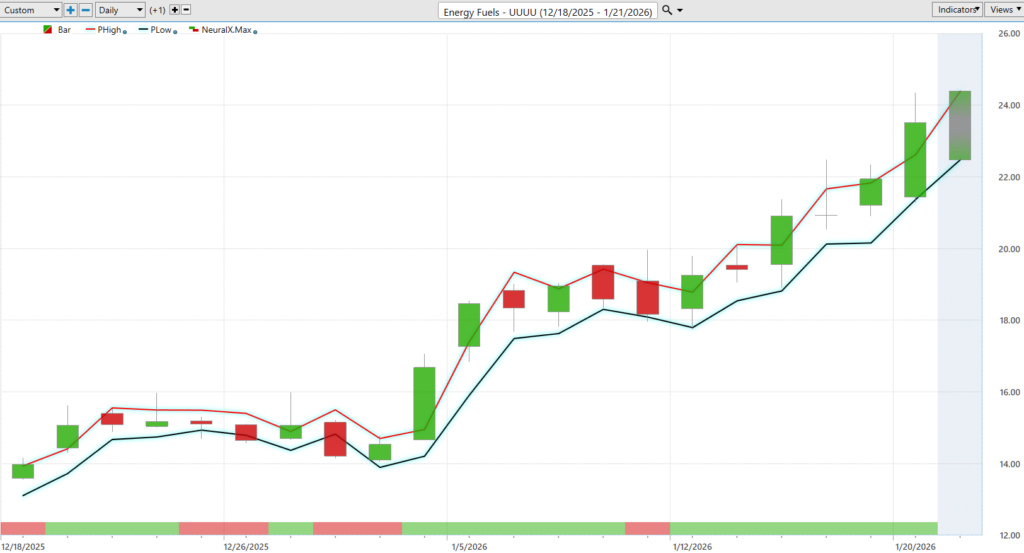
This is what traders want once the analysis dust settles. Clear expectations. Defined ranges. A framework for entries near support and exits closer to resistance, all while staying aligned with the prevailing trend. The Daily Range forecast does exactly that. It turns volatility from a source of anxiety into a tool, outlining both direction and distance in advance. In a stock that moves as aggressively as $UUUU, knowing where price is likely to travel next is not a luxury. It is the difference between trading with intent and reacting after the fact.
Intermarket Analysis
Energy Fuels ($UUUU) sits at the intersection of two powerful forces shaping today’s energy markets. The company produces uranium, a critical input for nuclear power, at a moment when prices are hovering around $85 per pound, levels that materially improve the economics of production. Demand for nuclear energy is rising as governments and corporations look for reliable, carbon free electricity, particularly for energy intensive uses like data centers. Supply, however, remains constrained. That imbalance supports higher uranium prices, which in turn strengthens Energy Fuels’ revenue outlook and draws investor attention to the stock.
Operationally, the company has executed with notable discipline. Its Pinyon Plain mine has exceeded expectations, delivering higher volumes of uranium at lower extraction costs. That combination matters. Higher grade material pulled from the ground more efficiently translates directly into improved margins. Just as important, Energy Fuels has secured long-term contracts with utilities, providing predictable cash flow and reducing exposure to short-term price swings. For investors, that blend of operational strength and revenue visibility tends to inspire confidence, especially in a sector known for volatility.
Beyond uranium, Energy Fuels is positioning itself for what could be a second act. The company is investing in rare earth elements, materials essential to electric vehicles, advanced electronics, and defense applications. Building domestic rare earth processing capacity carries upfront costs, but it also aligns with broader policy and supply chain priorities in the United States. If successful, this initiative could diversify revenue and expand the company’s strategic relevance. Taken together, elevated uranium prices, disciplined mining operations, and optionality from rare earth development help explain why $UUUU has captured the market’s attention.
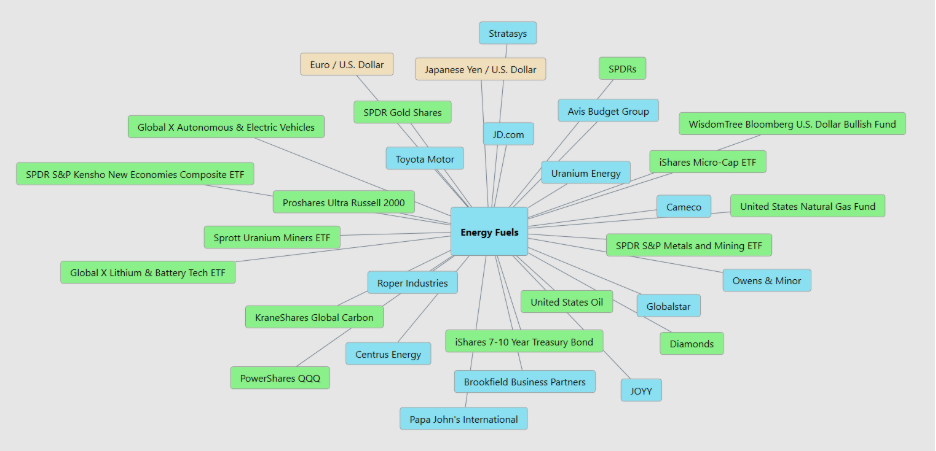
This graphic shows that Energy Fuels ($UUUU) is connected to a lot of different parts of the market, not just one thing. It is tied to uranium and energy, but also to mining, metals, clean energy, electric vehicles, and small company stocks. That means the stock can move when uranium prices change, when energy or mining stocks move, or when investors feel more or less comfortable taking risks. Because so many things influence it at the same time, the stock can move fast and swing a lot. In simple terms, $UUUU is like a hub with many roads leading in and out, and when traffic picks up on any of those roads, the stock feels it.
Our Suggestion
In the last two earnings calls, Energy Fuels ($UUUU) management sounded confident. They said they are producing more uranium than expected, especially from mines like Pinyon Plain, and that they are hitting or beating their production goals. They also have long-term contracts to sell uranium to power companies, which means they already know they will have buyers in the future. This shows the company is doing what it said it would do.
The company’s main goals are to keep increasing uranium production, lock in more long-term sales contracts, and build out rare earth production in the U.S. Rare earths are important metals used in electric cars and technology. The biggest risks are that uranium prices can go up and down, rare earth projects cost a lot of money to build, and mining can sometimes face delays or unexpected problems.
The key is to use good money management. This stock moves a lot, so position size matters. Put $UUUU on your watchlist and pay attention to how it trades. 2026 is already shaping up to be a very active year for mining stocks, and Energy Fuels is right in the middle of that action.
Use the VantagePoint A.I. Daily Range Forecast to locate short-term trading opportunities.
It’s not magic.
It’s machine learning.
Disclaimer: THERE IS A HIGH DEGREE OF RISK INVOLVED IN TRADING. IT IS NOT PRUDENT OR ADVISABLE TO MAKE TRADING DECISIONS THAT ARE BEYOND YOUR FINANCIAL MEANS OR INVOLVE TRADING CAPITAL THAT YOU ARE NOT WILLING AND CAPABLE OF LOSING.
VANTAGEPOINT’S MARKETING CAMPAIGNS, OF ANY KIND, DO NOT CONSTITUTE TRADING ADVICE OR AN ENDORSEMENT OR RECOMMENDATION BY VANTAGEPOINT AI OR ANY ASSOCIATED AFFILIATES OF ANY TRADING METHODS, PROGRAMS, SYSTEMS OR ROUTINES. VANTAGEPOINT’S PERSONNEL ARE NOT LICENSED BROKERS OR ADVISORS AND DO NOT OFFER TRADING ADVICE.