






Hot Stock Snapshot was created for one purpose: to help traders quickly understand why a stock from our Hot Stocks Outlook is moving, what themes are driving it, and whether the trend deserves attention. In just a few charts and a few minutes, we isolate the essential story behind the price action. Not the noise. Not the endless opinions. Just the facts, the momentum, the capital flows, and the catalysts that matter. Every Snapshot is designed to answer the most important question in speculation: Who is winning, and why? Because in markets, opportunity rarely arrives with a formal invitation. It reveals itself first in performance.
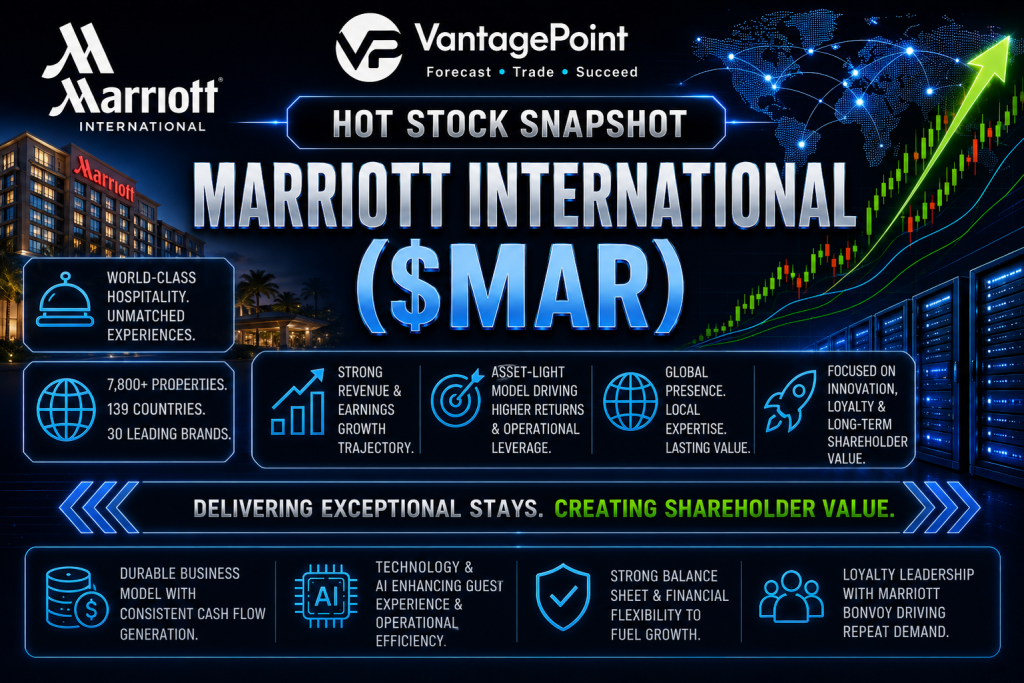
When most people think about Marriott International, they think about hotel rooms, vacations, business trips, and loyalty points. Wall Street sees something different. It sees one of the largest travel platforms in the world, a company that has spent nearly a century building a global network that now stretches across thousands of properties and dozens of brands.
Marriott traces its roots back to 1927 when J. Willard Marriott opened a small root beer stand in Washington, D.C. Nearly one hundred years later, the company operates an empire that includes brands such as Marriott Hotels, Ritz-Carlton, St. Regis, W Hotels, Sheraton, Westin, Courtyard, Fairfield, and many others. Its footprint spans more than 140 countries and territories.
What makes Marriott particularly interesting is that it is not primarily a real estate company. Many investors assume Marriott owns the hotels carrying its name. In reality, much of the company’s business revolves around managing and franchising hotels owned by other parties. Marriott collects fees for operating properties, licensing brands, and providing access to its enormous loyalty program. This approach allows the company to grow while requiring less capital than traditional hotel ownership.
The opportunity facing Marriott is straightforward. People continue to travel. Business travelers still need meetings, conferences, and events. Families continue to vacation. International tourism continues expanding. Emerging markets are creating millions of new travelers every year. As long as travel demand grows, Marriott benefits from increased bookings, higher room rates, and continued expansion of its global network.
The company’s loyalty program may be its greatest competitive advantage. Millions of travelers accumulate points and rewards through Marriott’s ecosystem. Once customers become accustomed to earning and redeeming points, they often remain within the network. This creates a powerful cycle that encourages repeat business and helps hotel owners choose Marriott brands when opening new properties.
But risks remain. Travel is closely connected to economic confidence. When consumers become nervous about spending, vacations can be postponed. When businesses reduce expenses, corporate travel budgets often shrink. Geopolitical events, health scares, recessions, and airline disruptions can all affect travel demand. Marriott cannot completely escape those realities.
Yet investors appear increasingly confident in the company’s ability to navigate those challenges. Marriott’s combination of global scale, strong brands, recurring fee revenue, and customer loyalty has positioned it as one of the dominant players in the travel industry.
Why Traders Should Care
Marriott is not merely participating in the travel recovery. It is outperforming the broader market by a substantial margin while continuing to generate record revenue. For traders searching for leadership stocks, that combination deserves attention.
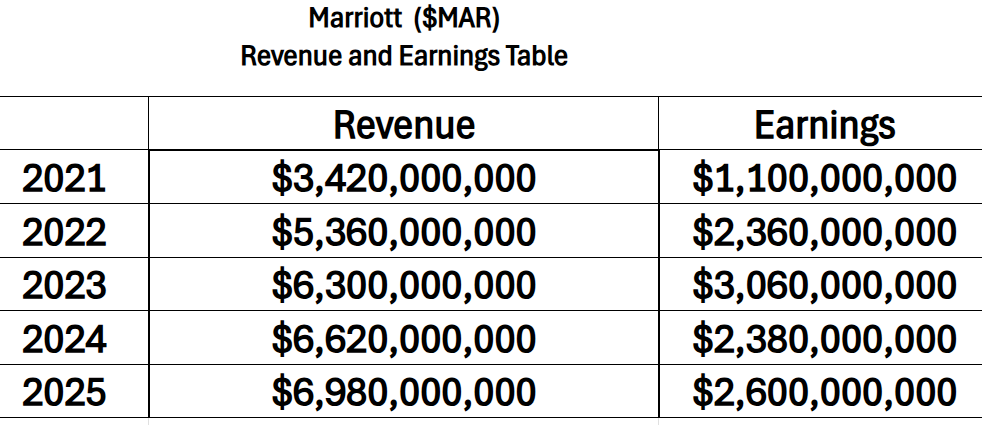
The numbers tell a very encouraging story for traders. Since 2021, Marriott has nearly doubled its revenue from $3.42 billion to $6.98 billion, while earnings have climbed from $1.1 billion to $2.6 billion. What is particularly impressive is that profits have remained strong even as the company continues to expand globally. There was a temporary earnings slowdown in 2024, but management quickly returned the business to growth in 2025. In simple terms, Marriott is not a company struggling to recover. It is a company producing record sales, generating substantial profits, and demonstrating that its hotel management and franchise model continues to scale efficiently. For traders, this financial performance helps explain why the stock has been acting like a market leader. Wall Street generally rewards companies that can consistently grow both revenue and earnings, and Marriott has been doing exactly that.
52 Week High and Low Boundaries
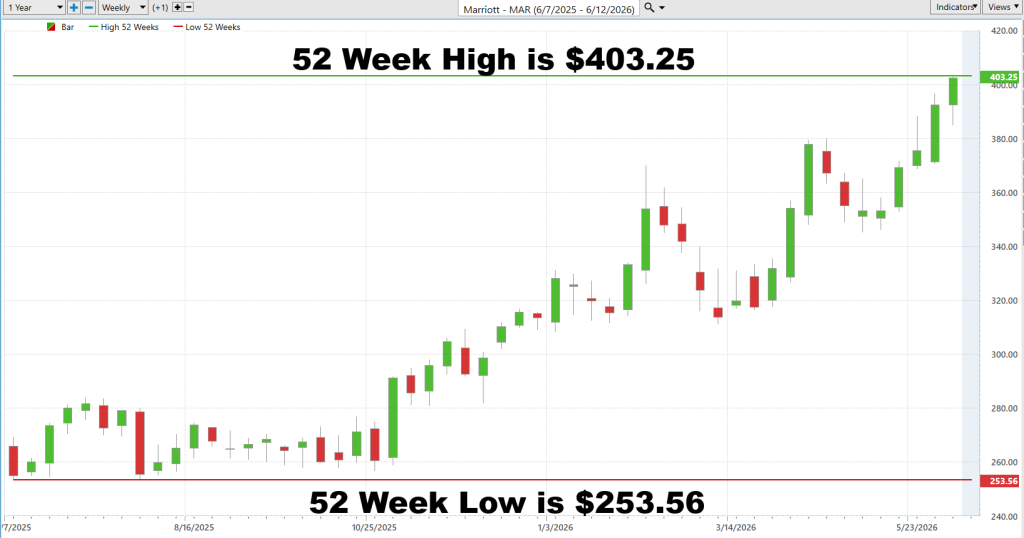
With a 52-week high of $403.25, a 52-week low of $253.56, and a recent close of $402.54, Marriott is trading less than **1% below its highest price of the past year and nearly *59% above its 52-week low*. That tells traders something important: this is not a stock fighting to recover from weakness, it is a stock operating in clear leadership territory. Investors who bought during the past year are overwhelmingly sitting on gains, which often reflects strong institutional confidence in both the company and its future prospects. The key takeaway is that Marriott is pressing against new highs rather than retreating from them, a sign that buyers remain firmly in control and that Wall Street continues to reward the company’s strong financial performance and growth outlook.
Best Case Scenario
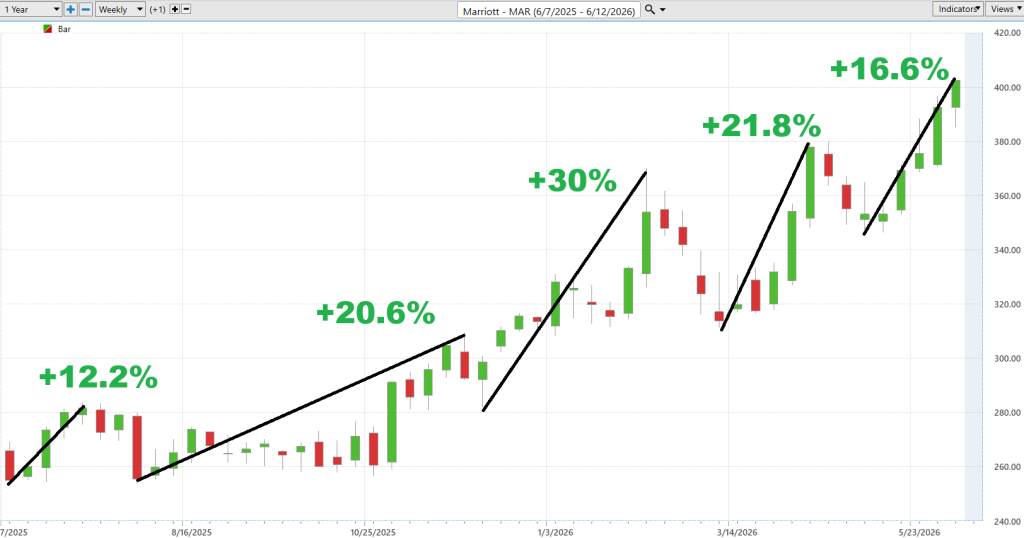
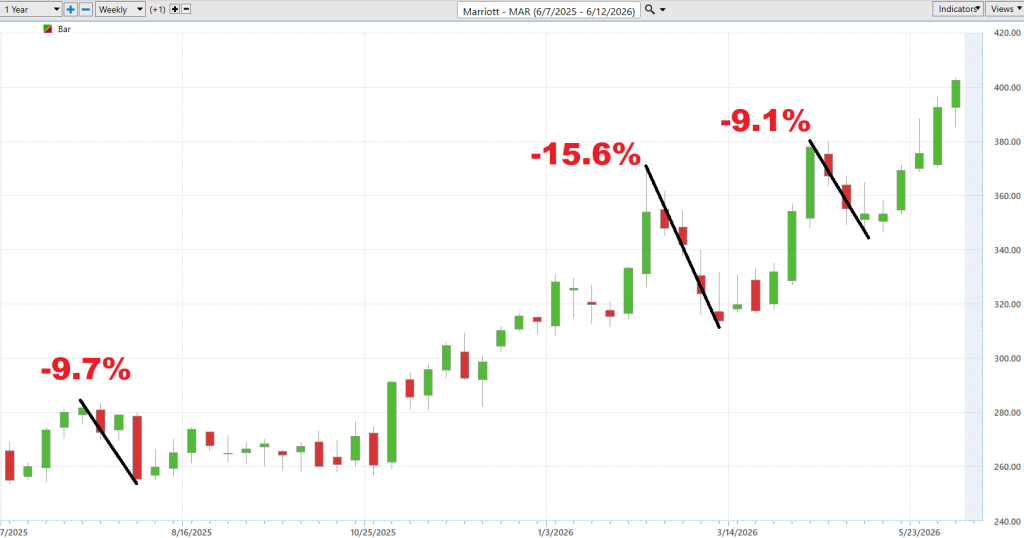
The bull case for Marriott is surprisingly simple. Over the past year, every meaningful pullback has eventually been followed by an even larger advance. The stock has produced rallies of roughly 12%, 21%, 30%, 22%, and 17%, a pattern that suggests investors continue viewing weakness as an opportunity rather than a warning sign. If global travel remains healthy, business travel continues recovering, and Marriott keeps expanding its network and loyalty ecosystem, Wall Street could continue rewarding the company with a premium valuation and push the stock into a new phase of price discovery above current highs.
Worst Case Scenario
The bear case is less about Marriott itself and more about the economic backdrop. Even within this powerful uptrend, the stock has experienced corrections of approximately 10%, 16%, and 9%. Those declines remind traders that travel-related companies remain sensitive to consumer confidence, corporate spending, and broader economic conditions. If travel demand softens, room rates come under pressure, or investors begin rotating away from economically sensitive stocks, Marriott could experience another meaningful correction even while the underlying business remains fundamentally healthy.
Risk Versus Reward
The most important takeaway is that Marriott’s winners have historically been larger than its losers. The average advance has significantly exceeded the average decline, which helps explain why the stock is sitting near a new 52-week high today. In Wall Street terms, this is what leadership looks like: a company delivering strong financial results, attracting institutional capital, and consistently recovering from setbacks. The risk is real, but the evidence suggests investors continue betting that Marriott’s next move will be another advance rather than a prolonged retreat.
VantagePoint AI Predictive Blue Line
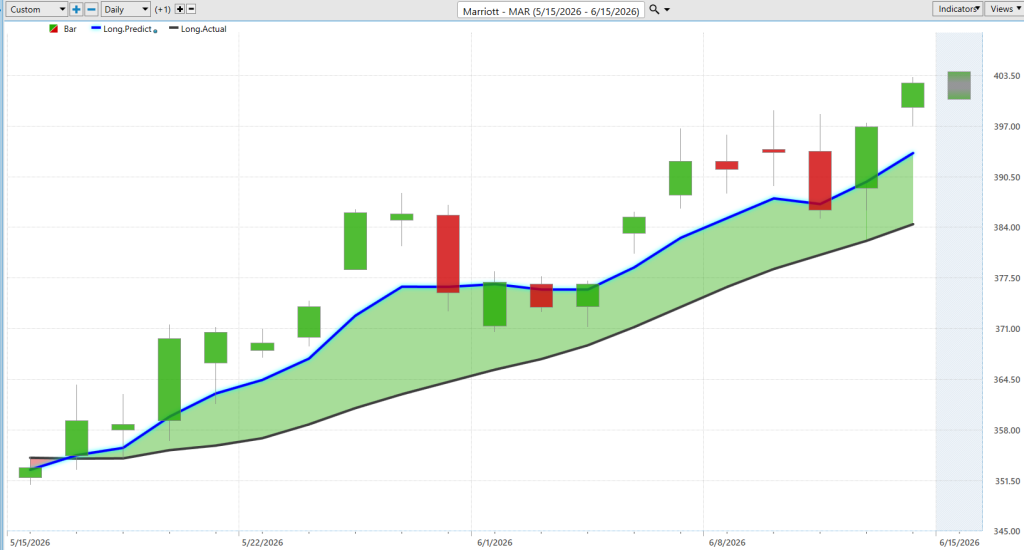
The Predictive Blue Line continues to paint a constructive picture for Marriott ($MAR). Over the past month, the forecasted trend has remained consistently above the actual trend line, and both lines are moving higher together, a sign that momentum continues building rather than fading. What stands out is the widening gap between the forecast and actual trend during Marriott’s recent advance toward new 52-week highs, suggesting the AI has been anticipating strength before it fully appeared in the stock’s price action. Equally important, the brief periods of consolidation did not cause the forecast to break down, indicating that underlying demand remained intact even when the stock paused. For traders, the essential takeaway is simple: the AI continues to track a healthy and strengthening uptrend, with no meaningful evidence yet that the dominant bullish trend is losing momentum.
VantagePoint AI Neural Index
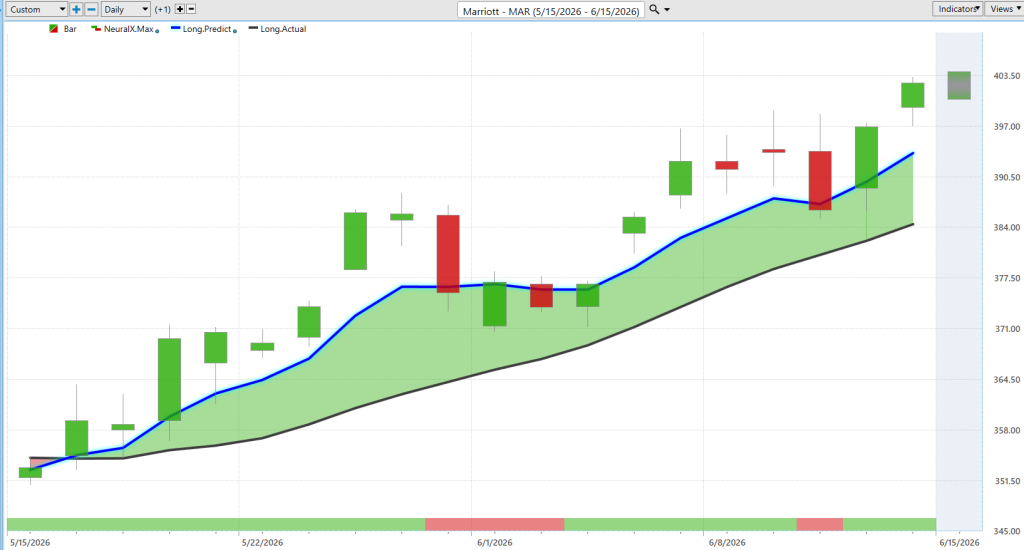
The Neural Index has been overwhelmingly constructive for Marriott ($MAR). While there were two brief periods where the indicator shifted to a cautious stance, those signals proved short-lived and were quickly followed by renewed strength in the stock. What matters most is that the overwhelming majority of recent readings have remained positive while Marriott advanced from the mid-$350s to new 52-week highs above $400. In practical terms, the AI is detecting continued buying pressure rather than widespread distribution. For traders, the message is straightforward: institutional demand appears to remain intact, confidence in the trend remains high, and there is currently little evidence that buyers are abandoning what has become one of the market’s stronger leadership stocks.
VantagePoint AI Daily Range Forecast
The Daily Range Forecast suggests that buyers remain firmly in control of Marriott’s short-term trend. Throughout the past three months, price has repeatedly respected the lower forecast boundary while gravitating toward the upper boundary, a pattern that typically reflects persistent demand. Even during brief pullbacks, the stock quickly regained momentum and continued making higher highs and higher lows. Most recently, Marriott has pushed to new 52-week highs near $403, indicating that traders remain willing to pay increasingly higher prices rather than waiting for significant pullbacks.
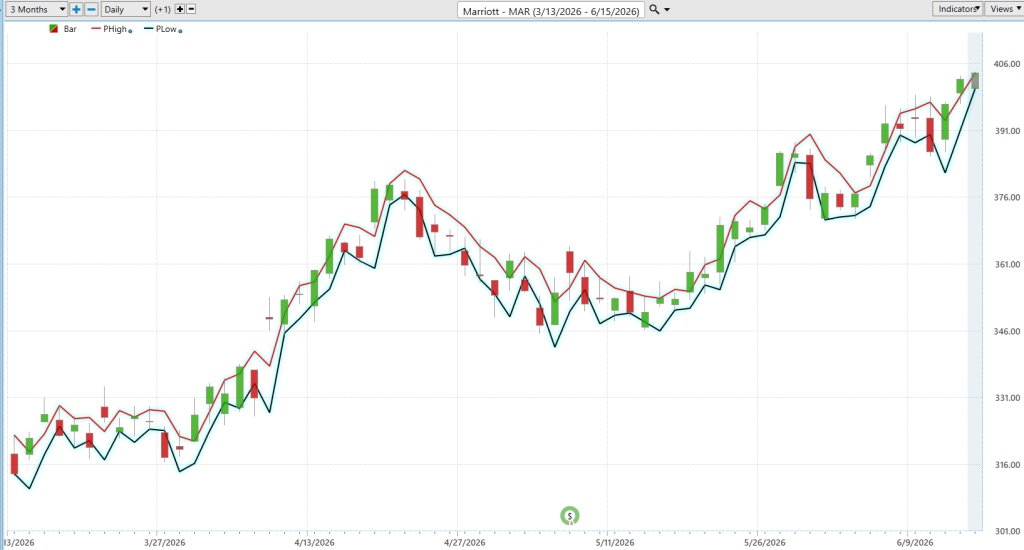
For traders, the key takeaway is that the forecast continues to point toward strength rather than exhaustion. The stock is trading near the upper end of its projected range, which signals confidence but also means expectations are elevated. As long as Marriott continues holding above the lower forecast boundary and the projected range keeps moving higher, the path of least resistance remains upward. The forecast currently suggests a market that is rewarding strength, not one preparing for a major reversal.
Our Suggestion
If you listen carefully to Marriott’s last two earnings calls, what emerges is not the story of a company struggling to find growth. It is the story of a company that is steadily executing against a very clear playbook. Management’s objectives are straightforward: expand the number of hotels carrying the Marriott flag, deepen customer loyalty through the Bonvoy ecosystem, and generate growing streams of fee income from a larger global footprint. By those measures, the company appears to be succeeding. Revenue continues to grow, earnings remain robust, and Marriott’s development pipeline has reached record levels. In Wall Street terms, this is a company that is advancing the ball down the field rather than defending its own goal line.
The more interesting question is whether the stock’s opportunity still outweighs its risks. Marriott today is not a hidden gem. Investors understand the company’s strengths and have rewarded the shares accordingly, pushing the stock to new highs. That creates a different challenge. Expectations become higher. Future gains require continued execution. The biggest threat is not operational mismanagement. It is a slowdown in global travel demand caused by economic weakness, geopolitical uncertainty, or pressure on consumer spending. In other words, Marriott’s risk profile is increasingly tied to the health of the broader economy rather than flaws within the company itself.
Yet the opportunities remain substantial. Marriott’s asset-light business model allows it to expand without bearing the full cost of owning hotels. Every new property added to the system creates another stream of recurring fees. At the same time, the Bonvoy loyalty program continues to strengthen customer engagement and encourage repeat business across Marriott’s vast portfolio of brands. International markets represent another major growth avenue. More than half of the company’s development pipeline sits outside North America, giving Marriott meaningful exposure to regions where travel demand is expected to grow for years to come.
For traders and investors, two catalysts stand above all others. The first is the conversion of Marriott’s enormous development pipeline into operating hotels that contribute new revenue and earnings. The second is the continued resilience of global travel demand. If both trends remain intact, Marriott could continue delivering the kind of steady growth that institutions reward. The bottom line is that management appears to be hitting its objectives, the company is moving forward rather than standing still, and the long-term opportunities remain compelling. The challenge is not whether Marriott can grow. The challenge is whether it can grow fast enough to exceed the already high expectations reflected in a stock trading near all-time highs.
Use the VantagePoint Daily Range Forecast to isolate short term trading opportunities.
Practice great money management on all of your trades.
Ready to learn more about forecasting stocks and options days before anyone else with up to 87.4% proven accuracy? Attend a FREE LIVE CLASS.
Let’s Be Careful Out There.
It’s not magic.
It’s machine learning.
THERE IS A SUBSTANTIAL RISK OF LOSS ASSOCIATED WITH TRADING. ONLY RISK CAPITAL SHOULD BE USED TO TRADE. TRADING STOCKS, FUTURES, OPTIONS, FOREX, AND ETFs IS NOT SUITABLE FOR EVERYONE.IMPORTANT NOTICE!
DISCLAIMER: STOCKS, FUTURES, OPTIONS, ETFs AND CURRENCY TRADING ALL HAVE LARGE POTENTIAL REWARDS, BUT THEY ALSO HAVE LARGE POTENTIAL RISK. YOU MUST BE AWARE OF THE RISKS AND BE WILLING TO ACCEPT THEM IN ORDER TO INVEST IN THESE MARKETS. DON’T TRADE WITH MONEY YOU CAN’T AFFORD TO LOSE. THIS ARTICLE AND WEBSITE IS NEITHER A SOLICITATION NOR AN OFFER TO BUY/SELL FUTURES, OPTIONS, STOCKS, OR CURRENCIES. NO REPRESENTATION IS BEING MADE THAT ANY ACCOUNT WILL OR IS LIKELY TO ACHIEVE PROFITS OR LOSSES SIMILAR TO THOSE DISCUSSED ON THIS ARTICLE OR WEBSITE. THE PAST PERFORMANCE OF ANY TRADING SYSTEM OR METHODOLOGY IS NOT NECESSARILY INDICATIVE OF FUTURE RESULTS. CFTC RULE 4.41 – HYPOTHETICAL OR SIMULATED PERFORMANCE RESULTS HAVE CERTAIN LIMITATIONS. UNLIKE AN ACTUAL PERFORMANCE RECORD, SIMULATED RESULTS DO NOT REPRESENT ACTUAL TRADING. ALSO, SINCE THE TRADES HAVE NOT BEEN EXECUTED, THE RESULTS MAY HAVE UNDER-OR-OVER COMPENSATED FOR THE IMPACT, IF ANY, OF CERTAIN MARKET FACTORS, SUCH AS LACK OF LIQUIDITY. SIMULATED TRADING PROGRAMS IN GENERAL ARE ALSO SUBJECT TO THE FACT THAT THEY ARE DESIGNED WITH THE BENEFIT OF HINDSIGHT. NO REPRESENTATION IS BEING MADE THAT ANY ACCOUNT WILL OR IS LIKELY TO ACHIEVE PROFIT OR LOSSES SIMILAR TO THOSE SHOWN.