

The purpose of this week’s article is simple: to drag traders back to reality at a time of year when reality is usually drowned out by forecasts, opinions, and wishful thinking. January is when everyone suddenly becomes a visionary. Targets get raised, themes get baptized, and narratives get promoted as if conviction itself were a strategy. But markets don’t reward conviction. They reward performance. And performance is the only honest record the market keeps. Everything else is commentary layered on top after the fact.
Take $NVDA as the cleanest possible example. When NVIDIA went public in 1999, it did so at roughly $12 a share, back when most people thought a GPU was either a typo or a brand of copier toner. Today, $NVDA sits at roughly a $5 trillion market capitalization, having risen not hundreds but tens of thousands of percent from its early days. That kind of move doesn’t come from clever storytelling or fashionable themes. It comes from relentless, persistent outperformance — month after month, year after year — long before the dinner-party crowd knew the name.
If you had ignored the opinions, ignored the doubts, ignored the “too expensive” arguments, and simply looked at performance every month over the past decade, $NVDA would have kept showing up at the top of the leaderboard. That’s the lesson traders cannot afford to forget. Today, NVIDIA is no longer obscure. It’s famous, scrutinized, and burdened with the job, fairly or unfairly, of symbolizing the entire A.I. industry. The narrative has changed completely. But the way it earned its place never did. Traders don’t get paid for spotting stories early. They get paid for recognizing leadership while it’s still being ignored and for respecting what performance is trying to tell them before everyone else starts explaining it.
Markets run on stories the way airports run on announcements — constant, authoritative, and mostly irrelevant to whether your flight is leaving. Every cycle has its mythology: the Fed, geopolitics, elections, debt, artificial intelligence, recession-that-is-or-isn’t-coming. These narratives feel causal. They give price movement a backstory. But in practice, markets do not wait for coherent explanations before moving. Price adjusts first. The story shows up later to explain why that adjustment was inevitable all along.
This is not a flaw in the system; it is the system. Markets aggregate action, not opinion. By the time a narrative feels “obvious,” the trade is usually mature.
The best traders don’t need to be right about the story, only right about the direction of price. And the best traders don’t get paid for understanding the story, they get paid for understanding the direction.
You don’t have to agree with the narrative, you simply have to observe who is winning and who is losing. Markets reward strength, not clever explanations. Winners tend to keep winning because capital continues to flow toward what is already working, long before the story feels comfortable or obvious.
The narrative cycle begins after the trend is already established. A sector starts outperforming, a stock breaks higher, and only then does the market develop a tidy explanation. Suddenly the move is “about” something. The explanation feels clean and inevitable, which is exactly why it is dangerous.
Institutions act before explanations exist. They respond to flows, constraints, and relative opportunity, not headlines. Explanation follows action because clients want clarity and markets want to feel logical. But logic is a post-trade luxury.
By the time a trade makes sense to everyone, the real money has already been made. Here’s the brutal truth, the moment a trade feels obvious is usually the moment the easy money is gone. When everyone finally agrees; when the headlines line up, the experts nod in unison, and your Uber driver brings it up unprompted — that’s crowding. And crowded trades don’t offer upside; they offer exits for the people who were early.
The real money is made in the uncomfortable phase, when the chart is improving but the story hasn’t caught up yet. When the trade still feels a little lonely. When you’re buying strength and the commentary says “too expensive,” or selling weakness while the narrative insists “this can’t go any lower.” Professionals operate there because they understand something amateurs don’t: markets don’t pay you for certainty, they charge you for it. By the time a trade makes sense to everyone, the risk has shifted to you, and the reward has already been booked by someone else.
Price is the final vote of all market participants, weighted by capital and updated continuously. It captures fear, greed, information, and error in one unforgiving number. Unlike narratives, price simply records what participants were willing to do.
Relative strength is where reality leaks out. When stocks outperform while commentary remains skeptical, capital is telling a different story than the headlines. Outperformers keep outperforming because money compounds toward success.
Markets reward alignment with strength, not being early with an opinion.
Macro headlines without price confirmation are commentary, not signals. If the news is dramatic and price is indifferent, the market has already voted. Ignoring that vote in favor of the narrative is a voluntary tax traders pay for emotional comfort.
Political commentary is even easier to discard. Markets do not trade ideology; they trade incentives. And one-day news spikes without follow-through are invitations to overreact, not opportunities to compound capital.
If price doesn’t confirm the idea, the idea doesn’t matter.
The most actionable information in markets is rarely exciting. Sector leadership relative to the S&P 500 shows where capital is concentrating, not where attention is loudest. Leadership persists because institutions move deliberately and slowly reallocate.
Let’s look at a current example. The performance grid below shows the performance of the S&P 500 across different time frames. Anything that is bolded means that it outperformed the benchmark, which is the S&P 500 Index. What immediately jumps out from this grid is how quickly the market begins to separate leadership from laggards once you stop listening to headlines and start looking at performance. Over the 1-month and 3-month time frames, strength is not evenly distributed — it’s concentrated. Health Care, Materials, Financials, and Industrials are quietly doing the heavy lifting, consistently beating the S&P 500 while other sectors struggle just to keep up. That’s the market telling you, in plain English, where capital is flowing, not where commentators think it should be flowing.
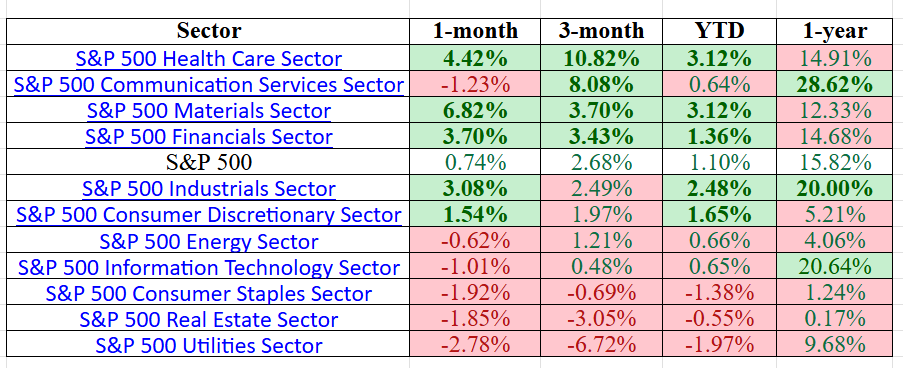
Now zoom out to year-to-date and 1-year performance, and the lesson becomes even clearer. Leadership compounds. Sectors like Industrials, Information Technology, and Communication Services don’t just outperform once, they keep showing up near the top over longer horizons. Meanwhile, traditionally “defensive” areas such as Utilities, Real Estate, and Consumer Staples lag across multiple time frames, despite plenty of macro narratives arguing they should be working. This is exactly why opinions are dangerous and performance is priceless. The market doesn’t care about comfort; it rewards results.
Pick one sector and dig into the leaders in that sector and you will understand how price moves first and narratives form afterwards to try and explain the move. Here’s where most traders blow it, because instead of zooming in, they keep zooming out. They stare at the whole market, the whole economy, the whole world, and end up paralyzed. The real edge comes when you pick one sector and dig in, because that’s where the truth leaks out first. Price moves quietly, deliberately, and without explanation. The narrative only shows up later to make everyone feel smart about missing it.
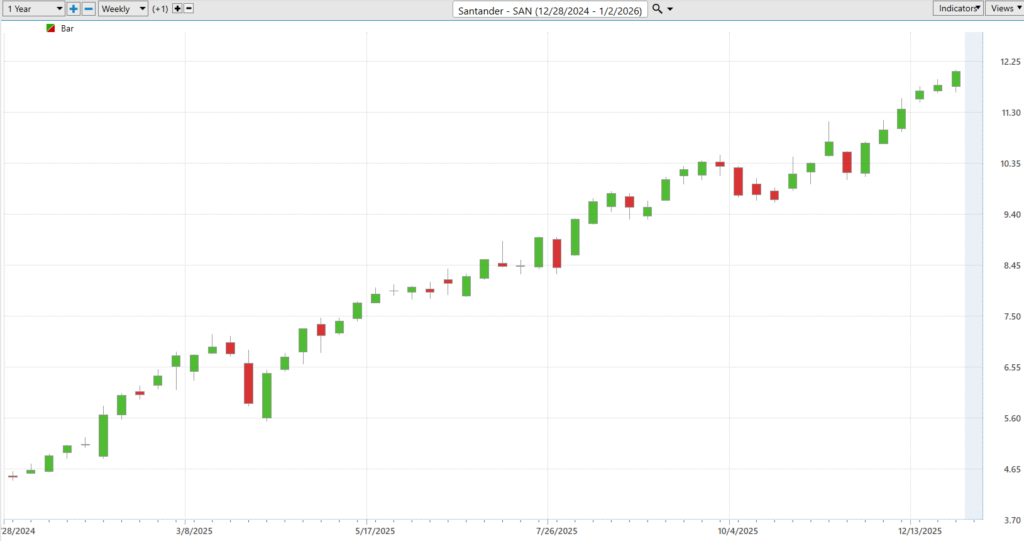
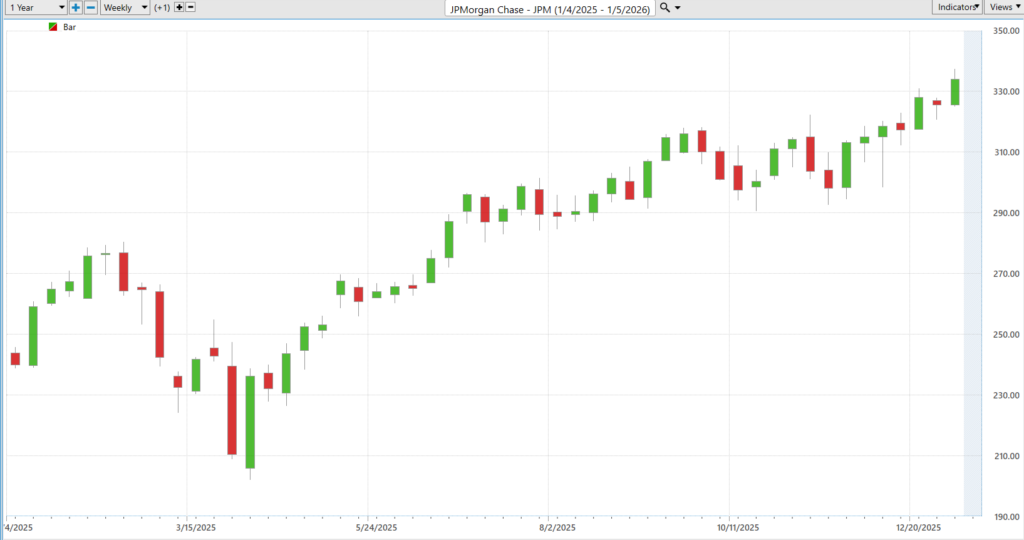
Take the Financials over the past three months. While the headlines were busy arguing about rate cuts, recessions, and whether banks were “safe,” stocks like $JPM, $GS, $C, and $SAN were already sprinting ahead — outperforming not just the sector, but the S&P 500 by four to seven times. That kind of move doesn’t come from hope or hype. Big money leaves footprints on the chart.
Here’s a chart of Santander ($SAN) which has been one of the strongest stocks in the financial sector all year.
Here is titan J.P. Morgan Chase and Co. Which follows the same powerful trend.
And here’s the punchline: once these moves became obvious, the explanations suddenly arrived. “Stronger balance sheets.” “Higher net interest margins.” “Improved capital positioning.” All true. All late. The market had already voted. This is the pattern traders must internalize if they want to get paid. Price leads. Performance confirms. Stories follow. A trader’s job isn’t to wait for permission from the narrative, it’s to recognize leadership early, align with it, and let everyone else argue about why after the money’s already been made.
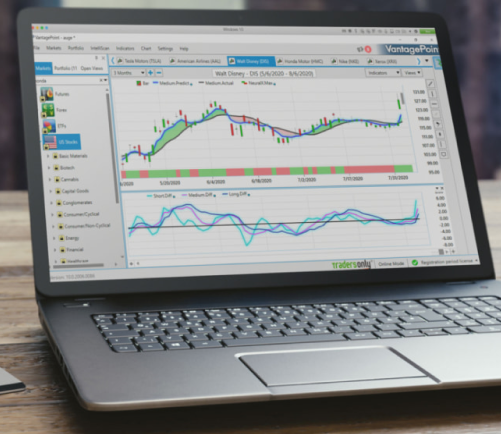
For traders, this grid is a reality check. It shows you who is winning right now, who has been winning consistently, and who continues to lose despite favorable stories. Trends don’t announce themselves with sirens; they reveal themselves through repeated outperformance. If you discipline yourself to forecast stocks and options trends with VantagePoint’s artificial intelligence and review a table like this regularly, you don’t need to guess where the next opportunity is forming.
Stocks making new highs while news remains negative reveal unresolved demand. Markets that refuse to fall after bad news demonstrate absorption. These are not mysteries, they are messages.
The market tells you what matters by what it refuses to do.
When stories dominate, discipline becomes the edge. Trends should define bias, not conviction. Bias adapts as price adapts. Conviction resists — and resistance is expensive in markets.
Stops matter most when emotions run highest. They convert uncertainty into defined risk. And when volatility is headline-driven, smaller size preserves clarity. Survival is strategic.
Narratives make markets sound intelligent.
Trends make traders money.
The difference is discipline.
Let’s bring this home with one undeniable truth: the speed of markets is accelerating, and human reaction time is not. Alvin Toffler warned decades ago that the future would arrive faster and faster, and nowhere is that more evident than in today’s markets. Price moves before explanations. Leadership rotates before headlines. Opportunities appear and disappear while most traders are still debating yesterday’s story. The gap between those who adapt and those who hesitate is widening, and it’s widening fast.
This is precisely why we’re inviting you to a FREE live online A.I. MasterClass where you can see VantagePoint’s artificial intelligence applied to trading in real time. Not theory. Not promises. Actual A.I. forecasting markets, identifying trends, and helping traders reduce emotional stress by replacing guesswork with probabilities. When decisions are grounded in data instead of fear or hope, clarity replaces anxiety, and consistency replaces chaos.
You can keep trading the old way, relying on instincts and opinions in a market that no longer waits for either…
Or you can step into the future and see VantagePoint in action, understand how it filters noise, identifies leadership, and supports better decision-making.
The future is already here and it’s moving quickly. Don’t be left behind.
It’s not magic.
It’s machine learning.
THERE IS A SUBSTANTIAL RISK OF LOSS ASSOCIATED WITH TRADING. ONLY RISK CAPITAL SHOULD BE USED TO TRADE. TRADING STOCKS, FUTURES, OPTIONS, FOREX, AND ETFs IS NOT SUITABLE FOR EVERYONE.IMPORTANT NOTICE!
DISCLAIMER: STOCKS, FUTURES, OPTIONS, ETFs AND CURRENCY TRADING ALL HAVE LARGE POTENTIAL REWARDS, BUT THEY ALSO HAVE LARGE POTENTIAL RISK. YOU MUST BE AWARE OF THE RISKS AND BE WILLING TO ACCEPT THEM IN ORDER TO INVEST IN THESE MARKETS. DON’T TRADE WITH MONEY YOU CAN’T AFFORD TO LOSE. THIS ARTICLE AND WEBSITE IS NEITHER A SOLICITATION NOR AN OFFER TO BUY/SELL FUTURES, OPTIONS, STOCKS, OR CURRENCIES. NO REPRESENTATION IS BEING MADE THAT ANY ACCOUNT WILL OR IS LIKELY TO ACHIEVE PROFITS OR LOSSES SIMILAR TO THOSE DISCUSSED ON THIS ARTICLE OR WEBSITE. THE PAST PERFORMANCE OF ANY TRADING SYSTEM OR METHODOLOGY IS NOT NECESSARILY INDICATIVE OF FUTURE RESULTS. CFTC RULE 4.41 – HYPOTHETICAL OR SIMULATED PERFORMANCE RESULTS HAVE CERTAIN LIMITATIONS. UNLIKE AN ACTUAL PERFORMANCE RECORD, SIMULATED RESULTS DO NOT REPRESENT ACTUAL TRADING. ALSO, SINCE THE TRADES HAVE NOT BEEN EXECUTED, THE RESULTS MAY HAVE UNDER-OR-OVER COMPENSATED FOR THE IMPACT, IF ANY, OF CERTAIN MARKET FACTORS, SUCH AS LACK OF LIQUIDITY. SIMULATED TRADING PROGRAMS IN GENERAL ARE ALSO SUBJECT TO THE FACT THAT THEY ARE DESIGNED WITH THE BENEFIT OF HINDSIGHT. NO REPRESENTATION IS BEING MADE THAT ANY ACCOUNT WILL OR IS LIKELY TO ACHIEVE PROFIT OR LOSSES SIMILAR TO THOSE SHOWN.