

In 2025, the stock market rewarded awareness. Traders who understood where money was flowing — and measured that movement against clear benchmarks — consistently outperformed those who relied on stories, instincts, or isolated wins. While headlines fixated on policy debates, rate forecasts, and political noise, the market itself was quietly delivering verdicts through relative performance. Sectors leading the major indexes signaled confidence; those lagging reflected pressure from tighter financial conditions and shifting economic priorities. The divide between winners and losers was not intelligence or effort, but whether participants bothered to ask a simple, essential question: compared to what?
Benchmarks provided the answer. Without them, even strong returns risked becoming optical illusions. A stock that rose 10% in 2025 could appear successful in isolation yet still represent a missed opportunity if its sector or the broader market advanced twice as much. The S&P 500 and major sector indexes served as the market’s scorecard, revealing where capital was truly being rewarded. Traders who anchored their decisions to relative performance gained an objective lens through which to assess strength, avoid laggards, and stay aligned with institutional behavior. Those who did not were left navigating the year without a map.
In 2025, the market had little patience for clever stories or chest-thumping predictions. It paid the bills only to those who bothered to look up from their opinions and notice what was happening. Traders who paid attention — to price, to leadership, to where money was clearly flowing — were rewarded. Those who didn’t were left explaining why they were “right” while their accounts said otherwise.
Bravado turned out to be expensive. Awareness, on the other hand, proved remarkably profitable. Knowing which sectors were gaining ground and which ones were quietly bleeding mattered far more than having a bold thesis. The market was handing out clues every day, but it didn’t bother to repeat them for anyone who wasn’t listening.
And 2025 made one thing unmistakably clear: markets don’t move in straight lines or fair proportions. They never have. Opportunity clusters, capital concentrates, and winners pull away from the pack. The idea that everything rises together is comforting, but it’s
fiction. In real markets, awareness is what lets you spot strength early, before the crowd notices, and long before the excuses start.
Benchmarks served as the market’s reality check in 2025, stripping away narrative and exposing results for what they were. Without a clear frame of reference, performance quickly became subjective, an exercise in storytelling rather than analysis. Gains, viewed in isolation, often felt impressive. Measured against the broader market, many of those same gains looked far less convincing.
This was where benchmarks mattered. The S&P 500, sector exchange-traded funds, and direct peer comparisons provided an objective scorecard, one that was difficult to argue with and impossible to spin. They clarified where capital was being rewarded and where it was not, offering a disciplined way to separate true leadership from temporary momentum.
The idea is straightforward, practical, and deliberately disciplined. Performance is measured against the S&P 500 — the market’s most widely accepted benchmark. Anything that underperforms it is set aside, without debate or justification. Attention, capital, and analysis are then concentrated on the smaller group of stocks that are demonstrably outperforming. The result is not complexity, but clarity: focus naturally aggregates around leadership, where momentum, confidence, and institutional capital are already aligned.
Here is what the year looked like. Anything bolded has outperformed the benchmark S&P 500 for that time frame.
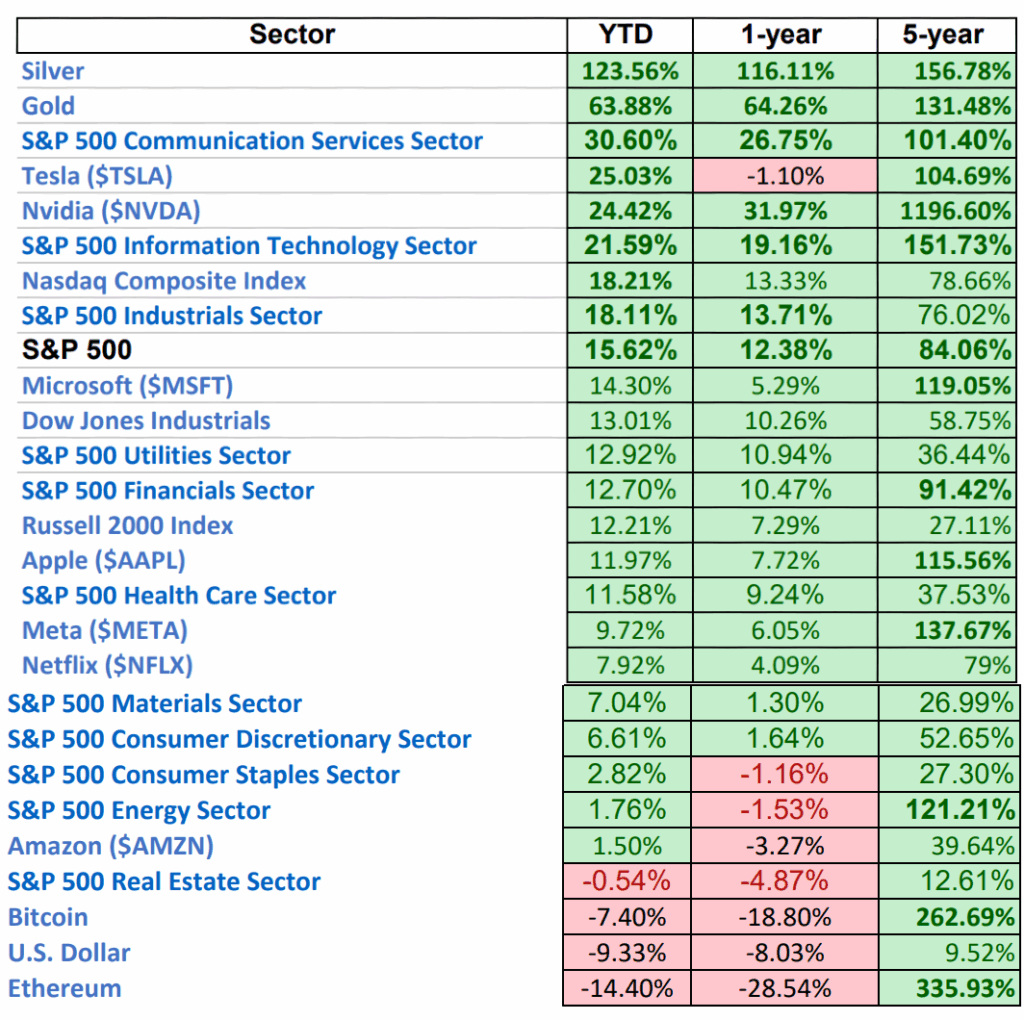
A perfect case study played out in precious metals, the asset class Wall Street loves to sneer at while quietly keeping a seat reserved at the table. Gold and Silver have long been dismissed as barbaric relics; souvenirs from a primitive era best left to survivalists and history books. And yet, all through 2025, they calmly ran circles around the broader stock market averages while the financial media mostly pretended not to notice. That silence held until October, when J.P. Morgan finally blessed the conversation by publicly promoting the debasement trade, at which point it suddenly became respectable for the nation’s largest banks to advise clients to adjust and optimize portfolios for persistent currency erosion. Funny how that works. The irony, of course, is that this wasn’t new information. With government debt compounding at an exponential rate, this trade has been staring investors in the face for years. We’ve been pointing to it for nearly six, and it remains the backbone of my macroeconomic thinking — not because it’s fashionable, but because the math never takes a day off.
For traders who ignored that scorecard, movement was frequently mistaken for progress. Prices changed, positions fluctuated, and activity felt productive. But without relative measurement, those signals lacked meaning. In a year defined by concentration and dispersion, benchmarks were not a technical detail, they were the difference between understanding the market and simply participating in it.
If you were looking for balance in 2025, you were in the wrong decade. The market did not resemble a rising tide lifting all boats. It looked more like a yacht club where a few vessels took off at full throttle while the rest bobbed politely at the dock, wondering what they’d done wrong. Capital did not spread itself evenly. It concentrated. Aggressively. And it left behind a paper trail that, for anyone paying attention, was impossible to ignore.
The performance table above reads less like a diversification brochure and more like a blunt performance review. Out of 11 S&P 500 sectors, only three managed to outperform the S&P 500 Index. That alone should give pause to anyone still clinging to the idea that “owning the market” is the same thing as beating it. The real story wasn’t hidden in obscure corners, it was written plainly in relative performance. Money flowed where returns justified conviction, and it quietly exited where returns did not.
Even the market’s most celebrated royalty, the so-called Magnificent Seven, failed to live up to their collective billing. Only three out of seven outperformed the S&P 500. The rest were fine companies, well-run, widely admired, and, by the market’s own cold arithmetic, mediocre investments for the year. In other words, brand recognition did not equal leadership, and popularity did not equal performance. The scoreboard didn’t care.
Meanwhile, outside traditional equities, the contrast grew sharper. Crypto assets delivered losses, the U.S. Dollar quietly declined, and dispersion widened across asset classes. These weren’t random outcomes. They were reflections of policy, liquidity, and investor preference made visible through price. Sector leadership didn’t just tell traders where money was, it told them what the market believed.
The lesson was not subtle. Stock picking without benchmarks and market selection was like arguing over which seat to take on a sinking ship. Traders who focused on sector strength saw institutional money already committed and moving with purpose. Those who didn’t were left explaining why their perfectly reasonable ideas underperformed an index they never bothered to benchmark against. In 2025, awareness of where strength lived was the whole game.
In 2025, the stocks that did the heavy lifting all had one thing in common: they weren’t just going up, they were going up faster than everything around them. They beat their sector, they beat the index, and they did it consistently. That’s not luck — that’s leadership. A stock doesn’t become a leader by accident; it earns the title by attracting capital while others struggle to keep attention.
These leadership names reflected something deeper than a good headline. They showed discipline in how capital was deployed, clarity in earnings, and a level of confidence that only shows up when big money is involved. Markets are brutally honest that way. When institutions believe, price confirms it. When they don’t, no amount of storytelling can hide the weakness.
Traders who paid attention to relative strength didn’t have to chase. They recognized leadership early, when trends were still forming and risk was defined. Those who ignored it usually arrived later, after the move was obvious, the easy money was gone, and the excuses were already lined up.
Markets, unlike politicians, vote every day and publish the results in real time. not debated by pundits. Awareness replaced prediction, and the market did the explaining.
A great many investors celebrated in 2025 and they shouldn’t have. They made money, yes, but they made less than the market, which is the financial equivalent of finishing a marathon behind a moving sidewalk and calling it a personal victory.
Without benchmarks, underperformance had an uncanny ability to hide in plain sight, often disguised as “prudence,” “long-term thinking,” or the ever-popular “at least I didn’t lose.” Awareness, inconvenient as it may be, forced a reckoning. It demanded comparison. Blindness, on the other hand, allowed complacency to flourish. And that was the real lesson: the gap between winners and losers wasn’t brilliance or luck, it was whether someone bothered to measure their results against reality. Study the performance of the Magnificent 7 in the performance grid above and we can all agree their performance was less than ‘magnificent.’
Awareness, despite what motivational posters might suggest, is not a gut feeling or a mystical gift bestowed upon traders who drink the right coffee. It is a discipline — learned the hard way — through comparison, observation, and the stubborn habit of checking the scoreboard. The best traders in 2025 didn’t treat the market like a bedtime story with heroes, villains, and satisfying plot twists. They treated it like a living, breathing system that adapts, mutates, and punishes laziness. When the evidence changed, they changed with it. Exposure was adjusted not because of conviction, comfort, or cocktail-party confidence, but because price said it was time. Benchmarking turned awareness from an emotional experience into a repeatable process, which is another way of saying it removed hope from the decision-making loop.
If 2025 taught anything worth remembering, it’s that markets reward decisiveness and punish nostalgia. Leadership must be recognized early, weakness abandoned promptly, and neither decision should require a committee meeting with one’s ego. Awareness remains the entry ticket to every other trading skill — risk management, timing, allocation — none of which work particularly well in the dark. We now live in a world drowning in information and starving for insight, which means the advantage goes to those who know what to ignore. Benchmarking is not a technical footnote or an academic exercise; it is the line between clarity and confusion, between trading with the market and merely watching it move.
Let’s review a point that is both simple and decisive. In 2025, only three sectors managed to outperform the S&P 500 Index: Information Technology, up 21%; Communication Services, up 30%; and Industrials, up 18%. Framed differently, eight of the eleven sectors failed to keep pace — meaning roughly 73% of the market lagged the benchmark. That concentration matters. It tells us that outperformance was not broadly distributed, but narrowly earned. Except for precious metals, the market’s strongest stocks were overwhelmingly found within these three sectors. For traders, the implication is clear: success in 2025 was less about finding isolated winners and more about being positioned where leadership was already established.
Within Information Technology, the concentration of leadership was even more striking when viewed at the stock level. A small group of names did the heavy lifting all year, and they did it in plain sight. Micron Technology (MU) rose 158%, driven by sustained demand and improving visibility. Western Digital (WDC) surged 255%, reflecting a decisive re-rating by the market. Palantir Technologies (PLTR) gained 135%, continuing to attract capital as confidence in its business model firmed. Broadcom (AVGO), more measured but no less important, advanced 40%, outperforming the broader market with consistency. These were not late-cycle surprises or short-lived trades. They outperformed steadily, month after month, offering any attentive trader repeated opportunities to participate. In 2025, leadership did not hide.
Within Communication Services, leadership kicked the door in and took over the room. AST SpaceMobile (ASTS) ripped higher by 203%, EchoStar (SATS) exploded 352%, Alphabet (GOOGL) delivered a solid, authority-level 56%, and AppLovin (APP) surged 102%. This wasn’t random noise or lucky timing. These stocks were broadcasting strength early and often, daring traders to pay attention. If you were waiting for confirmation, you got it — repeatedly. And if you ignored it, the market didn’t send a sympathy card.
Within Industrials, leadership was just as clear and just as loud. Caterpillar (CAT) powered ahead with a 58% gain, while GE Vernova (GEV) delivered a blistering 92% move—numbers that don’t whisper, they announce. Add to that most military contractors, many of which posted banner years, and the message was unmistakable: capital was flowing toward hard assets, infrastructure, and defense with conviction. This wasn’t a subtle rotation. It was strength putting its name on the scoreboard and daring traders to ignore it.
By the end of 2025, one fact was impossible to deny: traders who understood relative performance stayed tethered to reality. Those who didn’t benchmark their decisions wandered the market blindfolded, bumping into explanations instead of results. Awareness never promised perfection — markets are far too unruly for that — but it dramatically improved outcomes by keeping decisions anchored in evidence rather than hope. In markets, as in life, progress begins the moment you stop guessing where you stand and finally look down at the ground beneath your feet.
The uncomfortable truth every trader eventually confronts is this: it is no longer enough to be right. In a world defined by relentless currency debasement, expanding debt, and policy-driven distortion, capital must do more than grow — it must outrun erosion. Sitting still is falling behind. Choosing “good companies” is no longer a strategy; it’s a starting point. The real challenge is identifying which stocks are actually compounding faster than the value of money is being diluted and doing it before the move becomes obvious to everyone else.
This is where most traders break down. With hindsight, the fundamentals often make perfect sense. You can be 100% correct about the long-term forces shaping the economy — rates, liquidity, deficits, demographics — and still lose money if your timing is off. Markets don’t pay for being early, and they punish being late. In trading, timing isn’t a detail; it’s the difference between profit and frustration. The market moves first, explanations follow later.
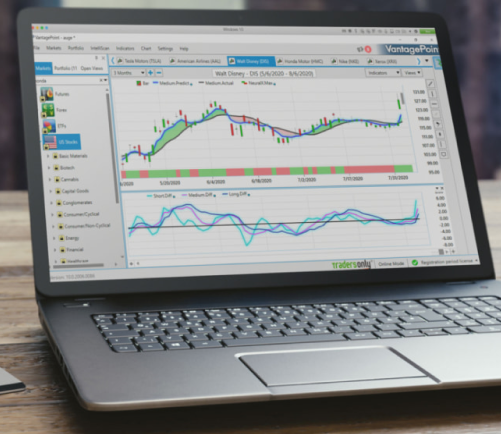
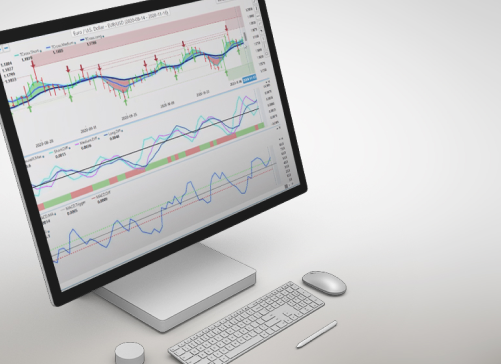
The objective of VantagePoint’s A.I. trading software is brutally simple: keep you on the right side of the right trend at the right time. Not by guessing. Not by hoping. But by predicting what the market will do and adjusting as conditions change.
A.I. doesn’t argue with price, doesn’t get emotionally attached to narratives, and doesn’t cling to yesterday’s winners. It identifies strength while it is still strengthening and signals weakness before it becomes obvious.
VantagePoint delivers something most traders have never consistently had: objectivity at scale. It filters thousands of markets, compares performance across sectors, measures trend strength, and updates its outlook continuously — doing in seconds what would take a human hours, if not days. It removes emotional bias, reduces overtrading, improves risk management, and — most importantly — keeps focus where opportunity is expanding, not where stories are most comforting.
If 2025 was the year awareness separated winners from losers, then 2026 will belong to those who systematize that awareness. The fastest way to see what this looks like in real time is to watch it work. That’s why you’re invited to attend a FREE live online masterclass, where you can see the A.I. in action — how it identifies leadership, manages risk, and keeps traders aligned with the strongest trends in the market. No theory. No hype. Just a clear demonstration of how to trade with VantagePoint in markets that no longer forgive guesswork.
Register to attend the Masterclass here.
It’s not magic.
It’s machine learning.
THERE IS A SUBSTANTIAL RISK OF LOSS ASSOCIATED WITH TRADING. ONLY RISK CAPITAL SHOULD BE USED TO TRADE. TRADING STOCKS, FUTURES, OPTIONS, FOREX, AND ETFs IS NOT SUITABLE FOR EVERYONE.IMPORTANT NOTICE!
DISCLAIMER: STOCKS, FUTURES, OPTIONS, ETFs AND CURRENCY TRADING ALL HAVE LARGE POTENTIAL REWARDS, BUT THEY ALSO HAVE LARGE POTENTIAL RISK. YOU MUST BE AWARE OF THE RISKS AND BE WILLING TO ACCEPT THEM IN ORDER TO INVEST IN THESE MARKETS. DON’T TRADE WITH MONEY YOU CAN’T AFFORD TO LOSE. THIS ARTICLE AND WEBSITE IS NEITHER A SOLICITATION NOR AN OFFER TO BUY/SELL FUTURES, OPTIONS, STOCKS, OR CURRENCIES. NO REPRESENTATION IS BEING MADE THAT ANY ACCOUNT WILL OR IS LIKELY TO ACHIEVE PROFITS OR LOSSES SIMILAR TO THOSE DISCUSSED ON THIS ARTICLE OR WEBSITE. THE PAST PERFORMANCE OF ANY TRADING SYSTEM OR METHODOLOGY IS NOT NECESSARILY INDICATIVE OF FUTURE RESULTS. CFTC RULE 4.41 – HYPOTHETICAL OR SIMULATED PERFORMANCE RESULTS HAVE CERTAIN LIMITATIONS. UNLIKE AN ACTUAL PERFORMANCE RECORD, SIMULATED RESULTS DO NOT REPRESENT ACTUAL TRADING. ALSO, SINCE THE TRADES HAVE NOT BEEN EXECUTED, THE RESULTS MAY HAVE UNDER-OR-OVER COMPENSATED FOR THE IMPACT, IF ANY, OF CERTAIN MARKET FACTORS, SUCH AS LACK OF LIQUIDITY. SIMULATED TRADING PROGRAMS IN GENERAL ARE ALSO SUBJECT TO THE FACT THAT THEY ARE DESIGNED WITH THE BENEFIT OF HINDSIGHT. NO REPRESENTATION IS BEING MADE THAT ANY ACCOUNT WILL OR IS LIKELY TO ACHIEVE PROFIT OR LOSSES SIMILAR TO THOSE SHOWN.