

I love talking with traders. Always have. Put two traders in the same room and within minutes you get charts on napkins, stories about “the one that got away,” and a few battle scars nobody admits still sting. The war stories are part of the culture. They are how we measure time in this business.
But there is one question I always ask that changes the mood fast.
What did you learn from that experience?
And that is when the pause shows up.
A long, quiet lag while the mind searches for something useful to say.
Because most traders remember the trade…
but far fewer can explain the lesson.
Everyone has that trade. The one that still pops into your head uninvited, usually while brushing your teeth or staring at a perfectly innocent chart that did nothing wrong. It was not a lack of information. The data was there, waving its arms like a person on fire. The problem was that you had an opinion, and once a trader has an opinion, reality becomes a hostile witness.
You did not lose money because the market surprised you. You lost money because you argued with it. You explained. You justified. You doubled down. The trade stopped being a position and turned into a personality trait. At that point, selling would have felt less like risk management and more like an attack on your character.
That is the part nobody puts in the trading books. Opinions feel free. They arrive fully formed, require no margin, and flatter the ego. But they are never cheap. The market has a very efficient billing system, and it charges interest on every moment you spend being stubborn.
Many politicians and monetary authorities tend to despise the markets. Not because markets are immoral or unfair, but because they are uncontrollable, uncooperative, and brutally honest.
Markets refuse to salute titles. They do not care about speeches, intentions, or five-year plans. They expose bad policy in real time. When prices move against official narratives, it feels personal. So, the opinion forms naturally: markets are the problem. From there comes the urge to manage them, guide them, smooth them, suspend them, or “fix” them. And every attempt to control a market produces the same result. More distortion, less information, and eventually a bigger mess that cannot be ignored.
That mindset leaks straight into trading.
An opinion feels like shelter. It gives your brain a chair to sit in. Once you decide what should happen, uncertainty quiets down. You stop thinking and start believing. Belief is comfortable. Belief does not require adjustment.
Markets are the opposite. They do not care what should happen. They care about what is happening. And what is happening can change without permission.
Here is the line that separates traders who survive from traders who explain losses:
Certainty is emotional. Evidence is mechanical.
Emotion wants reassurance. Evidence wants obedience. The trader who insists on certainty ends up negotiating with price. The trader who follows evidence simply responds.
Here is how it usually starts. A thought becomes a position. A position becomes an opinion. And once that happens, the chart stops being information and starts being a debate.
When you form an opinion, your brain immediately goes to work protecting it. Every green candle is proof you were right. Every red candle is “noise.” Bad price action is not a warning anymore; it is an inconvenience. Instead of respecting what the market is doing, you explain to yourself why it is temporarily wrong.
This is where traders get stuck without realizing it. The price you first bought becomes a mental reference point. Everything is measured against that one moment. You are no longer trading what is happening now. You are defending a past decision.
That is how a small loss quietly turns into a “long-term conviction.” Not because the opportunity improved, but because admitting you are wrong feels worse than losing a little more money. The market does not trap traders. Traders anchor themselves and call it patience.
Think of stubbornness as a financing arrangement you never intended to enter. The moment a trade moves against you and you refuse to adjust; you have effectively borrowed from the market. Not in cash, but in time, attention, and optionality. The rate is variable. The terms are not disclosed. And the lender is unforgiving.
The market charges interest the longer you stay wrong. At first, the cost seems manageable. A little drawdown here. A little patience there. But the balance does not sit still. It compounds.
Time is the first expense. Capital tied up in a losing position cannot be deployed elsewhere. Opportunity cost follows immediately. While you are waiting for one idea to redeem itself, other trades are moving without you. Then comes emotional capital, the least visible but most expensive line item. Doubt creeps in. Decision-making slows. Risk tolerance distorts.
By the time the lesson becomes obvious, it is rarely cheap. A small loss taken early is a controlled expense. A big loss later is tuition, paid with interest, for refusing to change your mind.
Markets run on a continuous, unsentimental voting process. Every second, capital expresses a preference. Not through speeches or forecasts, but through transactions. Price is the tally. It is the only opinion that carries weight.
That price incorporates every view in the system, including the ones you find misguided, irrational, or outright wrong. Optimists, pessimists, insiders, outsiders, algorithms, institutions, and individuals all meet at the same clearing point. Their disagreements are resolved not by debate, but by execution.
When price and personal opinion diverge, the outcome is not ambiguous. Price prevails. It does not negotiate. It does not wait for validation. It simply moves on, leaving dissenters to reconcile the difference on their own time.
The practical rule that follows is straightforward. Argue with people. Question narratives. Challenge assumptions. But when it comes to charts, listen. They are not trying to persuade you. They are reporting the results.
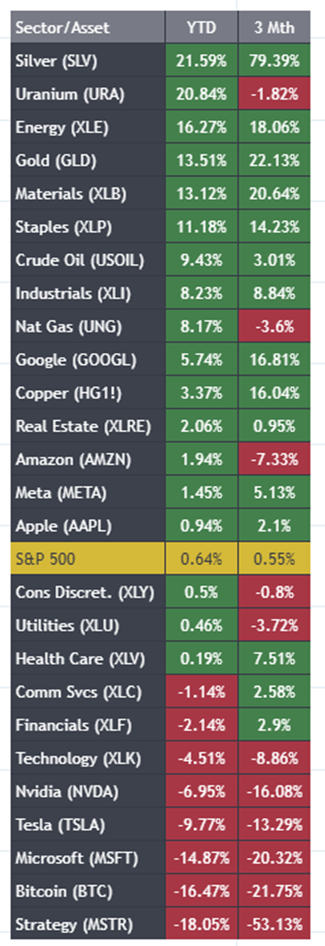
There is a strong temptation, when confronted with a tidy performance grid like this one, to immediately begin composing a sweeping macroeconomic novel starring central bankers, geopolitical intrigue, and a cameo appearance by whatever crisis is fashionable this quarter. Resist that urge. This table is not a prophecy, a theory, or a graduate seminar in global finance. It is a scoreboard. It measures two plain, stubborn facts: what has happened over the last three months and what has happened year to date. Nothing more ambitious than that. When those two time frames point in the same direction, whether up or down, the trend is doing its job for bulls or bears. When they disagree, the market is arguing with itself, which can still be traded, but usually with the statistical elegance of juggling chainsaws.
The deeper mistake is not misunderstanding the numbers. It is forgetting what they are for. Traders love to wrap performance data in elaborate economic storytelling, partly because storytelling makes us feel intelligent and partly because it gives us someone to blame. But the market rewards awareness. Our real edge is the simple discipline of noticing what is winning and what is losing without adding poetry, politics, or personal opinion. That quiet awareness is how we discover where money is being made, which, in a profession (or hobby) devoted to making money, seems like a detail worth keeping in mind.
While traders debate, defend, and deliver closing arguments on positions that are clearly not working, capital is doing something far less emotional and far more important. It is leaving. Quietly, efficiently, and without asking permission, money migrates toward strength, persistence, and alignment across time frames. The market does not wait for your thesis to recover or your pride to negotiate a better exit. It simply reallocates to what is moving now. The only useful question is not why a losing trade should come back, but where money is going right now while you argue with losers.
Smart traders lose money all the time. In fact, they may lose it more elegantly than anyone else. They lose with charts, footnotes, spreadsheets, and a very convincing explanation for why the market is temporarily wrong and will soon come to its senses.
Intelligence is a marvelous tool for many things. Trading is not always one of them. A smart person can justify almost any bad decision if given enough data and a quiet room. More information does not necessarily lead to better judgment. Often it just provides additional furniture to hide behind while the loss grows larger.
This is why being smart is not the edge. The market is not impressed by IQ. It does not grade on a curve. It does not award partial credit for effort or insight. It rewards only one thing: the ability to change when the facts change.
Flexibility beats brilliance. Every time.
Opinion-based trading starts with a story. The story creates hope. Hope demands patience. And when the trade goes bad, the story expands. New explanations appear. The position is defended. The loss is managed emotionally instead of financially.
Evidence-based trading works in the opposite direction. It starts with the trend. The trend either confirms or it does not. If it confirms, you act. If it does not, you step aside. No drama. No loyalty. No need to be right.
This is the part that trips people up. Evidence traders change their mind fast. Not because they are weak, but because they want to survive. Changing your mind is not failure. Staying wrong is.
VantagePoint’s patented artificial intelligence enters the trading process without a point of view. It has no thesis to defend, no narrative to protect, and no emotional investment in the outcome. It does not care why a trade should work. It forecasts what is working.
What it predicts is straightforward but consequential. Trend, relative strength, momentum, and timing. These are not opinions. They are conditions. There is no persuasion involved, only assessment.
One of the most expensive misunderstandings in trading lives in two small words: is and should.
Should is where opinions live. It is where narratives, valuations, and personal beliefs set up camp. A stock should bounce here. A sector should rotate by now. The market should react differently to this news. Should feels intelligent. It sounds reasonable. It also has no enforcement power.
Is is different. Is is observable. It does not argue. It does not explain. It simply reports. Price is up or it is down. Strength is improving or it is fading. Momentum is accelerating or it is not. Is exists whether you agree with it or not.
Most traders get trapped because they fall in love with should. They build positions around expectations instead of behavior. When the market refuses to cooperate, they wait, explain, and defend. They treat the market like a courtroom where logic eventually wins.
Great traders operate in is. They do not need to be convinced. They observe, align, and act. When is changes, they change with it. No speeches. No apologies. No emotional cleanup required.
The market does not reward fairness or foresight. It rewards alignment with reality. And reality always lives in is, never in should.
Most people think trading is about finding the perfect entry or mastering the clean exit. Those things matter, but they are not the hard part. The hard part is much quieter and far less glamorous.
The hardest skill in trading is letting go of being right.
Being right feels good. It feels earned. It feels like proof that you know what you are doing. But the market does not pay for correctness. It pays for alignment. Alignment with trend. Alignment with strength. Alignment with what is happening, not what you argued should happen last week.
Every profitable trader eventually learns this lesson. The moment the trade stops working, the job is not to defend it. The job is to release it. No drama. No identity crisis. Just a clean decision and a clear mind.
Validation feeds the ego. Alignment feeds the account.
At the end of the day, the market is not interested in who you are, what you believe, or how smart your argument sounds. It is not a debate. There are no judges, no closing statements, and no appeals.
It is a scoreboard.
Every day the numbers update. Wins, losses, and trends are posted in plain sight. You either line up with them or you do not. The market does not care how emotionally invested you are in a position. Attachment does not reduce risk. It multiplies it.
The fastest way to lower risk is to lower attachment. Trade the market in front of you, not the identity you are trying to protect.
The market does not punish opinions. It charges interest on them.
If you ever get the chance to talk with a seasoned floor trader, take it. Not for the market insight, though there is plenty of that, but for the humor. These are people who have watched thousands of human dramas unfold in real time, complete with heroes, villains, plot twists, and the occasional financial tragedy performed without rehearsal. After enough years on an exchange floor, you either develop a sharp sense of humor or a nervous condition. Successful floor traders choose humor.
Many years ago I spoke with a few of these veterans who told me, with perfectly straight faces, that the quickest way to ruin a great trader is to teach him how to read and write. At first glance this sounds insulting, anti-intellectual, and possibly grounds for a strongly worded letter to someone important. But what they meant was simpler and far more dangerous. The more words you have, the easier it is to explain why reality should behave differently than it does. Literacy becomes a tool for arguing with price, and price, being illiterate, refuses to participate.
Great trading, as it turns out, is about embracing what is working and releasing what is not. Including dogma. Including the fixed ideas. Including the very clever explanation you wrote for why the trade should have worked. The market does not grade essays. It keeps score.
Here is the quiet truth most traders discover too late. The market does not reward effort, intelligence, or conviction. It rewards alignment with what is happening. And in a world moving faster every year, the greatest advantage is not having stronger opinions. It is having clearer evidence, delivered sooner, without emotional distortion.
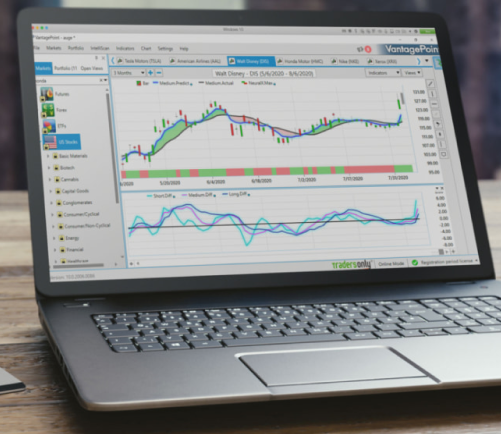
This is where VantagePoint’s artificial intelligence changes the game. VantagePoint’s A.I. does not argue with price. It does not cling to yesterday’s narrative or defend a losing idea out of pride. It processes trend, relative strength, momentum, and timing with disciplined consistency, revealing where opportunity is strengthening and where risk is quietly expanding. Instead of guessing, you are measuring. Instead of hoping, you are acting with informed clarity.
The practical benefit is profound. Decisions become calmer. Losses become smaller. Winning trades are held with greater confidence because they are supported by objective signals, not fragile belief. Over time, this shift from opinion to evidence is what separates random outcomes from repeatable performance. Not magic. Not prediction. Just disciplined alignment with reality, reinforced every single day.
If you would like to see how this works in real time, you are invited to attend a Learn How To Trade with VantagePoint A.I. Live Online Masterclass. During this session you will watch the technology forecast trends, filter noise, and highlight high-probability opportunities before they become obvious to the crowd. It is a clear, practical look at how trading with VantagePoint’s A.I. can help you protect capital, act with confidence, and stay on the right side of the market where the real money is made.
It’s not magic.
It’s machine learning.
THERE IS A SUBSTANTIAL RISK OF LOSS ASSOCIATED WITH TRADING. ONLY RISK CAPITAL SHOULD BE USED TO TRADE. TRADING STOCKS, FUTURES, OPTIONS, FOREX, AND ETFs IS NOT SUITABLE FOR EVERYONE.IMPORTANT NOTICE!
DISCLAIMER: STOCKS, FUTURES, OPTIONS, ETFs AND CURRENCY TRADING ALL HAVE LARGE POTENTIAL REWARDS, BUT THEY ALSO HAVE LARGE POTENTIAL RISK. YOU MUST BE AWARE OF THE RISKS AND BE WILLING TO ACCEPT THEM IN ORDER TO INVEST IN THESE MARKETS. DON’T TRADE WITH MONEY YOU CAN’T AFFORD TO LOSE. THIS ARTICLE AND WEBSITE IS NEITHER A SOLICITATION NOR AN OFFER TO BUY/SELL FUTURES, OPTIONS, STOCKS, OR CURRENCIES. NO REPRESENTATION IS BEING MADE THAT ANY ACCOUNT WILL OR IS LIKELY TO ACHIEVE PROFITS OR LOSSES SIMILAR TO THOSE DISCUSSED ON THIS ARTICLE OR WEBSITE. THE PAST PERFORMANCE OF ANY TRADING SYSTEM OR METHODOLOGY IS NOT NECESSARILY INDICATIVE OF FUTURE RESULTS. CFTC RULE 4.41 – HYPOTHETICAL OR SIMULATED PERFORMANCE RESULTS HAVE CERTAIN LIMITATIONS. UNLIKE AN ACTUAL PERFORMANCE RECORD, SIMULATED RESULTS DO NOT REPRESENT ACTUAL TRADING. ALSO, SINCE THE TRADES HAVE NOT BEEN EXECUTED, THE RESULTS MAY HAVE UNDER-OR-OVER COMPENSATED FOR THE IMPACT, IF ANY, OF CERTAIN MARKET FACTORS, SUCH AS LACK OF LIQUIDITY. SIMULATED TRADING PROGRAMS IN GENERAL ARE ALSO SUBJECT TO THE FACT THAT THEY ARE DESIGNED WITH THE BENEFIT OF HINDSIGHT. NO REPRESENTATION IS BEING MADE THAT ANY ACCOUNT WILL OR IS LIKELY TO ACHIEVE PROFIT OR LOSSES SIMILAR TO THOSE SHOWN.