





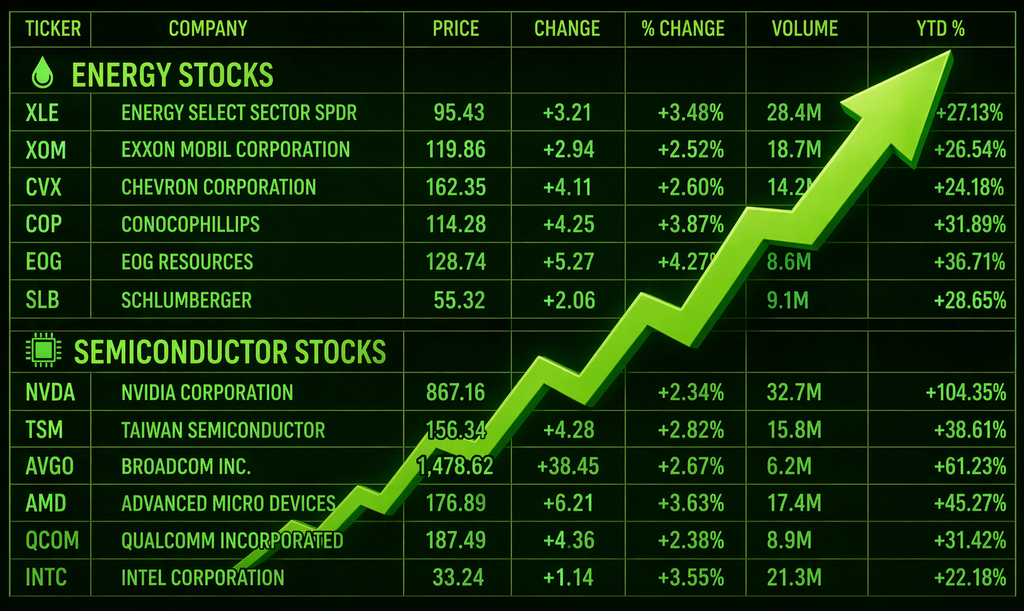
One of the great ironies of trading is this: traders spend their days staring at screens… and still manage to miss what’s sitting right in front of them. Observing the patently obvious turns out to be harder than it sounds, especially when the obvious isn’t exciting enough to tweet about.
War dominates headlines. Fear dominates sentiment. Cable news treats it like the end of civilization, and traders treat it like a riddle wrapped in a mystery inside a margin call. But neither one pays. What pays traders is where the money goes. And since the Iran conflict began, it didn’t scatter in panic. It marched, quite sensibly, into energy, logistics, semiconductors, and chemicals.
Markets reward clarity. The biggest trends rarely hide. They sit in plain sight, quietly compounding, while the crowd chases noise and overthinks every move. When something is obvious, it’s often dismissed as too easy, and that’s precisely why it works. The discipline is not in finding something new. It’s in acting on what everyone can see, but few have the conviction to follow.
One of the most revealing yet underutilized questions in financial markets is also the simplest: who is winning, and who is losing? It is the closest thing traders have to a real-time truth detector. And yet, in practice, many market participants drift toward narratives, valuation arguments, or macro forecasts that feel intellectually satisfying but are often disconnected from actual price performance. The market, by contrast, offers a continuous scoreboard. It does not editorialize. It does not explain itself. It simply reflects where capital is flowing and where it is not.
This creates a persistent disconnect. While leadership trends emerge clearly across sectors and asset classes, many traders remain anchored to stories they believe should play out rather than evidence that already has. The result is a kind of cognitive lag, where portfolios are positioned for a future that has not arrived, while ignoring a present that is unfolding in plain sight. The irony is that the market rarely hides its intentions. Strong trends tend to persist, often longer than expected, precisely because institutional capital moves deliberately and at scale.
Reframing the problem through the lens of winners and losers changes the exercise entirely. Instead of asking what should happen, the focus shifts to what is happening. Which sectors are consistently outperforming? Which assets are being quietly abandoned? This scoreboard approach strips away interpretation and replaces it with observation. And in doing so, it offers something far more actionable than narrative: a clear signal of where opportunity resides and where risk is quietly building.
Paul Tudor Jones put it best: traders want to know which horse is the fastest. And once the first move in energy was obvious, the fastest horse didn’t stay in the same lane. It moved. The market began pricing something deeper than higher oil prices. It began pricing disruption. That is when the second wave emerged. Capital rotated with precision into shipping and tanker firms as freight rates surged, into insurers as war-risk premiums expanded, and into chemical companies that suddenly held a cost advantage over global competitors. These were not random moves. They were the market’s logical response to a changing environment.
Most traders miss this phase entirely. They are still debating oil while the market has already moved on to the consequences of oil. The fastest horse is no longer the obvious one. It is the one benefiting from the ripple effects. Shipping routes tighten, insurance costs rise, input costs shift, and entire industries reprice. This is where the real edge lives. Not in chasing the first move, but in recognizing what that move sets in motion.
So, the discipline is clear. Do not stop at the headline. Follow the chain reaction. Identify where the next pocket of strength is forming. Because the market rewards those who can track momentum as it evolves. And in every cycle, the biggest opportunities often come from these second-order winners that quietly take the lead while everyone else is still watching yesterday’s race.
When you focus on a ‘scoreboard,’ everything gets simpler. Not easy. But simple. You stop arguing with narratives and start measuring what’s working, what’s not, and how powerful those moves really are. Because here’s the truth. No matter how disciplined you think you are, as humans we’re wired for stories. We want explanations. We want cause and effect neatly packaged. And the market knows that. It feeds that addiction every single day. But price doesn’t care about your story. It only reflects where money is going. And if you train yourself to watch that scoreboard, you begin to filter out the noise automatically.
Let me give you a real example from this year. By late January and early February, it was becoming obvious that tensions in the Middle East were escalating. You didn’t need a headline to confirm it. You could see it in crude oil moving higher. And more importantly, you could see it in the leadership. For six straight months, five sectors were consistently beating the S&P 500 Index. Energy was leading. Materials were right behind it. Consumer Staples, Industrials and utilities were holding strong. Meanwhile, I’d have financial media running in the background, and they’d say higher oil prices were bad for stocks. And yes, you can make that argument. Higher oil means inflation. Higher costs. Pressure on margins. Sounds logical.
But here’s the problem. You can make the exact opposite argument just as easily. Higher oil drives inflation. Inflation pressures central banks. If interest rates go higher, it bankrupts the government and the economy. Rates eventually come down. Liquidity comes back into the system. You can build a smart, convincing case in either direction. And that’s the trap. Because in this business, you don’t get paid for sounding smart. You get paid for being aligned with what price “IS” doing. And when the conflict began, the scoreboard told a very different story. Precious metals sold off. Treasuries dipped, then stabilized. And as oil pushed higher, the second-order effects showed up exactly where you’d expect if you were watching closely. Energy names surged. Refiners strengthened. Shipping, Insurers and materials, especially chemicals, started to move.
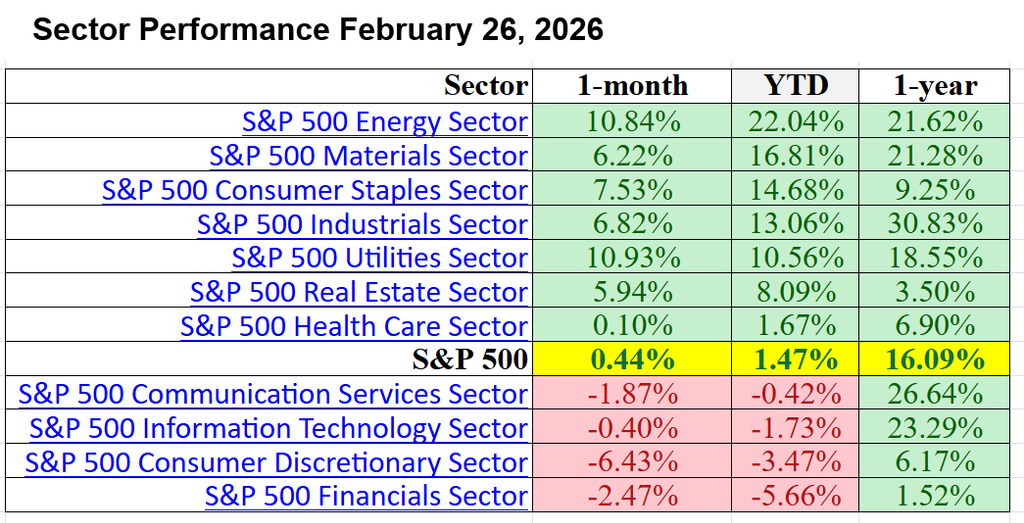
Energy isn’t just leading, it’s lapping the field like Secretariat on a good day, while the rest of the market is somewhere between jogging and looking for a chair. And yet, the financial media will spend the next 24 hours trying to explain this with a dozen competing storylines, each one more dramatic than the last, as if the market were a soap opera instead of a scoreboard. But as a trader, your job is not to be entertained. This graphic makes it painfully obvious who to avoid and, more importantly, where the money is flowing. From there, the real work begins. You dig into the winners. You ask which names are driving the move, big cap, mid cap, or small cap. You figure out which parts of the sector are outperforming the ETF itself. It may sound tedious, but it beats chasing whatever story is trending today. Because this is how you build a narrative grounded in evidence, not in whatever the media needed to fill airtime between commercials.
Here are charts of Chevron and Exxon which illustrate the powerful trends which has unfolded in the Energy Sector and how VantagePoint AI navigates the volatility and predicts winners before they even show up on scoreboards:
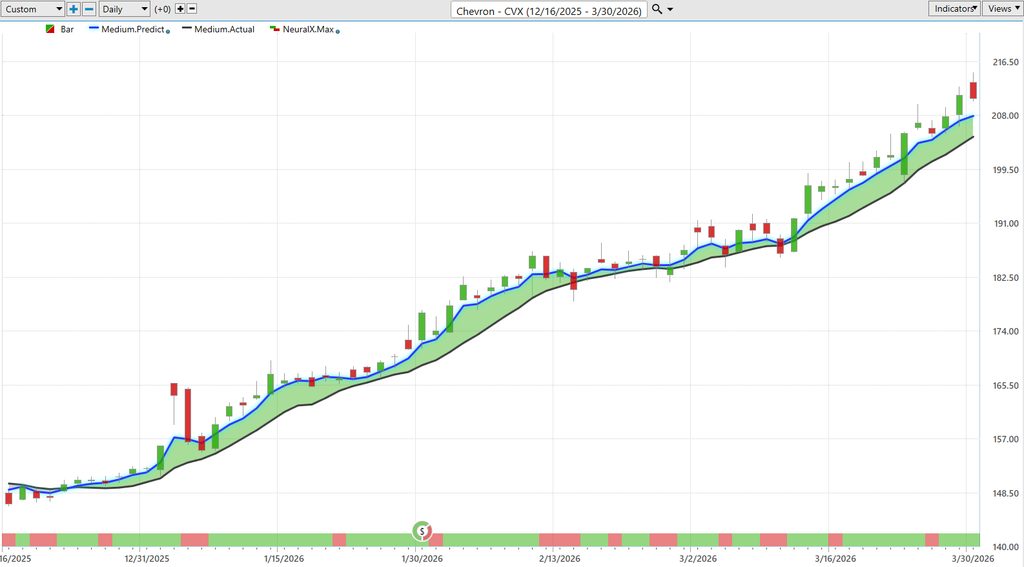
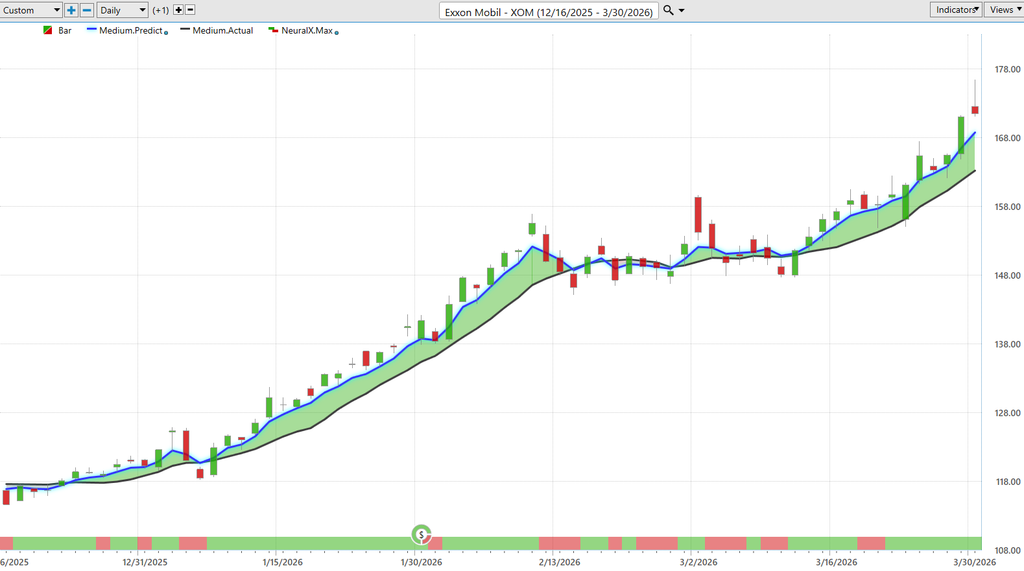
In moments like this, it becomes essential to recognize that the oil sector is not a monolith but a layered ecosystem, spanning large integrated producers, smaller exploration and production companies, refiners, and the equipment and services firms that enable the entire complex. Each segment responds differently to shifts in crude prices, supply constraints, and geopolitical risk, yet in aggregate they can tell a remarkably consistent story about where capital is flowing. And right now, that story is difficult to ignore.
Consider the contrast. The S&P 500 Index is up roughly 4% year to date, a respectable move by most standards. But within energy, the magnitude is on a different scale entirely. Exploration names like Valero Energy Corporation up 47%, APA Corporation up 50%, and ConocoPhillips up 26% suggest a far more aggressive repricing. In refining, Marathon Petroleum Corporation 34%, and Phillips 66 23.4%. Meanwhile, the equipment and services layer, often seen as a lagging indicator, has kept pace, with Schlumberger Limited up 35.2%, Baker Hughes Company up 32.6%, and Halliburton Company up 32.1%.
These are not incremental gains. They are decisive signals. And they underscore a broader point that traders often overlook: markets rarely move in unison, and the most important information is often found in the dispersion. When one sector, and more specifically multiple layers within that sector, are outperforming by such a wide margin, it is less a coincidence than a roadmap. The takeaway is straightforward but powerful. Pay attention to who is winning and who is losing. Because in markets, that distinction is not just descriptive. It is predictive.
Legendary trader Larry Williams would tell you something most traders don’t want to hear. The market isn’t hard. You’re making it hard. Price goes up. Price goes down. That’s it. But instead of focusing on that, traders pile on indicators, overlays, opinions, and stories until they can’t even see what’s right in front of them. They think more complexity equals more control. It doesn’t. It just creates confusion. And confusion leads to hesitation. Hesitation leads to losses.
My favorite Larry Williams quote is “Most traders lose money not because the market is too complex, but because they make it too complex. The market is not complicated. People are.“
Here’s the reality. Price is the truth. Everything else is just someone’s opinion about what they think should happen. The traders who win aren’t the ones searching for some hidden formula or meaning. They’re the ones doing the obvious, consistently. They follow trends. They respect strength. They avoid weakness. It’s not flashy. It’s not complicated. But it works. The market doesn’t reward intelligence. It rewards discipline. And most traders would rather feel smart than do what makes money.
Big trends pay. Period. And here’s the costly mistake most traders make: they see a strong move and immediately assume they’ve missed it. So, they sit on their hands or worse, they bet against it. That’s how accounts get drained. Flip the script. Focus on the scoreboard. Who’s leading? Who’s lagging? That clarity cuts through the noise like a knife. Suddenly, you’re not guessing anymore. You’re aligning with strength and avoiding weakness. That’s the game.
Here is where the narrative often breaks down, and where many traders lose the thread entirely. Modern warfare is about computation. The infrastructure that underpins today’s conflicts is increasingly digital, and at the center of that infrastructure sits the semiconductor. Chips are not an ancillary component. They are foundational. From drones and surveillance systems to AI-driven targeting and encrypted communications networks, the modern battlefield is, in many ways, a semiconductor-driven ecosystem.
What makes this dynamic particularly important is that demand for these systems does not plateau during periods of conflict. It accelerates. Governments are not just deploying existing capabilities. They are upgrading them in real time, investing in more advanced sensors, faster processing, and increasingly autonomous systems. The result is a steady, and often urgent, pull on semiconductor supply chains that extend well beyond traditional commercial demand tied to consumer electronics or enterprise computing.
At the same time, the geopolitical implications of supply chain vulnerability have become impossible to ignore. Semiconductors are no longer viewed purely through the lens of technology leadership or economic competitiveness. They are now framed as a matter of national security. This has led to a renewed focus on domestic production, strategic stockpiling, and long-term industrial policy aimed at reducing reliance on foreign manufacturing. In practical terms, it means sustained capital flows into the sector, supported not only by private demand but by government incentives and defense budgets.
If you take a step back and study the winners, something becomes very clear very quickly. Semiconductors are leading the herd. Not by a little. By a mile. You’ve got Micron Technology up 70%, Intel Corporation up 76%, Advanced Micro Devices up 43%, and Monolithic Power Systems up 67%. That’s sustained outperformance. And here’s the key. This hasn’t just been a one-week move. These names have been leading for the last six months. The scoreboard has been flashing this signal the entire time.
Now here’s where most traders get tripped up. They think they need to understand the full story before they act. They want the why. They want the narrative. They want confirmation that makes them feel comfortable. Great traders don’t operate that way. They understand that performance is the story. Price is telling you everything you need to know. You may not fully understand what’s driving the move, and that’s fine. You don’t get paid for understanding. You get paid for alignment. The opportunity isn’t in explaining what might happen. It’s in recognizing what is happening and having the discipline to act on it.
If you approached this through a purely narrative lens, you would almost certainly conclude that defense contractors should be clear winners in a conflict with Iran. The logic is tidy. Heightened tensions lead to increased military spending, which should translate into stronger performance for companies like Lockheed Martin, RTX Corporation, Northrop Grumman, General Dynamics, and Boeing. But markets, as they often do, have taken a more nuanced view. Yes, there have been short-term trading opportunities around headlines and specific developments. But when you step back and look at year-to-date performance, the results are, at best, underwhelming.
Consider the scoreboard. Lockheed Martin is up 11.7%, RTX Corporation is down -3%, Northrop Grumman is up just 0.68%, General Dynamics is down -6%, and Boeing is up 1.5%. That is not leadership. That is not even particularly compelling participation. It is, frankly, lackluster. And that is precisely the point. What makes intuitive sense does not always align with how capital is being deployed. The market is not a referendum on logic. It reflects positioning, money flow, expectations, and relative opportunity. And in this case, defense has not been the beneficiary many assumed it would be.
The only way this kind of performance begins to make sense is if you step back and accept a less intuitive truth about markets. They are not reactive. They are anticipatory. Markets are, at their core, discounting mechanisms designed to process information ahead of time and reflect expectations before they become obvious. Prices are not responding to today’s headlines. They are responding to what investors collectively believe will happen tomorrow, next quarter, or even next year. Which means that by the time a geopolitical conflict dominates the news cycle, markets have often already spent weeks, if not months, adjusting to that possibility.
This reframing changes everything. What appears counterintuitive, such as defense contractors failing to meaningfully outperform during an active conflict, becomes far more logical when viewed through this lens. The expected increase in defense spending, the replenishment cycles, the geopolitical tension, these are not surprises. They are inputs that markets have already processed and, in many cases, priced in well before the first headline crosses the wire. In that sense, the news is less a catalyst and more a confirmation. And by the time confirmation arrives, the opportunity has often migrated elsewhere, to sectors and themes that are now discounting the next phase of the cycle rather than the one everyone is finally beginning to understand.
While capital surged into energy, semiconductors, and select industrial plays, other parts of the market were left behind. And that divergence matters. Metals and mining, despite their commodity linkage, failed to keep pace. Interest-rate-sensitive sectors, housing, mortgage finance, struggled under the weight of uncertainty and shifting expectations around rates. This is not random. This is the market drawing a very clear line between strength and weakness.
Now here is the critical lesson for every trader. Success in these markets is not just about identifying what to buy. It is about having the discipline to avoid what is not working. Weak sectors do not need a narrative. They reveal themselves through underperformance. And if you ignore that signal, if you insist on finding value where the market sees risk, you will pay the price. The market rewards alignment with strength and punishes attachment to weakness. That is not opinion. That is the reality of how capital flows.
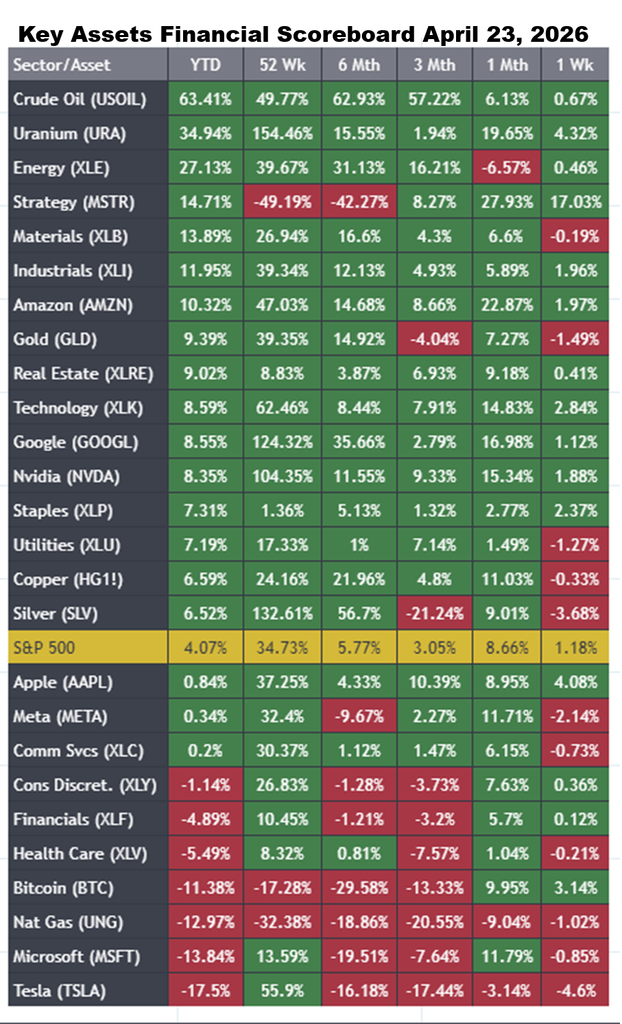
Study that scoreboard carefully. It tells you, with no ambiguity, where money is being made and where it is being lost. Now ask yourself a simple question. What is your best trade idea right now? How long will it take you to arrive at it? Five minutes. An hour. A full day of analysis. And once you find it, how much risk are you willing to take to prove you are right?
Now consider something far more uncomfortable. You are competing against systems that process millions of data points, measure relationships you cannot see, and never get tired, emotional, or distracted. Do you honestly believe you can outperform that? Or is the smarter move to align yourself with it? The goal is not to be clever. The goal is to be correct. And in markets, the trader who stays on the right side of the right trend, at the right time, is the one who gets paid.
Let’s cut through the noise.
The war didn’t create the opportunity. It exposed it.
The winners weren’t random. They never are. Energy surged because supply got squeezed. Logistics moved because disruption pays. Insurance stepped up because risk gets priced. Semiconductors took off because modern warfare runs on them. That’s not theory. That’s the scoreboard hitting you right between the eyes.
Now here’s where most traders go broke.
They chase headlines.
They listen to stories.
They try to outthink the market instead of reading it.
But the pros? They anticipate where the money is headed. They track strength. They ignore everything that isn’t working and press into what is. That’s the whole game. So next time the world gets loud and chaotic, don’t ask what’s happening. Ask where the money is going. Because the market doesn’t pay you for being informed. It pays you for being aligned.
You already know the truth most traders never admit out loud. The market does not reward opinions. It rewards positioning. And positioning requires one thing humans consistently fail at. Objective pattern recognition across thousands of variables, in real time, without hesitation. While human traders second guess, hesitate, and chase headlines, artificial intelligence is quietly scanning, filtering, and executing based on what is, not what sounds good.
Because here is the uncomfortable reality. Narratives entertain but trends pay. And there is no shortage of narratives flooding your feed every single day. Inflation fears. Rate cuts. Geopolitics. The next big thing. But buried beneath all that noise are a handful of real trends. Powerful, persistent, and quietly compounding into what can only be described as legacy level wealth. The question is not whether they exist. It is whether you can see them before they have already made their move.
So, ask yourself honestly. Do you know what those trends are right now? Do you know how to find them systematically? Can you instantly separate opportunity from risk before the crowd piles in? Because that is where most traders break. Not from lack of effort but from lack of a reliable lens.
When you choose VantagePoint AI trading software, you are choosing a tool designed to process more market information in seconds than any individual trader could manage in a day. It analyzes millions of data points daily, identifying emerging leadership before they become widely recognized.
The software tracks relationships across currencies, commodities, and equities at the same time. This matters, because markets rarely move in isolation. By observing these interconnections, VantagePoint provides a broader and more accurate view of what is actually driving price movement. It does so without emotion or hesitation, relying entirely on data.
Most traders spend their time reacting to what has already happened. VantagePoint is built with a different purpose. It is designed to anticipate likely market direction based on predictive analysis. It reduces complexity, filters out irrelevant noise, and highlights opportunities with a higher probability of success. As conditions change, the system adjusts, helping you stay aligned with the market as it is today, not as it was yesterday.
This is not a replacement for your judgment. It is a way to inform it. It gives you a clearer perspective, allowing you to make decisions with greater confidence and consistency.
If your goal is to protect your purchasing power and participate in today’s markets with a disciplined approach, this is worth your attention.
Which is exactly why I want to invite you to a free, live online masterclass where you will not just hear about this, you will see it in action. You will be able to pressure test your favorite tickers, watch how the AI evaluates opportunity versus risk in real time, and discover the exact trends it is currently focused on. The same ones quietly making the cash register ring. Reserve your seat now and come see what the market looks like when emotion is removed and precision takes over.
See you at the Learn How to Trade with AI Live Online Masterclass.
It’s not magic.
It’s machine learning.
THERE IS A SUBSTANTIAL RISK OF LOSS ASSOCIATED WITH TRADING. ONLY RISK CAPITAL SHOULD BE USED TO TRADE. TRADING STOCKS, FUTURES, OPTIONS, FOREX, AND ETFs IS NOT SUITABLE FOR EVERYONE.IMPORTANT NOTICE!
DISCLAIMER: STOCKS, FUTURES, OPTIONS, ETFs AND CURRENCY TRADING ALL HAVE LARGE POTENTIAL REWARDS, BUT THEY ALSO HAVE LARGE POTENTIAL RISK. YOU MUST BE AWARE OF THE RISKS AND BE WILLING TO ACCEPT THEM IN ORDER TO INVEST IN THESE MARKETS. DON’T TRADE WITH MONEY YOU CAN’T AFFORD TO LOSE. THIS ARTICLE AND WEBSITE IS NEITHER A SOLICITATION NOR AN OFFER TO BUY/SELL FUTURES, OPTIONS, STOCKS, OR CURRENCIES. NO REPRESENTATION IS BEING MADE THAT ANY ACCOUNT WILL OR IS LIKELY TO ACHIEVE PROFITS OR LOSSES SIMILAR TO THOSE DISCUSSED ON THIS ARTICLE OR WEBSITE. THE PAST PERFORMANCE OF ANY TRADING SYSTEM OR METHODOLOGY IS NOT NECESSARILY INDICATIVE OF FUTURE RESULTS. CFTC RULE 4.41 – HYPOTHETICAL OR SIMULATED PERFORMANCE RESULTS HAVE CERTAIN LIMITATIONS. UNLIKE AN ACTUAL PERFORMANCE RECORD, SIMULATED RESULTS DO NOT REPRESENT ACTUAL TRADING. ALSO, SINCE THE TRADES HAVE NOT BEEN EXECUTED, THE RESULTS MAY HAVE UNDER-OR-OVER COMPENSATED FOR THE IMPACT, IF ANY, OF CERTAIN MARKET FACTORS, SUCH AS LACK OF LIQUIDITY. SIMULATED TRADING PROGRAMS IN GENERAL ARE ALSO SUBJECT TO THE FACT THAT THEY ARE DESIGNED WITH THE BENEFIT OF HINDSIGHT. NO REPRESENTATION IS BEING MADE THAT ANY ACCOUNT WILL OR IS LIKELY TO ACHIEVE PROFIT OR LOSSES SIMILAR TO THOSE SHOWN.