






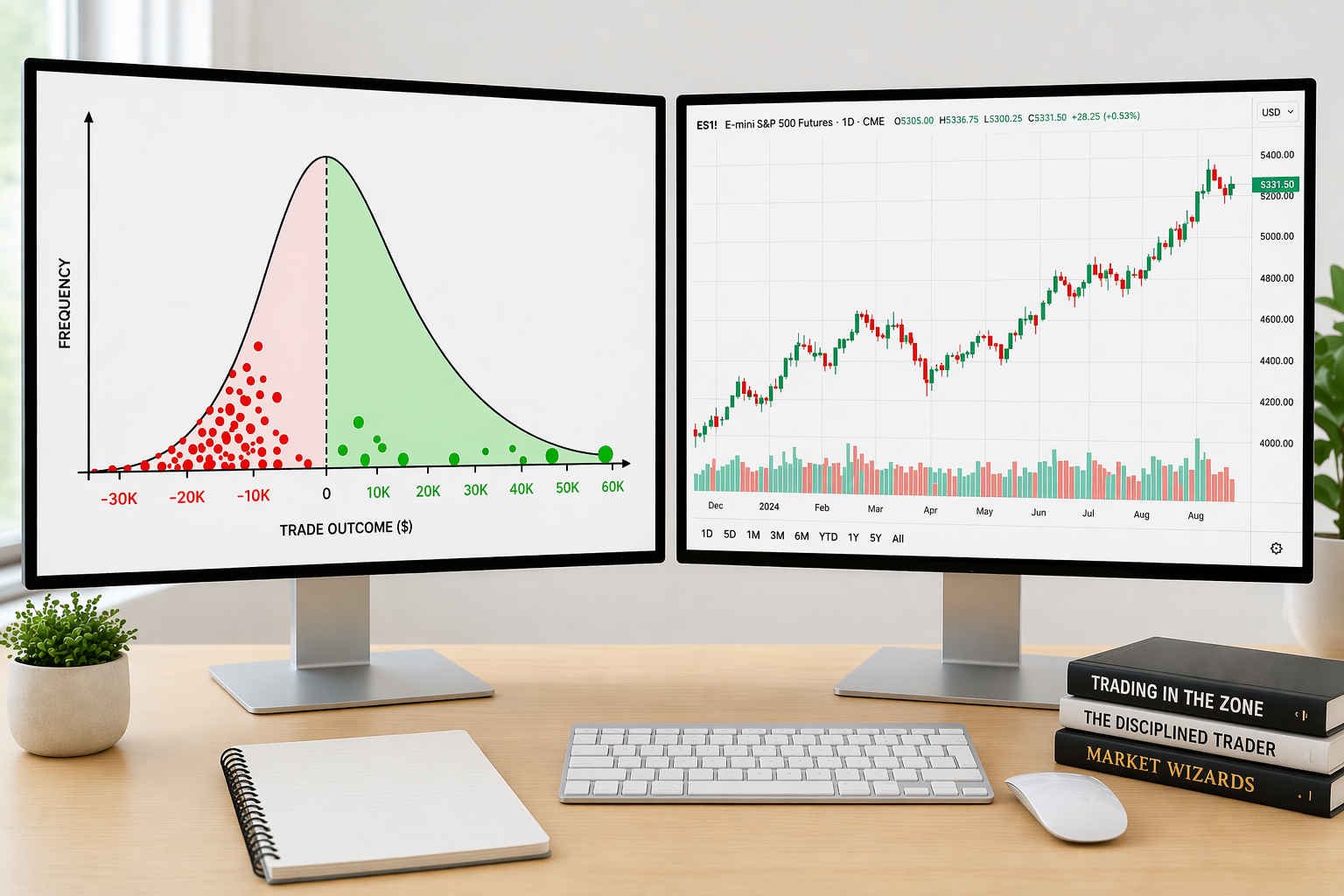
Most traders believe the same thing. If I can just be right more often, everything will work. It sounds logical and it feels right in the moment. But it is statistically deceptive. Trading is perceived to be a game of accuracy, but what trading really is about is learning how to manage risk.
In trading you can be right 70% of the time and still lose money. You can be wrong 60% of the time and build real wealth. That’s the part nobody tells you.
What the market rewards is how you manage being wrong. This is where most traders break down. They take small profits because it feels good and they hold losses because it feels hopeful. It creates the illusion of success, but underneath the math is working against them.
One loss quietly erases five wins. Another wipes out an entire week. Over time, the account starts bleeding. Not because they lack skill, but because they never understood the real game.
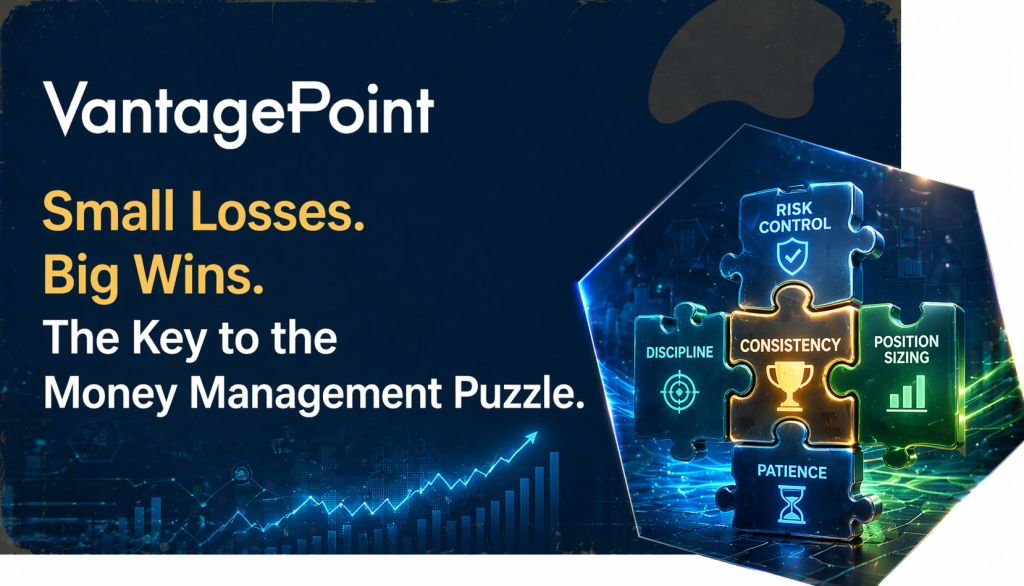
Here is the truth. You do not need to win ‘more.’ You need to lose differently. That single shift changes everything. Great trading is not how much you make when you are right but rather, how little you lose when you are wrong.
To better understand this concept, I want you to think about the airlines and the pilots they employ.
Pilots don’t rise to the occasion when something goes wrong. They fall back on their training. That’s the entire point of simulators, checklists, and endless repetition. Engine failure, loss of pressure, instrument malfunction, none of it is left to instinct or improvisation. It’s drilled until the response is automatic. Because in moments of stress and abnormality, there is no time to think clearly, no space to debate options. You revert to habit. And in aviation, that habit is the difference between control and catastrophe.
Trading is no different, but most traders treat it like it is. Traders study setups, watch markets, and build plans, but they don’t train their responses. When the trade moves against them, when volatility spikes, or when profits are on the line, they hesitate, override, or improvise. That’s not a strategy failure. That’s a habit failure. The outcome is being decided in real time by untrained behavior. The professionals understand this. They rehearse decisions, define responses in advance, and build patterns they can rely on when pressure shows up. Because just like a pilot, you don’t get to choose how you perform when things go wrong. You only get to choose how well you’ve prepared for it.
In trading, that habit begins with position sizing. If your size is correct, the situation stays manageable even when you’re wrong. The trade can move against you, volatility can expand, conditions can shift, and you’re still in control. But if your size is too large, everything changes. Small moves feel big. Normal fluctuations feel threatening. Decision-making compresses under pressure. What should be a routine adjustment turns into a moment of stress. And in that moment, just like the pilot, you don’t suddenly become disciplined. You fall back on whatever habits you’ve built. That’s why position sizing is not just a risk tool. It’s a behavioral tool. It determines whether you can think clearly enough to execute what you already know.
Position sizing is the one decision that determines whether a mistake stays small or turns into something that matters. Before the market has done anything, before you’re right or wrong, the outcome is already framed by how much you chose to put at risk. If the size is appropriate, the trade has room to breathe and you have room to think. If it’s too large, everything becomes urgent. Normal price movement feels like a threat. Decision-making compresses. And what should have been a routine trade turns into a test of emotional control. That’s why position sizing is about protecting your ability to execute.
The reason most traders don’t implement it properly is simple. They’re focused on the upside. They see the opportunity, they imagine the gain, and they quietly assume the downside won’t fully play out. So, they size the position based on what they want to make, not what they’re prepared to lose. It feels harmless in the moment. The trade looks good. The setup feels clean. But markets don’t care about intent. When the trade moves against them, the size they chose begins to dictate their behavior. Stops get widened, exits get delayed, and discipline fades. Not because they don’t know better, but because the position is now too large to manage rationally.
A more grounded approach starts with defining the consequence first. Before entering, you decide what a normal loss looks like and make sure it’s something you can accept without hesitation. Then you size the position so that outcome remains manageable. For example, if a trader has a $5,000 account and takes a position that moves against them by an amount that feels uncomfortable enough to cause hesitation, the position is too large. The exact numbers matter less than the response. The goal is to be able to take the loss cleanly and move on without emotional residue. Another example is scaling. Instead of committing fully at once, a trader can enter in stages. This keeps initial exposure small and allows adjustments as the trade develops, rather than forcing a single high-pressure decision at the start.
What’s ultimately important is this. Position sizing should make bad outcomes survivable and good decision-making repeatable. It should allow you to stay clear-headed when you’re wrong and composed when you’re right. Because in trading, you don’t get paid for being right once. You get paid for being able to continue.
Years ago, I was actively trading Forex. Like most traders, I decided to look at what I had already done. So, I went back and audited an entire year of my trading. Every single trade. I broke it down by currency pair and forced myself to see the truth in the numbers. No opinions. No excuses. Just results.
I looked at my average wins. I looked at my average losses. I identified which currency pairs I was consistently trading well and, just as importantly, the four pairs where I was consistently underperforming. Patterns started to show that I had completely missed in real time.
And what I found changed everything.
It wasn’t complicated. It wasn’t some hidden edge buried in the market. It was clarity. A simple understanding of where I was strong, where I was weak, and what needed to change. The solution, in the end, was far simpler than I ever imagined.
What I discovered was uncomfortable at first, but impossible to ignore. There was one currency pair that was quietly destroying my profitability. It didn’t matter what I did right elsewhere. That one market was dragging everything down. So, I made a simple decision and stopped trading it immediately.
Second, I started trading 25% smaller to retain my objectivity. Decisions are easy. Risk is obvious. I can see exactly where I’d get in, where I’d get out, and why. There’s no pressure, no attachment, no need to be right. But the moment I’m in a trade, something shifts. It’s subtle. Not dramatic. Just enough to matter. I start negotiating with information I would have respected minutes earlier. Objectivity doesn’t disappear. It erodes. And that erosion is where most of the damage begins.
What changed everything for me was realizing how closely that loss of objectivity was tied to size. When I trade small, I’m a different trader. I’m patient. I let things develop. I follow my plan without resistance. My account grows steadily, and there’s no stress attached to the outcome. But when size increases beyond what I can comfortably manage, the pressure shows up. And with it, the need to act, to control, to protect. That’s when clarity fades. Which leads to a simple but critical truth. The best risk decisions are made before the trade ever exists. When you’re flat, you’re objective. Once you’re in, you’re managing not just the trade, but yourself. So, the goal is to structure the trade in a way that protects that objectivity from the start. Keep size where thinking remains clear. Define actions in advance. And most importantly, have patience to stay within that framework. Because once a trader loses clarity, you’re no longer trading the market. You’re reacting to it.
That was it. No overhaul. No new system. Just removing what wasn’t working. And my own results improved. Success can be exactly that simple when one is willing to look at the truth and act on it.
If I were hypothetically working with a trader, this is the process I would walk them through. I would ask them to audit the last one hundred trades. Not selectively. Not the ones they remember. All of them. Because the answers are already there.
The average win. The average loss. The winning percentage and losing percentage. Then take the total profit or loss from those trades and divide it by the # of trades.
That number matters more than you think.
That is expectation. Statistically speaking, this is known as expected value, which is a fancy way of saying the market keeps score even when you don’t. It is the average outcome of every trade you take, not the ones you brag about, not the ones you remember fondly, but all of them, including the ones you’d prefer to forget. It does not care about your conviction, your charts, or that “this one felt different.” It only reflects what happened, which is deeply inconvenient for anyone still negotiating with reality. And that’s the beauty of it. Expected value strips away the storytelling and leaves you with the truth, unpolished, slightly rude, and completely unavoidable.
It is not a theory. It is not an opinion. It is the average outcome of everything you have been doing. And once you see it clearly, you will know exactly what needs to change.
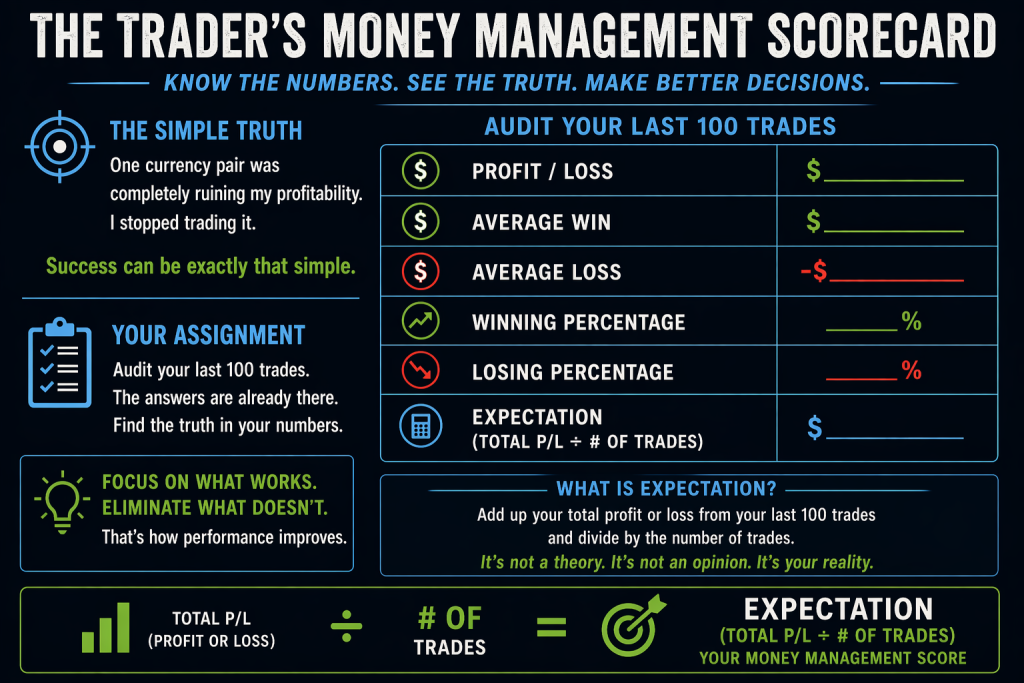
This scorecard represents a turning point. It is what happens when trading moves beyond instinct and into discipline. When decisions are no longer driven by gut feeling, but by facts. And frankly, that is where every serious trader needs to be.
Let’s be candid. Too many traders operate without any real measurement of their performance. They are guessing. They are reacting. And then they wonder why the results fail to meet expectations. You cannot improve what you do not measure. That is not opinion. That is reality.
What you have here is a scorecard. It is direct. It is unemotional. It is accountable. It does not care about confidence or conviction. It does not respond to headlines or narratives. It reflects one thing and one thing only: outcomes.
Average win. Average loss. Winning percentage. Losing percentage. Profit and loss. And most importantly, expectation. That single metric tells a trader whether their approach is sustainable or whether it is quietly deteriorating beneath the surface. It is the difference between progress and illusion.
There is a familiar story that emerges when traders finally sit down and audit their last 100 trades. On the surface, nothing appears obviously broken. The trader may even feel productive. Active. Engaged. In this case, let’s assume the numbers come back like this: a 58% winning percentage, an average win of $120, and an average loss of $110. At first glance, it feels respectable. More wins than losses. Losses seemingly contained. But when the total profit and loss is divided across those 100 trades, the expectation comes in at just a few dollars per trade, effectively flat after friction, commissions, or a single mistake. The realization is subtle but consequential. Activity is not the same as progress.
What becomes clear, and often uncomfortably so, is that the issue is not the trader’s ability to find trades. It is how those trades are being managed. The numbers tell the story plainly. Wins are being taken too quickly. Losses, while not catastrophic, are not being cut with enough efficiency to create meaningful separation. The edge, if it exists, is being diluted. And this is where the solution presents itself, through the data already in hand. Improve the asymmetry. Either expand the average win, reduce the average loss, or ideally both. Because in the end, expectation is not theoretical. It is a direct reflection of behavior. And in this case, the behavior is quietly canceling itself out.
Trading is a process. Not a slogan. Not a moment. A process. And like any process, it demands measurement and evaluation over time. Every trader has periods of success and periods of failure. The only way to know if you are moving forward is by tracking the data. Not opinions. Not emotions. Data.
This scorecard makes that clear. It shows you how you arrived at your current position, and more importantly, it shows you what must change to improve it.
That is the value of knowing your metrics. It replaces uncertainty with clarity. It replaces hope with evidence. And once you have that clarity, the only thing that remains is discipline.
Every trader says they want consistency. Very few track the numbers that create it. Losses are not a mistake in this business. They are the cost of admission. The problem is not losing. The problem is losing without knowing what it costs you mathematically.
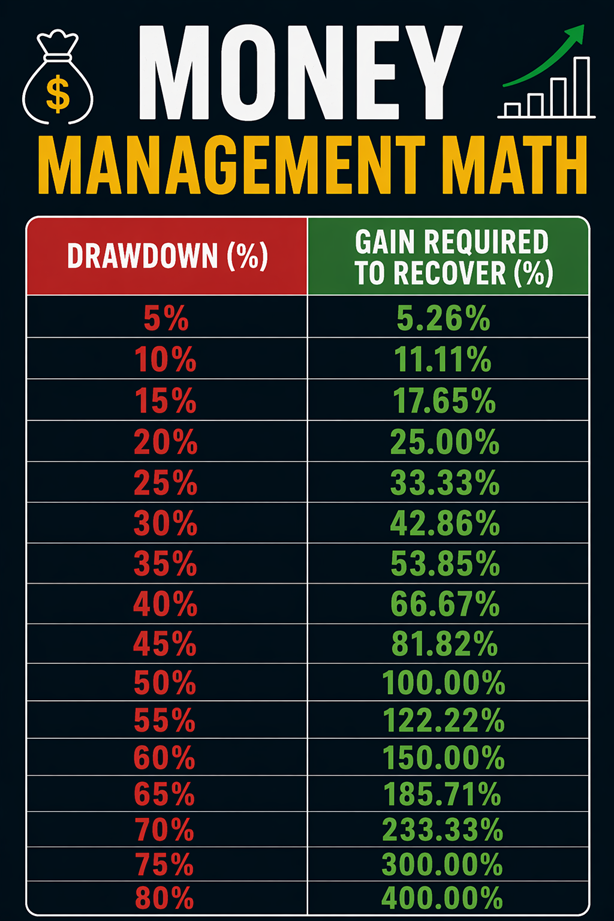
Look at the money management math. A 10% loss needs 11% to recover. Manageable. But push that to 30% and now you need nearly 43% just to get back to even. At 50%, you’re staring at a 100% climb. At 80% you need a 400% gain to get back to breakeven, That’s not trading anymore. That’s digging out of a hole. This is where most traders break, not because they lack opportunity, but because they let small, acceptable losses turn into large, compounding problems.
The professionals understand something simple but unforgiving. You don’t control outcomes. You control exposure. If you keep losses small, the math stays on your side and compounding can do its job. If you don’t, the math will quietly bury you. Know your metrics. Respect the drawdown curve. Because in this game, survival is not a slogan. It’s the strategy.
Most books on money management are packed with formulas, percentages, and complex models that make the subject feel far more complicated than it really is. They are quantitative by design, but all that math is trying to communicate one very simple truth. Great trading is never about how much money you make when you are right. It is always about how little you lose when you are wrong. Strip away the equations and that is the entire game, because if losses stay small, the opportunity to win remains, but once losses get out of control, no amount of being right can save you.
There is a quiet assumption embedded in how most traders evaluate performance. They believe success should look balanced, orderly, and almost symmetrical. A steady mix of wins and losses that resembles control. The most profitable trading outcomes look anything but balanced.
Consider a distribution of 100 trades. Ninety of them result in losses, each modest and contained between one hundred and three hundred dollars. The remaining ten trades generate gains ranging from one thousand to five thousand dollars. At first glance, the win rate appears catastrophic. But the outcome tells a very different story.
The losses, while frequent, are tightly clustered and predictable. They form a dense grouping near the zero axis, reflecting discipline and consistency. The winners, by contrast, are fewer and far more dispersed. They extend meaningfully to the right, creating a positive skew that ultimately defines the entire performance profile.
This asymmetry is not accidental. It is the result of a deliberate approach to risk and reward. The trader is effectively underwriting many small, manageable losses in exchange for the opportunity to participate in a handful of outsized gains. Over time, those gains more than compensate for the steady cadence of losses.
Richard Dennis, one of the greatest commodity traders who has ever lived, used to say something that sounds almost absurd at first glance. He would often boast that 90% of his trades were losers. Stop and contemplate that for a moment. Imagine I am your broker and 90% of the trades I suggest lose money. If you are obsessed with being right on every trade, you would fire me without hesitation. And yet, traders who think that way would have walked away from one of the most successful trading minds in history.
Because what mattered was not how often Dennis was wrong. It was what happened when he was right. The 10% of trades that worked did not just make money. They made substantial money. Some would say super big money. Those few outsized winners more than compensated for the steady stream of small, controlled losses. That is the distribution most traders fail to understand. It is not balanced. It is not symmetrical. It is skewed decisively in favor of those who can keep losses small and let winners expand.
This is where the conversation shifts from theory to execution. It is not enough to understand the idea. Define your risk before you enter the trade. Size the position so that the loss is small and acceptable. Do not move the stop. Do not negotiate with the market. A small loss is one that does not change your behavior on the next trade. If it does, it was too large.
Losing streaks are part of the game. Not occasionally. Guaranteed. That is not a signal that something is broken. That is probability doing its job. If your approach cannot survive that, it is not a strategy. It is a gamble. And when losses grow too large, the recovery becomes exponentially harder. Lose half your capital and you need to double it just to get back to even. That is the trap most traders fall into.
At the center of all of this is position size. This is where math meets behavior. Keep it small and you remain disciplined. Increase it beyond your tolerance and emotion takes over. Most professionals anchor themselves to risking a small fraction of capital on each trade, often in the range of one to two percent. Not because it is a magic number, but because it is a survival rule. No single trade should be able to hurt you badly. Position size is not just a calculation. It is a psychological decision disguised as one.
The difference between amateurs and professionals becomes clear here. Amateurs focus on being right. They increase size when they feel confident and react emotionally when trades move against them. Professionals focus on risk. They keep size consistent. They think in terms of probabilities and distributions. They understand that their job is not to eliminate losses, but to define them.
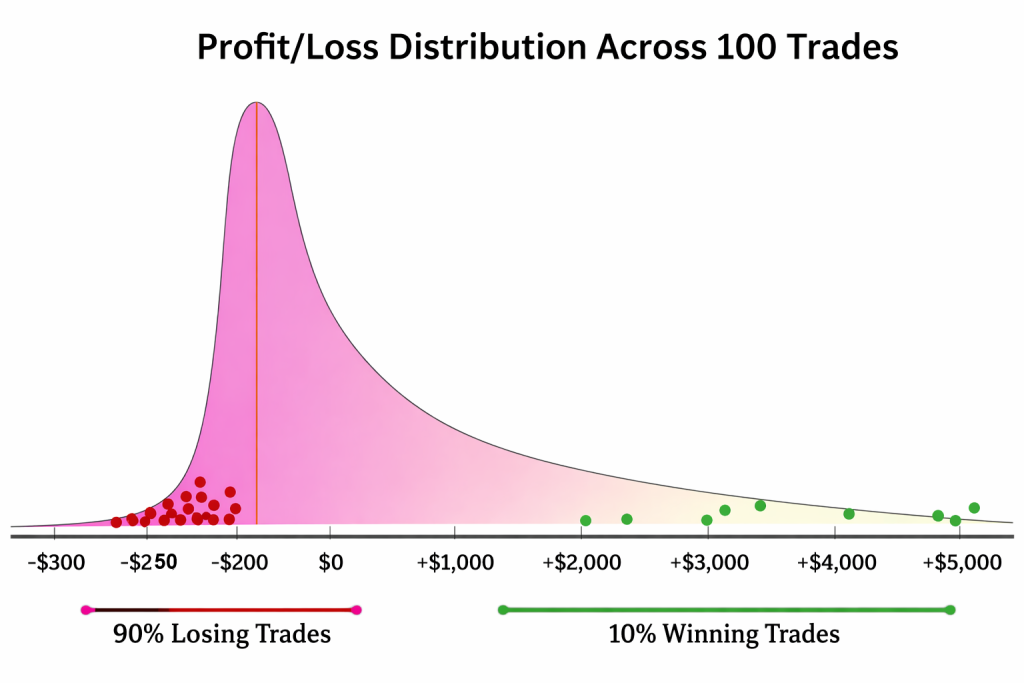
This is what Richard Dennis’s trading style looked like. Not balanced. Not symmetrical. Skewed big time. He was wrong 90% of the time. But his losses were small, controlled, and consistent. When he’s right…he’s not a little right. He’s dramatically right. That imbalance is where the money comes from.
All the math in the world points to one simple truth: survival comes first. Keep your losses small, and the probabilities can work in your favor. Let your losses get out of control and no strategy can save you.
Position sizing is the one decision that determines whether a mistake stays small or turns into something that matters. Before the market has done anything, before you’re right or wrong, the outcome is already framed by how much you chose to put at risk. If the size is appropriate, the trade has room to breathe and you have room to think. If it’s too large, everything becomes urgent. Normal price movement feels like a threat. Decision-making compresses. And what should have been a routine trade turns into a test of emotional control. That’s why position sizing isn’t just about protecting capital. It’s about protecting your ability to execute.
The reason most traders don’t implement it properly is simple. They’re focused on the upside. They see the opportunity, they imagine the gain, and they quietly assume the downside won’t fully play out. So they size the position based on what they want to make, not what they’re prepared to lose. It feels harmless in the moment. The trade looks good. The setup feels clean. But markets don’t care about intent. When the trade moves against them, the size they chose begins to dictate their behavior. Stops get widened, exits get delayed, and discipline fades. Not because they don’t know better, but because the position is now too large to manage rationally.
A more grounded approach starts with defining the consequence first. Before entering, you decide what a normal loss looks like and make sure it’s something you can accept without hesitation. Then you size the position so that outcome remains manageable. For example, if a trader has a $5,000 account and takes a position that moves against them by an amount that feels uncomfortable enough to cause hesitation, the position is too large. The exact numbers matter less than the response. The goal is to be able to take the loss cleanly and move on without emotional residue. Another example is scaling. Instead of committing fully at once, a trader can enter in stages. This keeps initial exposure small and allows adjustments as the trade develops, rather than forcing a single high-pressure decision at the start.
What’s ultimately important is this. Position sizing should make bad outcomes survivable and good decision-making repeatable. It should allow you to stay clear-headed when you’re wrong and composed when you’re right. Because in trading, you don’t get paid for being right once. You get paid for being able to continue.
The most important rule in trading is rarely the most exciting. It does not promise quick profits or dramatic wins. It does not appeal to the ego. But it is the rule that determines whether you survive long enough to succeed.
Never risk so much on a single trade that it alters your judgment.
This principle is not theoretical. It is practical, measurable, and proven. When your position size is small, you think clearly. You follow your plan. You accept losses without hesitation. But when your position is too large, everything changes. Logic gives way to emotion, and discipline begins to erode.
Most traders believe their problem is strategy. Often, their problem is size. They risk too much when they feel confident and too little when they should act decisively. They allow conviction to override consistency. And in doing so, they introduce instability into what should be a controlled process.
The professionals approach this differently. They treat position sizing as a safeguard, not an opportunity. They understand that consistency in risk leads to consistency in results. They do not seek to maximize gains on a single trade. They seek to protect the integrity of their decision-making over time.
If you remember only one idea, remember this. The purpose of money management and position sizing is not to make you rich quickly. It is to ensure that no single mistake can prevent you from becoming wealthy at all.
Keep it simple, mechanical, and grounded in behavior rather than prediction. Consider a trader with a $5,000 account who decides, before anything else, that a $100 loss is acceptable on any single trade. If they buy a stock at $50 with a clear exit at $48, they are risking $2 per share. The math is straightforward. They can take only 50 shares, committing $2,500 in capital, while still limiting the downside to $100. The capital deployed may feel substantial, but the actual risk remains controlled. The distinction is critical. Position sizing is not about how much is invested. It is about how much is exposed if the idea proves wrong.
Now consider the same trader, the same $100 risk, but with a more tightly defined setup. If the entry remains $50 but the exit is now $49, the risk per share drops to $1. This allows the trader to take 100 shares, effectively using the full $5,000 account, yet still capping the potential loss at $100. What appears, at first glance, to be a more aggressive position is, in reality, no riskier than the previous example. The difference lies in precision. When trades are better defined, size can increase without altering the underlying risk profile.
Finally, imagine a wider, less precise setup. The trader enters again at $50, but this time the exit is $45, introducing $5 of risk per share. To maintain the same $100 loss threshold, the position must shrink to just 20 shares, or $1,000 in capital. Here, less money is deployed, but the risk remains constant. This is where many traders lose discipline, mistaking smaller positions for missed opportunity. In reality, the opposite is true. The wider the uncertainty, the smaller the position must be. The numbers do not negotiate.
This principle is obvious but often not observed by traders until they start studying their losses more intently. The deeper the loss, the more pressure you feel to recover. And that’s when things get interesting, in the same way a car crash is “interesting.” Because now you’re not trading anymore. You’re negotiating with your own panic.
That pressure doesn’t make you smarter. It makes you bold in all the wrong ways. Suddenly, you’re not managing risk, you’re trying to win it back in one heroic swing. You size up, you override your rules, and you convince yourself this next trade is the one that fixes everything. It isn’t.
What you’ve done is take a bad situation and give it a megaphone. The loss gets bigger, the pressure gets louder, and now you’re trapped in a feedback loop designed by your own urgency. And the market, being the cold and indifferent machine that it is, is more than happy to take the other side of that emotional decision.
That’s the trap. Not the first loss. The reaction to it. Because once you start trading to recover instead of trading to execute, you’re no longer in control. You’re just accelerating the damage.
Most traders already know what to do. They’ve heard it. They’ve read it. They’ve probably even said it out loud to someone else like they believe it. Keep losses small. Let winners run. Don’t overtrade. Simple stuff.
And then the market opens… and they do the exact opposite.
They grab a quick profit like it’s about to be stolen from them. Then they sit on a losing trade like it’s a family heirloom. Hoping. Praying. Negotiating with the screen like it owes them something. It doesn’t. It never did.
Now here’s the part most traders never confront…
You are asking a human brain wired for survival, fear, and instant gratification to behave like a machine of cold precision in an environment designed to exploit every emotional weakness you have.
That is a losing battle.
Because no matter how many strategies you learn, no matter how many indicators you stack on your chart, the moment pressure hits, emotion takes the wheel. It always does.
But what if it didn’t have to?
What if, instead of fighting your psychology, you simply removed it from the equation?
This is where VantagePoint AI changes everything.
AI does not hesitate. It does not second guess. It does not move stops, chase entries, or hope a trade comes back. It does one thing and it does it flawlessly. It defines the risk on every single trade before the trade is ever taken.
Not based on how you feel. Not based on what you hope will happen. But based on objective probabilities designed to keep you aligned with the market’s true direction.
Which means you are no longer reacting. You are no longer guessing. And most importantly, you are no longer sabotaging yourself at the exact moment execution matters most.
VantagePoint AI has one mission: to keep you the traders on the right side of the right trend at the right time with risk already controlled before emotion even has a chance to interfere.
And that is the real breakthrough. Not more knowledge. Not more complexity.
But finally stepping off the emotional rollercoaster that has been draining your account and replacing it with a system that enforces discipline whether you feel like it or not.
Because in trading, the edge does not belong to the smartest trader.
It belongs to the one who executes correctly every single time.
Let’s be honest. When you hear “AI trading,” you probably think of fully automated systems, simplified promises, and results that look impressive on the surface but rarely hold up in practice. And that skepticism is justified. Most of what people see in this space is built around making the process appear easier than it is. That is exactly why this is different. This is not about outsourcing decisions or relying on something you do not understand.
In our free live classes, you can see how VantagePoint AI is actually used by serious traders. Not to automate profits, but to forecast stocks and options trends and reduce noise and bring structure to decision-making. It processes large amounts of data, filters what matters, and highlights potential opportunities while you stay in control. We walk through real examples step by step. What the AI identified, why it mattered, and how a disciplined trader evaluates it without emotion or guesswork. No hype. No assumptions. Just a clear look at how the process works.
If you are curious but still skeptical, reserve your seat, show up, and watch how it works in real time. No pressure to continue. No commitment beyond attending. Just a clear, live view of whether this approach makes sense or not.
There is a difference between guessing and knowing.
You should see it for yourself.
Register for the masterclass here.
It’s not magic.
It’s machine learning.
THERE IS A SUBSTANTIAL RISK OF LOSS ASSOCIATED WITH TRADING. ONLY RISK CAPITAL SHOULD BE USED TO TRADE. TRADING STOCKS, FUTURES, OPTIONS, FOREX, AND ETFs IS NOT SUITABLE FOR EVERYONE.IMPORTANT NOTICE!
DISCLAIMER: STOCKS, FUTURES, OPTIONS, ETFs AND CURRENCY TRADING ALL HAVE LARGE POTENTIAL REWARDS, BUT THEY ALSO HAVE LARGE POTENTIAL RISK. YOU MUST BE AWARE OF THE RISKS AND BE WILLING TO ACCEPT THEM IN ORDER TO INVEST IN THESE MARKETS. DON’T TRADE WITH MONEY YOU CAN’T AFFORD TO LOSE. THIS ARTICLE AND WEBSITE IS NEITHER A SOLICITATION NOR AN OFFER TO BUY/SELL FUTURES, OPTIONS, STOCKS, OR CURRENCIES. NO REPRESENTATION IS BEING MADE THAT ANY ACCOUNT WILL OR IS LIKELY TO ACHIEVE PROFITS OR LOSSES SIMILAR TO THOSE DISCUSSED ON THIS ARTICLE OR WEBSITE. THE PAST PERFORMANCE OF ANY TRADING SYSTEM OR METHODOLOGY IS NOT NECESSARILY INDICATIVE OF FUTURE RESULTS. CFTC RULE 4.41 – HYPOTHETICAL OR SIMULATED PERFORMANCE RESULTS HAVE CERTAIN LIMITATIONS. UNLIKE AN ACTUAL PERFORMANCE RECORD, SIMULATED RESULTS DO NOT REPRESENT ACTUAL TRADING. ALSO, SINCE THE TRADES HAVE NOT BEEN EXECUTED, THE RESULTS MAY HAVE UNDER-OR-OVER COMPENSATED FOR THE IMPACT, IF ANY, OF CERTAIN MARKET FACTORS, SUCH AS LACK OF LIQUIDITY. SIMULATED TRADING PROGRAMS IN GENERAL ARE ALSO SUBJECT TO THE FACT THAT THEY ARE DESIGNED WITH THE BENEFIT OF HINDSIGHT. NO REPRESENTATION IS BEING MADE THAT ANY ACCOUNT WILL OR IS LIKELY TO ACHIEVE PROFIT OR LOSSES SIMILAR TO THOSE SHOWN.