





The AI stock spotlight this week is Avis Budget Group ($CAR)
Let’s talk about Avis Budget Group, a company that sits at the intersection of travel demand, asset prices, and financial engineering, and somehow manages to look simple on the surface while behaving like a leveraged macro trade underneath.
It began in 1946, when Warren Avis had the modest idea that air travelers might want cars waiting for them when they landed. Over time, that idea expanded into a global rental network, split across brands like Avis, Budget, and later Zipcar, each targeting a slightly different customer profile. The company has navigated oil shocks, recessions, and the rise of ride sharing, emerging today as one of the largest vehicle rental operators in the world. It matters to markets not because renting cars is exciting, but because it is deeply tied to travel cycles, credit conditions, and used vehicle prices. When those forces shift, this stock tends to move quickly and sometimes violently.
At its core, the business is straightforward. Avis rents vehicles. But the economics are anything but.
The company operates through three primary channels. Its flagship Avis and Budget brands dominate airport locations, where pricing power tends to be strongest because customers are time constrained and options are limited. It also runs a meaningful off-airport business, serving insurance replacements and local renters, which provides a steadier, if less lucrative, revenue stream. Then there is Zipcar, the hourly rental model that caters to urban users who want access without ownership.
Revenue is generated through daily rental rates, ancillary fees such as insurance and fuel, and various service add-ons. But the real economic engine is the fleet itself. Avis buys vehicles, rents them intensively, and then sells them into the used car market. When residual values are strong, this model can produce outsized returns. When they weaken, profitability can erode quickly.
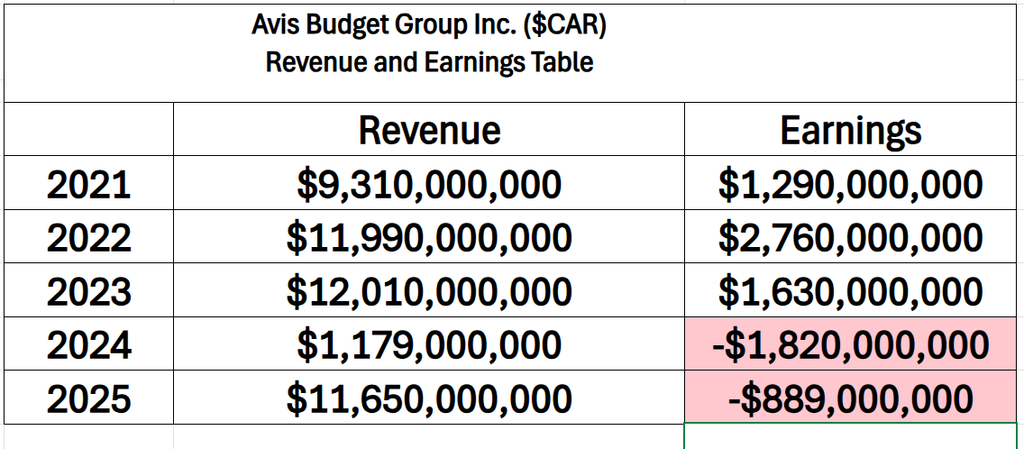
What you see here is a business that benefited from strong pricing and favorable conditions, driving both revenue and earnings sharply higher, only to experience a meaningful reversal when those conditions normalized, particularly around asset values and cost pressures. This is not a steady compounding machine but a cyclical operation, where profits can swing dramatically even when revenues appear relatively stable. Looking ahead, Wall Street is not forecasting a return to peak profitability, but rather a stabilization, with revenue expected to come in around $11.5 to $12.0 billion and earnings projected at approximately $120 to $140 million, or about $4 per share, recovering modestly from recent losses. The implication is clear: 2026 is viewed as a normalization year, not a breakout, and investors would be wise to focus less on past peaks and more on whether the business can deliver consistent, sustainable profitability going forward.
The customer base is broad but predictable. Business travelers, tourists, and insurance customers form the backbone of demand. The company is headquartered in Parsippany, New Jersey, and employs tens of thousands globally. Its competitive landscape includes Enterprise, Hertz, and increasingly the indirect competition of ride sharing platforms. Avis’s advantage is scale and network density. Its disadvantage is that its core asset depreciates every single day.
This brings us to the financial reality, which is where the story becomes more interesting.
Revenue trends are inherently cyclical, tracking travel demand and pricing power. In periods of strong demand, particularly post-pandemic, rental rates surged, utilization climbed, and margins expanded. In weaker environments, those same metrics can reverse quickly. Margins are highly sensitive to both pricing and depreciation. When the company locks in a fleet at favorable prices and rents those vehicles at elevated rates, profitability can look exceptional. But if used car prices decline, depreciation expense rises, and margins compress.
The balance sheet reflects the nature of the business. Cash flow can be robust during favorable cycles, but debt levels are significant because the fleet is financed. This is a capital-intensive model, where growth and maintenance require continuous investment in vehicles.
What traders often misunderstand is that this is not merely a service business. It is, in many ways, a leveraged exposure to used vehicle prices layered on top of travel demand. That combination creates both opportunity and risk.
Right now, traders are focused on three central questions.
First, are used car prices stabilizing after recent volatility, or is another leg down coming? This directly impacts depreciation and earnings.
Second, how resilient is travel demand in an environment of higher interest rates and shifting consumer behavior? The answer will determine utilization and pricing power.
Third, is management exercising discipline in fleet sizing and capital allocation, or are they overextending in response to recent strength?
Recent developments suggest a market that is cautiously optimistic. Travel demand has remained relatively strong, particularly in leisure segments. Fleet costs have moderated compared to the extreme conditions of the pandemic period. However, the rate of improvement is slowing, and investors are beginning to question what “normal” looks like.
Much of the recovery narrative is already reflected in the stock. Strong earnings and cash flow have been recognized. What may be underappreciated is how sensitive the model remains to changes in residual values and utilization.
This is where expectations can diverge from reality. Analysts often assume a gradual normalization. Historically, this business has not behaved gradually.
The stock’s recent performance reflects this dynamic. Over the past 90 days, it has benefited from earnings resilience and the absence of the sharp downturn many feared. Relief, in markets, can be a powerful catalyst.
Year-to-date, the same themes persist. Travel demand has held up, fleet economics have been manageable, and the company has continued to return capital through buybacks, supporting the share price.
The narratives driving this move are familiar. Travel recovery. Pricing discipline. Operational efficiency. But beneath those narratives, the critical variables have been utilization rates, average daily rental pricing, and depreciation trends.
Where consensus views are grounded is in recognizing that recent performance has been strong. Where they may fall short is in underestimating the speed at which conditions can change. This is not a business that offers stability. It offers leverage to macro conditions.
Opportunities remain if the current environment persists. Strong travel demand combined with stable or improving used car prices could sustain elevated earnings. In a best-case scenario, both pricing power and residual values improve, creating a powerful earnings tailwind.
The risks are equally clear. A decline in used car prices would increase depreciation expense. A slowdown in travel demand would reduce utilization. If both occur simultaneously, earnings could decline sharply.
The most significant upside surprise would be a scenario in which supply constraints return, supporting both pricing and residual values. The most important blind spot is the assumption that recent stability will continue uninterrupted.
Looking ahead, there are several catalysts that traders should monitor closely.
The next earnings release, expected in late April or early May, will provide updated guidance on pricing, utilization, and fleet costs. This is the primary event that can reset expectations.
Monthly used car price data, while less visible, is critical. It feeds directly into depreciation assumptions and earnings forecasts.
Guidance around the summer travel season, typically discussed in second quarter commentary, will shape expectations for peak demand.
Each of these events has the potential to shift the narrative, and with it, the stock.
The bottom line is straightforward.
This is a stock for traders who understand cycles and are comfortable with volatility. It is not designed for those seeking predictability.
For the current trend to continue, travel demand must remain resilient, used car prices must stabilize, and management must maintain discipline in fleet management. Early signs of trouble would include declining rental rates, rising depreciation costs, or cautious forward guidance. These indicators tend to appear before the broader narrative shifts.
In the end, Avis Budget is less about cars and more about timing. It is a business where the difference between success and struggle often comes down to a few key variables aligning at the right moment. For traders, that alignment is the opportunity.
In this weekly stock study, we will look at an analysis of the following indicators and metrics, which serve as our guidelines in determining whether to buy, sell, or stand aside on a particular stock:
Wall Street Analysts Ratings and Forecasts
52 Week High and Low Boundaries
Best-Case/Worst-Case Analysis
VantagePoint AI Predictive Blue Line
Neural Network Forecast (Machine Learning)
VantagePoint AI Daily Range Forecast
Intermarket Analysis
Our Suggestion
While our decisions are ultimately guided by artificial intelligence forecasts, we still take a brief look at the fundamentals to understand the financial landscape in which $CAR is operating.
Wall Street Analysts Price Forecasts
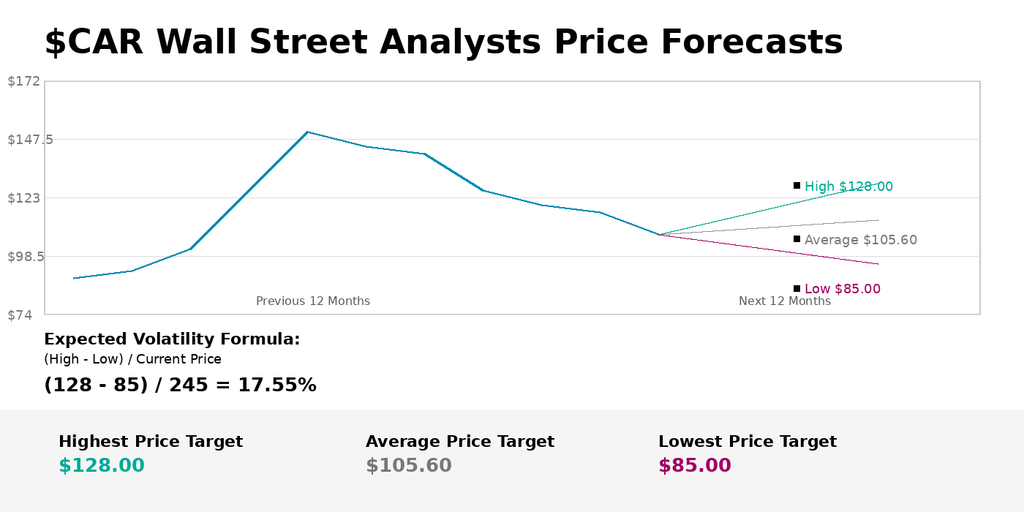
Let’s not overcomplicate this. $CAR has rallied more than 119% in just 24 trading sessions. That’s a rocket launch. And when price moves that far, that fast, it creates a problem. Either analysts are asleep at the wheel and need to aggressively upgrade their forecasts… or price has sprinted so far ahead of reality that it eventually snaps back toward the mean.
Now bring in Wall Street. Every single analyst target sits far below the current price. Not slightly below. Dramatically below. That tells you everything. Analysts are still anchored to a completely different reality. So the market is now at a crossroads. Either analysts will be forced to chase price higher and revise their models… or price will revert back toward that $85 to $128 range where expectations currently live. That gap between perception and price is where the opportunity is, but it is also where the risk is at its highest.
So what’s driving the move? The narrative being floated centers around tighter fleet supply, improving pricing power in rental markets, and a renewed appetite for travel. Fair enough. Those are real factors. But here’s the issue. None of those developments typically justify a triple-digit percentage move in under a month. That kind of price action is rarely about fundamentals alone. It smells more like positioning, short covering, and momentum piling on top of itself. In other words, the “why” exists… but the magnitude is questionable.
52 Week High and Low Boundaries

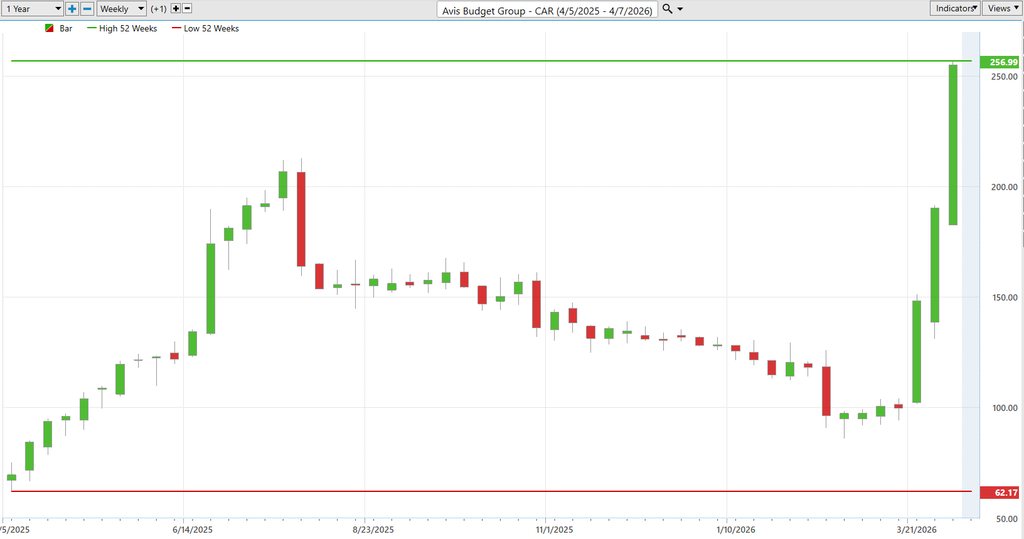
When you study the annual trading range as a percentage of the current price you see that over the past year $CAR has traded in a 190 point range which is 76.5% of the current price. This is massive and tells us just how volatile $CAR is.
Best-Case/Worst-Case Scenario Analysis
You’re looking at two charts. One shows the biggest uninterrupted rallies. The other shows the ugliest, no-mercy declines. No opinions. No forecasts. Just what this market has already done when it gets moving.
Here’s the part most traders miss…
Volatility is not theoretical. It is not a formula. It is not something cooked up in a spreadsheet to sound intelligent. It is raw, lived experience. It is price moving hard in one direction without asking for permission. And if you think it cannot happen again, the market has a way of correcting that belief… quickly.
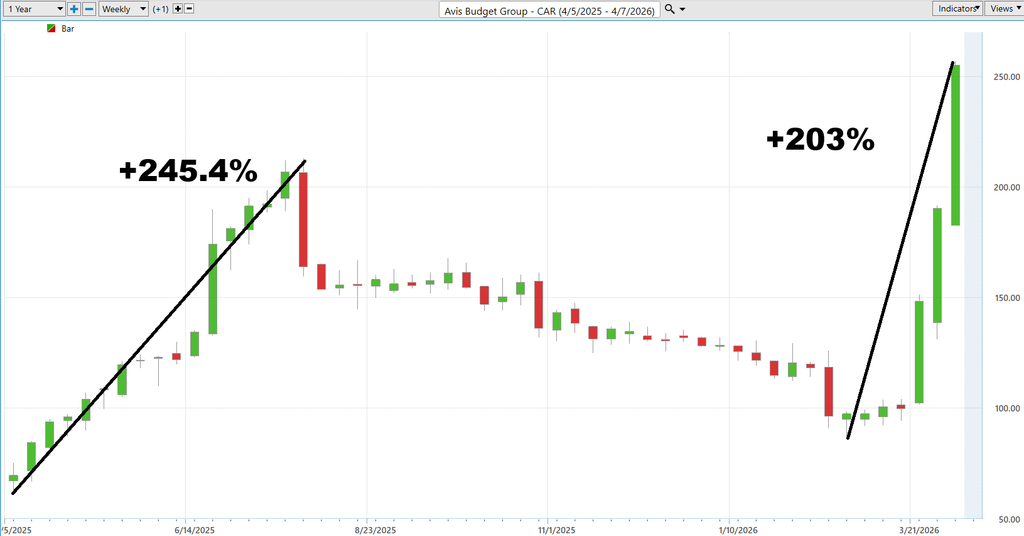
Now look at those rallies. +245.4%. +203%. That is not “upside potential.” That is proof of what this asset does when momentum grabs the wheel. That is opportunity. Real, measurable, repeatable opportunity. The kind that rewards traders who are positioned early and sized correctly.
Then look at the other side of the coin.
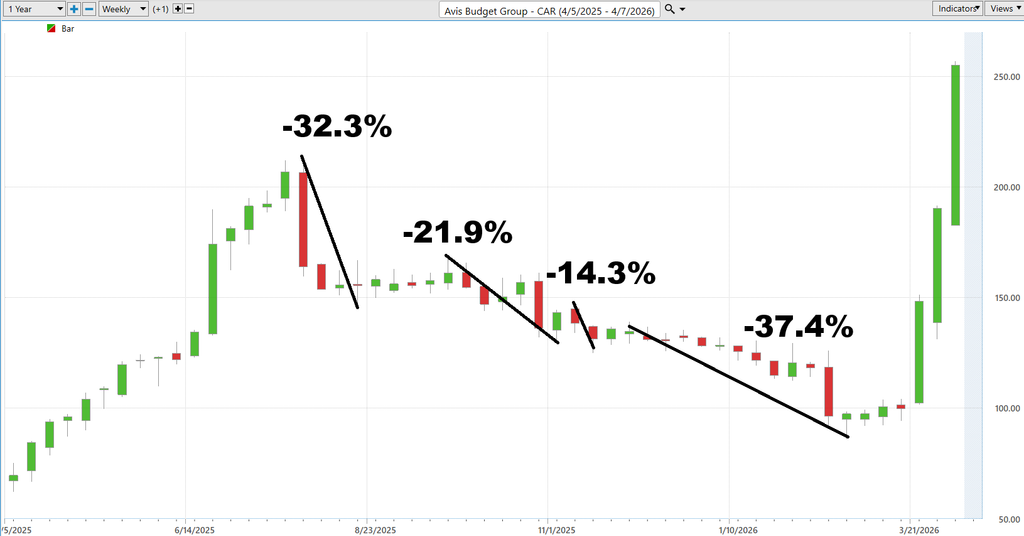
-32.3%. -21.9%. -14.3%. -37.4%. That is not bad luck. That is the cost of doing business in a volatile asset. That is risk in its purest form. And it does not show up politely. It shows up fast, and it does damage to anyone who has not planned for it.
Now here is where this becomes powerful.
You do not need a PhD. You take these two realities… the biggest moves up and the biggest moves down… and you ask one simple question:
“If I were in this trade, how would this move affect me?”
That is position sizing. That is risk control. That is real trading.
Because when you understand both sides… not just the dream of upside, but the reality of downside… you stop guessing. You start preparing.
And that is the difference between traders who survive…
…and traders who don’t.
$CAR has demonstrated the ability to deliver explosive upside moves north of 200% when momentum takes hold, but those gains are earned in an environment where sharp, uninterrupted drawdowns of 30% to nearly 40% are not exceptions, they are part of the structure.
The practical takeaway is simple: this is not a stock you “hold and hope” with size, it is a stock you position strategically where your upside participation is meaningful, but your downside exposure is pre-defined and survivable.
Next we compare $CAR to the broader stock market averages.

There is no ambiguity here. $CAR is decisively outperforming the broader market across every meaningful timeframe, separating itself from indexes that are, at best, uneven and, at worst, struggling to find direction. This is not marginal leadership. It is dominant, sustained outperformance that places the stock in a different category altogether.
What stands out is the persistence of that strength. This is not a short-lived spike driven by a headline or a temporary squeeze. The trend has held across multiple horizons, which suggests that capital is not rotating in and out, but building positions over time. That kind of consistency typically reflects institutional conviction, where buyers are responding not just to price, but to improving underlying conditions.
Those underlying drivers are not difficult to identify. The rental car industry has benefited from tighter fleet supply, which has supported pricing power, while travel demand has remained resilient, particularly in higher-margin segments like airport rentals. At the same time, $CAR has been aggressively managing its fleet and balance sheet, monetizing vehicles at favorable prices and improving operating efficiency. Layer in the company’s history of significant share repurchases and high short interest, and you have the ingredients for both fundamental support and technical acceleration. In that context, the outperformance begins to look less like an anomaly and more like the market repricing a business whose earnings power, at least for now, has exceeded expectations.
VantagePoint AI Predictive Blue Line
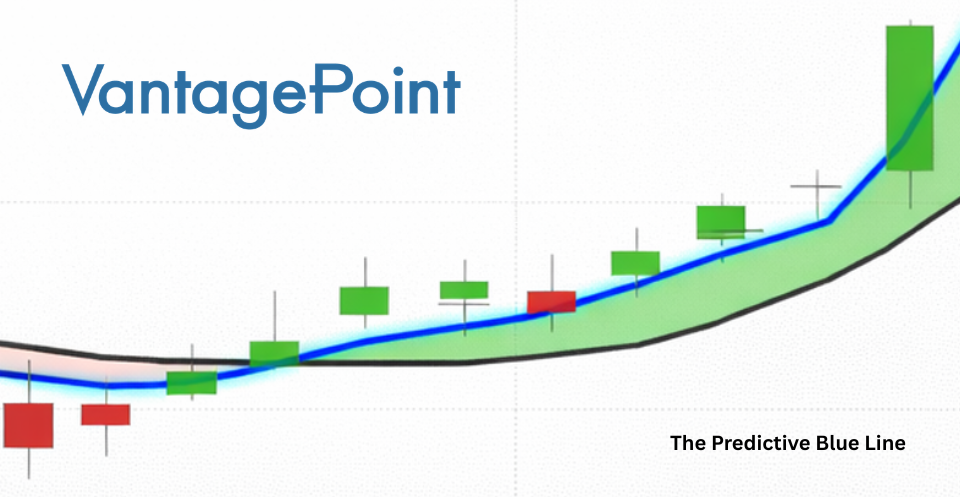
What you are looking at is not just a price move. It is a forecast validated by time.
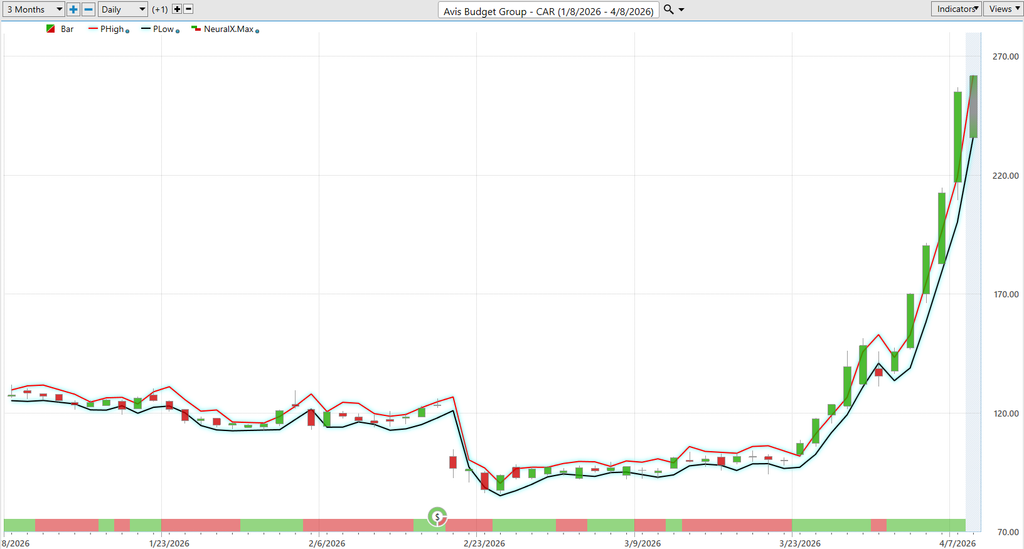
Since the last up forecast on March 11, 2026, $CAR has rallied 151%. That is what happens when direction, timing, and probability align. The move did not begin when the crowd noticed. It began when the predictive blue line turned higher and signaled that strength was building beneath the surface.
The VantagePoint predictive blue line is a forward looking compass designed to anticipate where price is likely to go. When that blue line is rising, it tells you that the short term trend is up. When it is falling, it signals weakness. The slope is everything. A rising slope means momentum is building. A flattening slope warns of transition. A downward slope signals that sellers are taking control.
Now here is where most traders get it wrong.
Professionals focus on the slope of the line itself. Because the slope changes first. It is the earliest indication that the trend is shifting. In the case of $CAR, the upward slope on March 11 was the tell. Price followed.
This is how you move from reacting to anticipating.
When the predictive blue line is rising and price pulls back toward it, that is where opportunity lives. When the slope rolls over, that is where risk begins. It is a simple framework, but it is grounded in one thing traders desperately need.
Clarity.
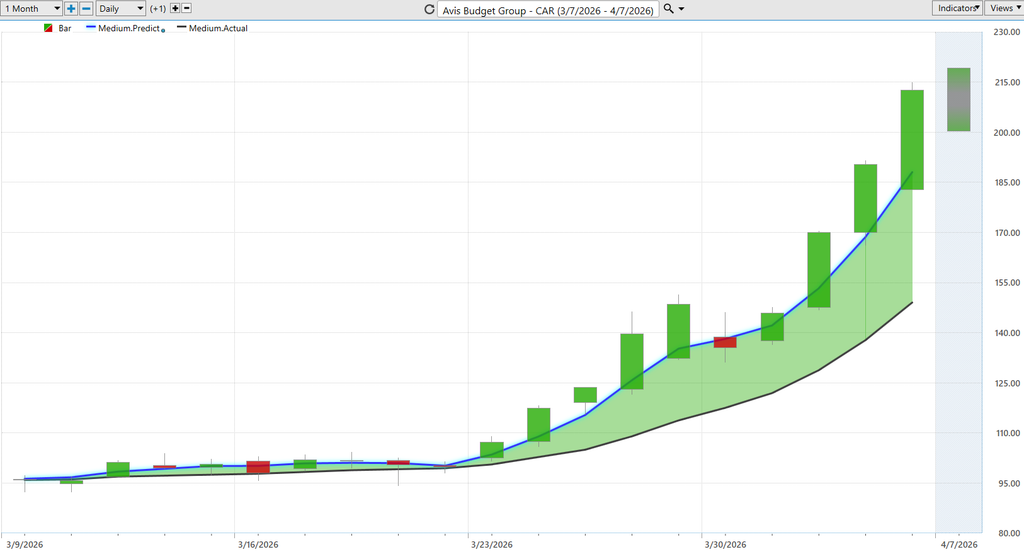
And when you combine that clarity with a move like 151% in a matter of weeks, you begin to understand what it means to see the trend before it becomes obvious.
That is exactly what we teach inside the VantagePoint Learn To Trade With AI live online masterclass.
Because once you understand how to read the slope, you stop chasing the market.
And start anticipating it.
VantagePoint AI Neural Index (Machine Learning)
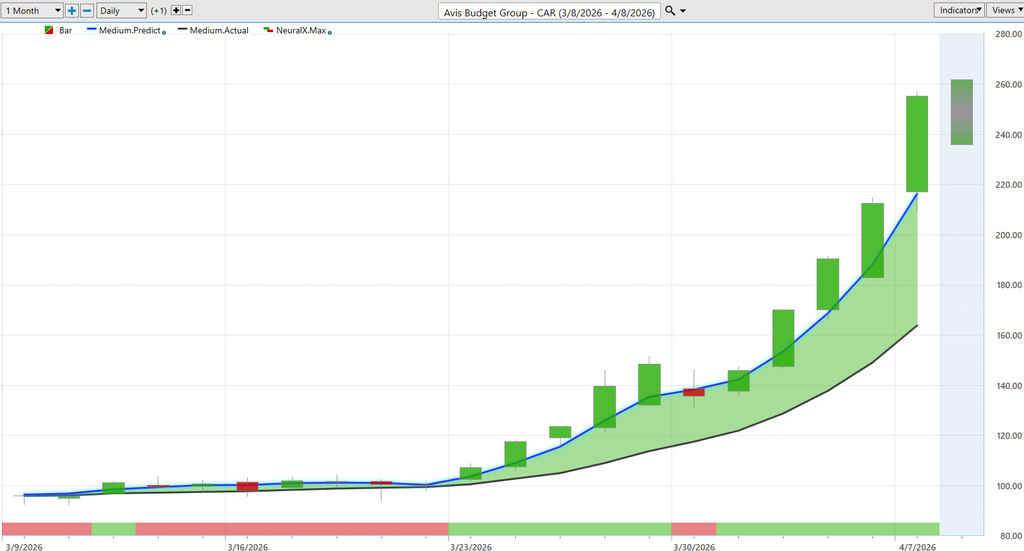
What stands out immediately in $CAR is the consistency of the Neural Index and what it reveals about the structure of the trend. This is not a reactive indicator. It is a forward looking probability tool designed to answer a simple question. Over the next 48 to 72 hours, is strength or weakness more likely. When the Neural Index turns green, it signals short term strength. When it turns red, it signals that weakness is beginning to emerge, often before it is fully expressed in price.
In this chart, the pattern is striking. The Neural Index remains green for extended stretches as the rally unfolds, confirming that buying pressure is not episodic but persistent. This is what sustained trends look like. They are not built on one move. They are built on a series of short term confirmations stacking on top of one another. The brief moments where the Neural Index turns red are not failures of the trend. They are pauses within it.
And those pauses are where the opportunity becomes most obvious.
When the Neural Index turns red, what is immediately observable is that price traditionally retraces back toward the predictive blue line or even slightly below it. This is not random behavior. It reflects a temporary cooling of momentum within a broader uptrend. For traders, this creates repeated positioning opportunities. Instead of chasing strength, you are given defined moments where price resets closer to its forecasted value.
The real edge appears when you combine the Neural Index with the Predictive Blue Line. A rising blue line establishes the direction. A green Neural Index confirms short term strength within that direction. A red Neural Index, in contrast, often signals a pullback toward value, not necessarily a reversal. In a trend as powerful as $CAR, that interplay becomes a roadmap. Strength tells you when to stay with the move. Weakness tells you where to prepare for the next entry.
For traders, the takeaway is practical and actionable. The Neural Index is not about precision in price. It is about timing and probability. It tells you when momentum is likely to continue and when it is likely to pause. And in a market where timing defines outcomes, that insight turns volatility into opportunity rather than uncertainty.
VantagePoint AI Daily Range Forecast
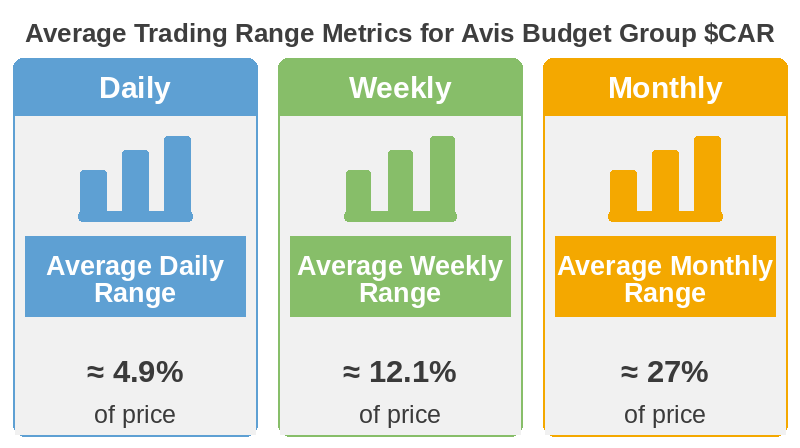
It is one thing to understand that $CAR is capable of meaningful movement across daily, weekly, and monthly timeframes, but it is something entirely different to know how to act on that information. The average trading ranges simply define the boundaries of expectation, giving you a sense of how far price can travel within a given period. They quantify volatility, but on their own, they stop short of telling you what to do with it.
Traders lack a framework for applying volatility in real time. What traders actually need is a kind of volatility GPS, something that translates that raw potential into actionable daily expectations. This is precisely where the VantagePoint A.I. daily range forecast steps in, taking those broad volatility characteristics and converting them into a structured, forward-looking map that defines where price is likely to move within a given session.
When you study the interaction between price and the forecast bands, a pattern emerges. Price does not move randomly within those ranges; it tends to respect them, oscillating between defined boundaries while aligning with the prevailing trend. This is where experienced traders separate themselves. They are not guessing direction, they are identifying where opportunity and risk live before the move unfolds. The daily range forecast delivers that clarity, turning volatility from an abstract concept into a practical tool for disciplined execution.
Intermarket Analysis
What jumps out immediately is that $CAR is not moving in isolation. It is sitting at the center of a very broad and diverse network that spans transportation, consumer discretionary, midcap equities, and even macro influences like currencies and commodities. That kind of connectivity tells you this is not a one-variable story. It is being influenced by multiple layers of the market at the same time, which typically points to a move that has deeper roots than just short-term speculation.
When you look at the surrounding relationships, there is a noticeable degree of alignment, particularly with consumer discretionary exposure, transportation-related ETFs, and broader equity strength proxies. That alignment matters. It suggests that the strength in $CAR is being reinforced by the same forces driving those sectors higher, whether that is resilient consumer demand, improving travel trends, or capital rotating into economically sensitive areas. There are a few macro cross-currents in currencies and commodities, but they are not strong enough to disrupt the broader agreement across the equity landscape.
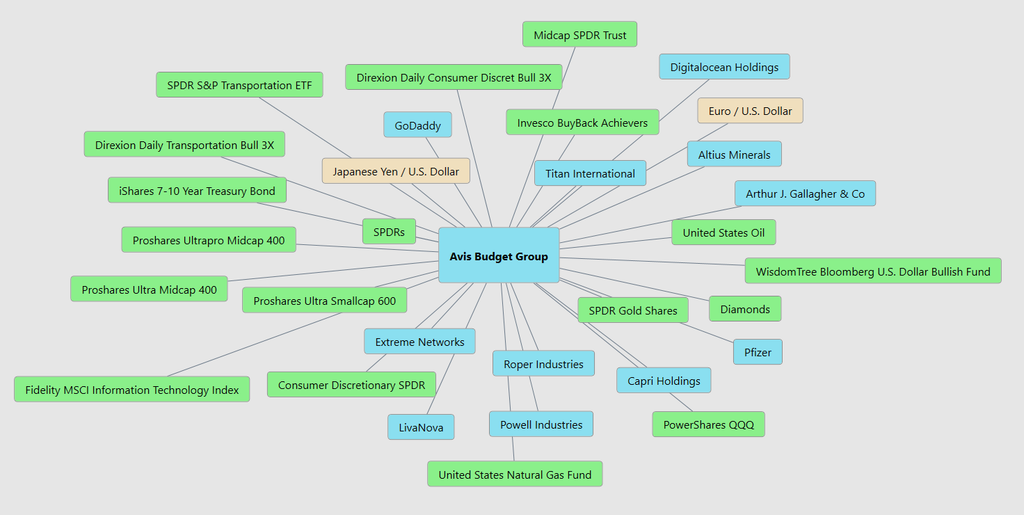
The takeaway for traders is straightforward. When an asset is supported by multiple related markets moving in the same direction, the trend tends to be more durable and less prone to sudden failure. That does not eliminate risk, but it does shift the odds. In this case, $CAR looks like a move that is being validated rather than questioned by its environment, which makes it a stronger candidate for continuation, provided that alignment remains intact.
Our Suggestion
Management at $CAR comes across as confident and firmly in control of the business, with messaging that suggests they are largely executing against their strategic objectives. Across the last two calls, leadership has emphasized operational discipline, fleet management, and pricing power, all while reinforcing their ability to navigate a dynamic travel environment. There is a noticeable consistency in tone, which typically signals that the company is not reacting to conditions, but actively managing through them with a clear plan.
At the same time, management does not appear blind to the risks. They have acknowledged the sensitivity of their model to used vehicle pricing, demand fluctuations in travel, and broader economic conditions that could impact consumer behavior. Importantly, these risks are not dismissed or minimized. Instead, they are framed as variables the company is actively monitoring and adjusting to, which suggests a level of awareness that is critical in a cyclical and capital-intensive business like this.
In terms of guidance, management has provided enough directional clarity to anchor expectations without overcommitting to rigid forecasts, which is often a sign of disciplined leadership.
For traders, the takeaway is straightforward: this is a company that understands both its opportunity set and its vulnerabilities. Clearly you need to be cautious when trading $CAR particularly now after a 150% move in the past month. Keep $CAR on your trading radar, as its volatility and positioning are likely to create numerous opportunities in the months ahead.
Use the daily range forecast to isolate short term trading opportunities.
Practice solid monet management on all of your trades.
Let’s be careful out there.
It’s not magic.
It’s machine learning.
Disclaimer: THERE IS A HIGH DEGREE OF RISK INVOLVED IN TRADING. IT IS NOT PRUDENT OR ADVISABLE TO MAKE TRADING DECISIONS THAT ARE BEYOND YOUR FINANCIAL MEANS OR INVOLVE TRADING CAPITAL THAT YOU ARE NOT WILLING AND CAPABLE OF LOSING.
VANTAGEPOINT’S MARKETING CAMPAIGNS, OF ANY KIND, DO NOT CONSTITUTE TRADING ADVICE OR AN ENDORSEMENT OR RECOMMENDATION BY VANTAGEPOINT AI OR ANY ASSOCIATED AFFILIATES OF ANY TRADING METHODS, PROGRAMS, SYSTEMS OR ROUTINES. VANTAGEPOINT’S PERSONNEL ARE NOT LICENSED BROKERS OR ADVISORS AND DO NOT OFFER TRADING ADVICE.