










This week’s AI stock spotlight is Micron Technology ($MU)
Let’s talk about Micron Technology, known to traders as $MU. If capitalism had a memory chip, this would be it. And like most memory, it’s occasionally brilliant, occasionally unreliable, and always expensive when you need it most.
Micron’s story, boiled down for people who don’t read 10-K filings for fun, goes something like this. It started in 1978 making memory chips when disco was still a thing. Its mission has always been simple: store the world’s data and sell it back at a profit. It survived brutal boom-and-bust cycles that have bankrupted lesser chipmakers. Today it operates at global scale with fabs, supply chains, and customers that include the biggest tech names on Earth. And it still matters because every AI model, cloud server, smartphone, and data center runs on memory. No memory, no magic.
Now here’s what Micron actually does, minus the corporate poetry. It makes two things that sound boring but are about as essential as oxygen in the digital economy: DRAM and NAND. DRAM is your short-term memory, fast and expensive. NAND is your long-term memory, slower but cheaper and everywhere. If DRAM is your brain thinking, NAND is your brain remembering where you left your car keys.
Micron sells these chips into data centers, smartphones, PCs, autos, and anything else that needs to store or process data. The biggest revenue drivers right now are data center DRAM tied to artificial intelligence workloads, and high-value memory used in servers running large language models. Translation: when AI demand spikes, Micron gets invited to the party and usually leaves with a fat check.
The customer list reads like a who’s who of trillion-dollar market caps. Think hyperscalers, cloud giants, and big device makers. Headquarters sits in Boise, Idaho, which is not exactly Silicon Valley but has quietly produced one of the most important chip companies in the world. Leadership is headed by CEO Sanjay Mehrotra, a veteran who understands that memory cycles are like weather. You don’t control them, you prepare for them. The company employs tens of thousands globally and competes with heavyweights like Samsung and SK Hynix. In this business, second place is still very profitable, but first place sets pricing power.
Now let’s address the part traders tend to misunderstand, which is Micron’s financial condition. This is not a smooth, predictable SaaS company with subscription revenue. This is a cyclical beast. Revenue rises fast when memory prices rise, and falls just as fast when supply gets ahead of demand. It’s a roller coaster with real consequences.
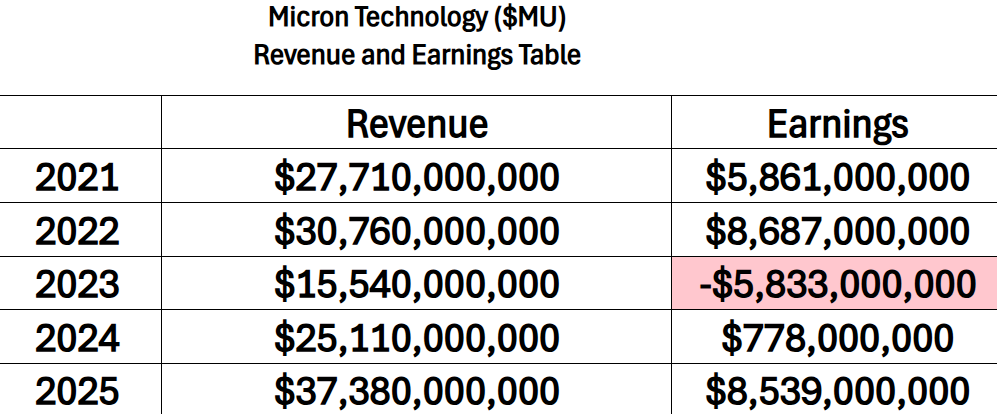
Recent revenue trends show a recovery after a brutal downturn. Margins collapsed during the last cycle because memory prices fell off a cliff. Now margins are expanding again as pricing power returns, especially in high-bandwidth memory tied to AI servers. Cash position is solid enough to survive downturns, but this is a capital-intensive business. Building fabs costs billions. Standing still is not an option. Debt is manageable, but the real burden is constant reinvestment.
Micron Technology is guiding to roughly $33.5 billion in quarterly revenue (± $750M) and about $19.15 in EPS (± $0.40) based on its latest outlook. If that pace holds, it implies a potential $120B to $140B+ annual revenue run rate In plain terms, management’s current trajectory suggests Micron could be generating $75B to $90B in annual earnings, assuming pricing, demand, and margins hold.
Management is signaling a record-setting year driven by AI demand and strong pricing power, assuming current conditions persist.
Here’s what traders often miss. Micron is not just selling more chips. It’s selling better chips at higher prices into tighter supply conditions. That is where the leverage comes from. When pricing flips from weak to strong, profits don’t just improve. They explode.
So what are traders asking right now?
First, is this AI-driven memory boom real or just another temporary spike? Traders have been burned before by memory cycles that looked strong until they weren’t.
Second, can Micron actually meet demand for high-bandwidth memory used in AI servers? Supply constraints are a feature, not a bug, but they also cap upside if production cannot keep up.
Third, how long will pricing power last before competitors flood the market? This industry has a long history of overbuilding capacity at exactly the wrong time.
Now let’s talk about recent news, because that is what moves stocks, not history lessons.
In the last 30 days, the big theme has been continued strength in AI-related demand, particularly for high-bandwidth memory. That’s not new. What is new is the confirmation from multiple industry players that supply is tight well into the next year. That matters because tight supply means higher prices and better margins.
What’s already priced in? A lot of optimism. Wall Street is not asleep here. Analysts are modeling strong revenue growth and margin expansion. The stock has already moved in anticipation of this.
What might Wall Street be missing? The degree of operating leverage if pricing continues to rise. Memory pricing shifts can create outsized earnings surprises, both up and down. If supply stays constrained longer than expected, earnings estimates could still be too low.
Where expectations could be wrong is on timing. Analysts tend to assume smooth curves. Memory cycles tend to look like cliffs.
Now let’s answer the question every trader actually cares about. Why is the stock up?
Over the past 90 days, Micron has rallied because the narrative shifted from oversupply and collapsing prices to tight supply and rising demand, driven by AI infrastructure spending. The market went from worrying about inventory to worrying about not having enough product.
Year to date, the stock is up because capital is flowing into semiconductors as a group. The entire space has become a proxy for AI growth. And within that space, memory is no longer the ugly stepchild. It’s suddenly the star.
You can see this clearly in the performance of Direxion Daily Semiconductor Bull 3X Shares (SOXL). When that thing starts trending, it tells you the entire semiconductor complex is under accumulation. It’s not subtle. It’s a sledgehammer.
Micron has benefited directly from this trend. When semis run, memory runs. When memory pricing improves, Micron often runs harder than the rest because its earnings are more sensitive to pricing changes.
The narratives that helped include AI demand, data center expansion, and supply discipline. The data points that actually mattered were inventory reductions, pricing stabilization, and confirmed orders for high-bandwidth memory.
Analysts have generally been right to turn more bullish as conditions improved. But let’s not pretend they saw this perfectly. Historically, analysts tend to be late on both the way down and the way up in memory cycles. They extrapolate trends just long enough to get them wrong.
Now for the part where we separate opportunity from wishful thinking.
What could go right? Continued tight supply, rising memory prices, and sustained AI demand could drive earnings far above current expectations. If Micron executes well on high-bandwidth memory, it could capture premium pricing and expand margins faster than expected.
What could go wrong? The classic memory mistake. Overproduction. If competitors ramp supply aggressively, pricing could fall just as quickly as it rose. Demand is strong, but supply can be stronger.
The single biggest upside surprise would be a prolonged supply shortage combined with accelerating AI demand. That is the scenario where earnings estimates get blown out of the water.
The biggest blind spot traders should respect is how quickly this industry can turn. Memory is not forgiving. When it rolls over, it does not send a polite warning email.
Now let’s look at the catalyst calendar, because markets move on events, not essays.
Next earnings report is the big one. That’s where pricing, margins, and forward guidance will either confirm the bullish thesis or poke holes in it.
Industry pricing data updates, which come out regularly, matter more than most people realize. Rising spot prices can front-run earnings surprises.
And any major announcements from hyperscale customers about AI infrastructure spending will ripple directly into memory demand expectations.
Why do these matter? Because Micron’s stock moves less on what it did last quarter and more on what it is expected to do next quarter. Guidance is king.
So here’s the trader’s takeaway.
Micron is best suited for traders who understand momentum and are willing to respect cyclical trends. This is not a buy-and-forget stock. It’s a ride-the-wave stock.
For the trend to continue, three things must stay true. Memory pricing must keep rising or at least stay firm. AI-driven demand must remain strong. And supply must stay constrained.
What would signal trouble early? Pricing weakness. Inventory build. Or any sign that competitors are ramping production faster than demand can absorb.
In plain English, if the story shifts from scarcity to surplus, you do not want to be the last one holding the bag.
Micron is not complicated. It’s just cyclical, which is Wall Street’s polite way of saying it can make you look like a genius or an idiot depending on your timing. Right now, the wind is at its back. The only question is how long it keeps blowing before someone decides to build too many chips.
In this analysis we will review and evaluate forecasts using the following set of indicators and tools.
Wall Street Analysts Ratings and Forecasts
52 Week High and Low Boundaries
Best-Case / Worst-Case Scenario Analysis
VantagePoint AI Predictive Blue Line
Neural Network Forecast (Machine Learning)
VantagePoint AI Daily Range Forecast
Intermarket Analysis
Our Suggestion
While we make our trading decisions based upon the artificial intelligence we also believe context is important and study of the fundamentals to see if they align with the technical trading narrative.
Wall Street Analysts Price Forecasts
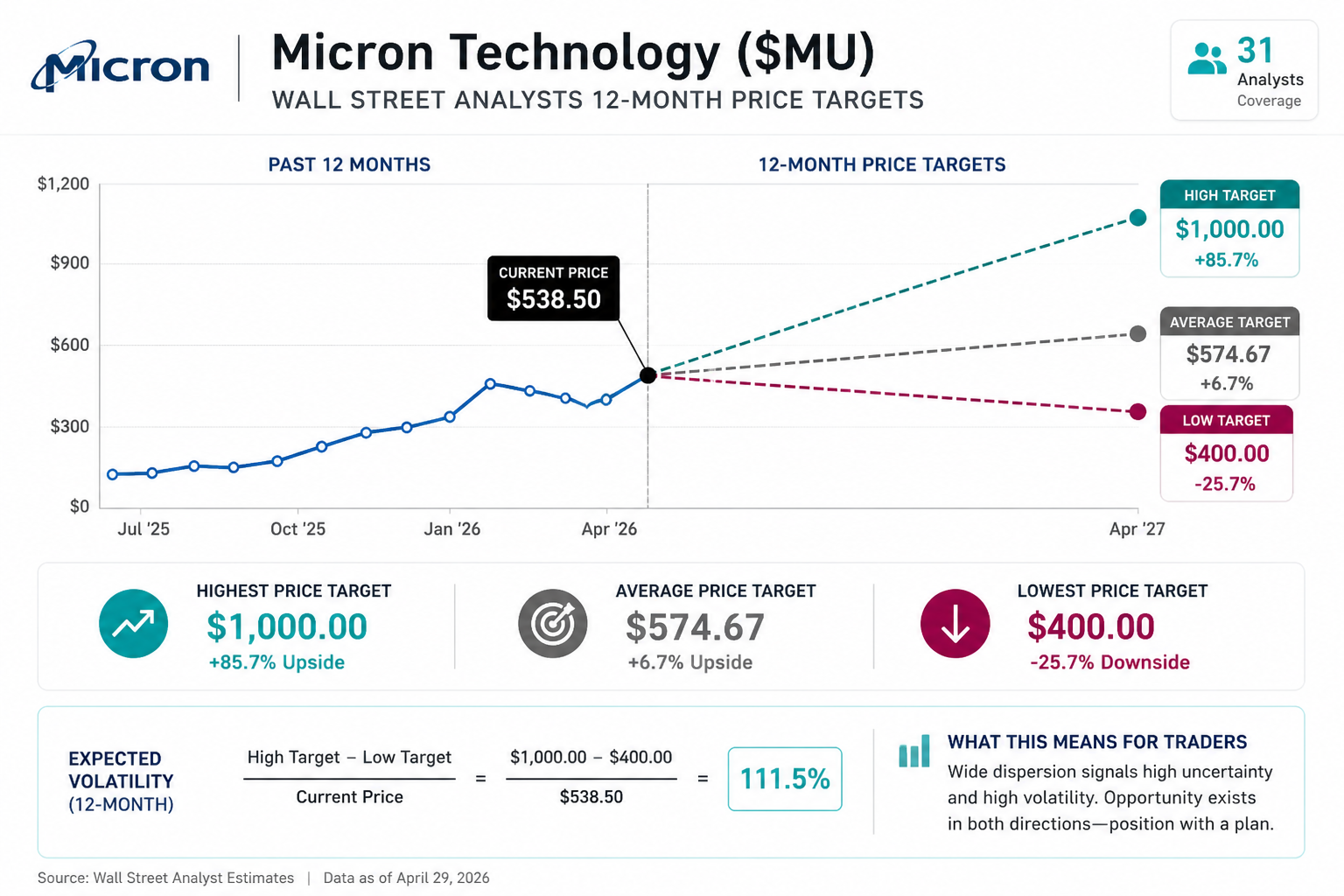
Micron Technology sits at $644.86, with Wall Street drawing a remarkably wide map of its future. Thirty-one analysts place the low at $400, the average at $574.67, and the high at a bold $1,000. That is not a consensus. That is a debate. The spread implies an expected move of roughly 111.5%, which tells you immediately that this is not a quiet stock. This is a battleground where conviction is scarce and opportunity is abundant.
What matters is not the average, but the distance between opinions. The upside case offers roughly 85% potential, while the downside risks about 26%. That asymmetry will catch a trader’s eye. Yet the modest premium of the average target above the current price suggests that expectations are not fully committed. In plain terms, Wall Street sees possibility, but not certainty. And when analysts disagree this widely, price rarely stands still.
The intelligent trader does not argue with forecasts. He studies behavior. A range this wide demands respect for volatility and discipline in execution. This is not about predicting Micron’s destination. It is about aligning with the trend as it reveals itself, and positioning accordingly. In markets like this, fortune does not favor the opinionated. It favors the prepared.
52 Week High and Low Boundaries

Micron is trading at $644.86, with a 52-week high of $651.74 and a low of $78.54. That places the stock at 98.8 percent of its 52-week range, essentially sitting right at the top. This is not a recovery story. This is a dominance story. The stock has already made a massive move, and it is now pressing against its highs, where decisions get made. Either demand continues, or the market pauses to reassess.
Now consider the scale of that move. The spread between the high and the low is $573.20, which equals roughly 89% of the current price. That is not normal volatility. That is expansion. It tells you this stock has experienced a powerful repricing over the past year. Stocks that move like this are not stable. They are directional. They trend, they pause, and then they resolve with force.
The takeaway is simple and practical. Micron is extended and powerful. The risk is not that it is weak. The risk is that traders assume strength will continue without interruption. At these levels, the next move matters more than the last one. Breakout leads to continuation. Failure leads to sharp pullbacks. This is where discipline separates amateurs from professionals. You do not predict what comes next. You prepare for both outcomes and act when the market shows its hand.
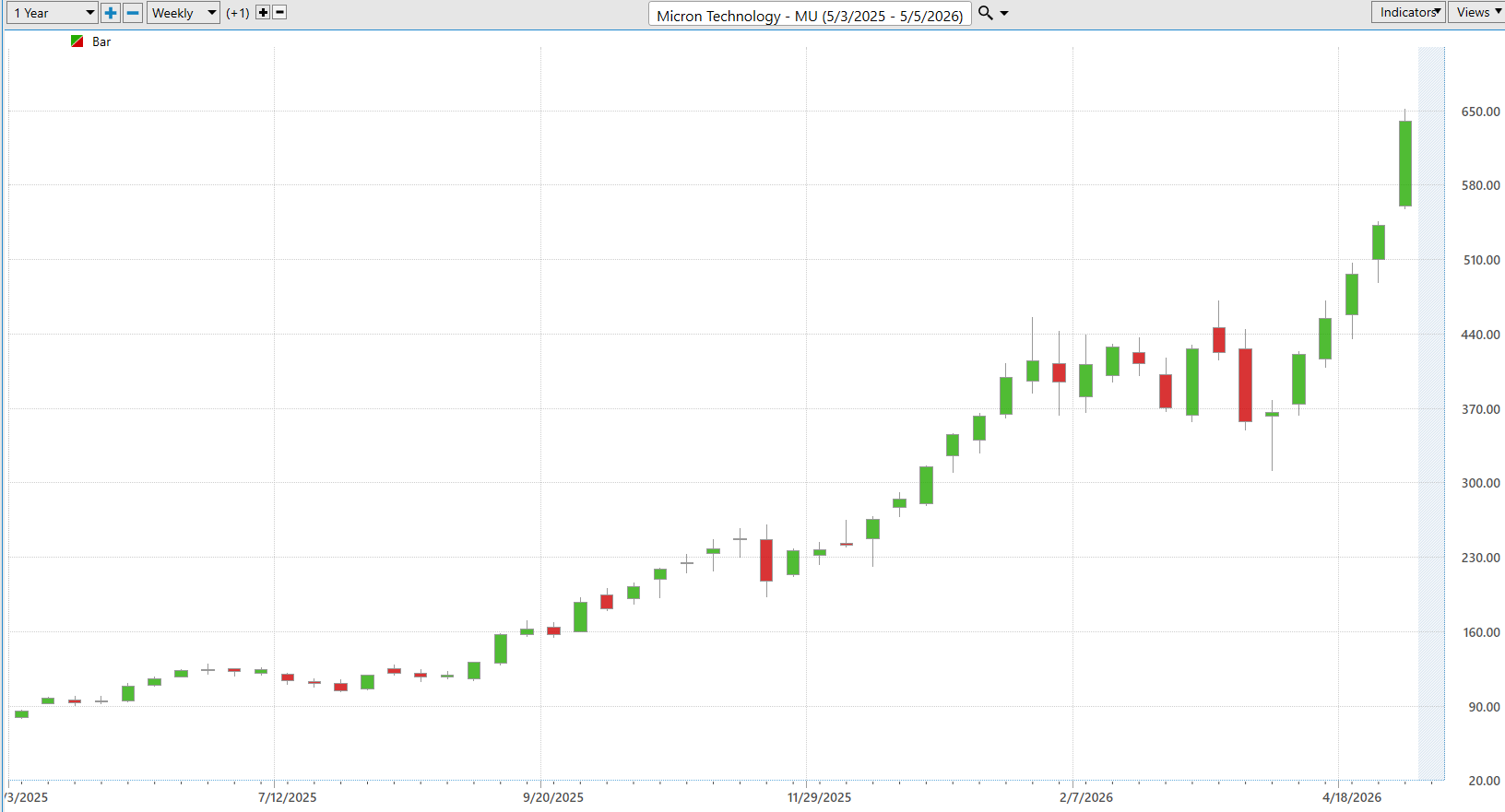
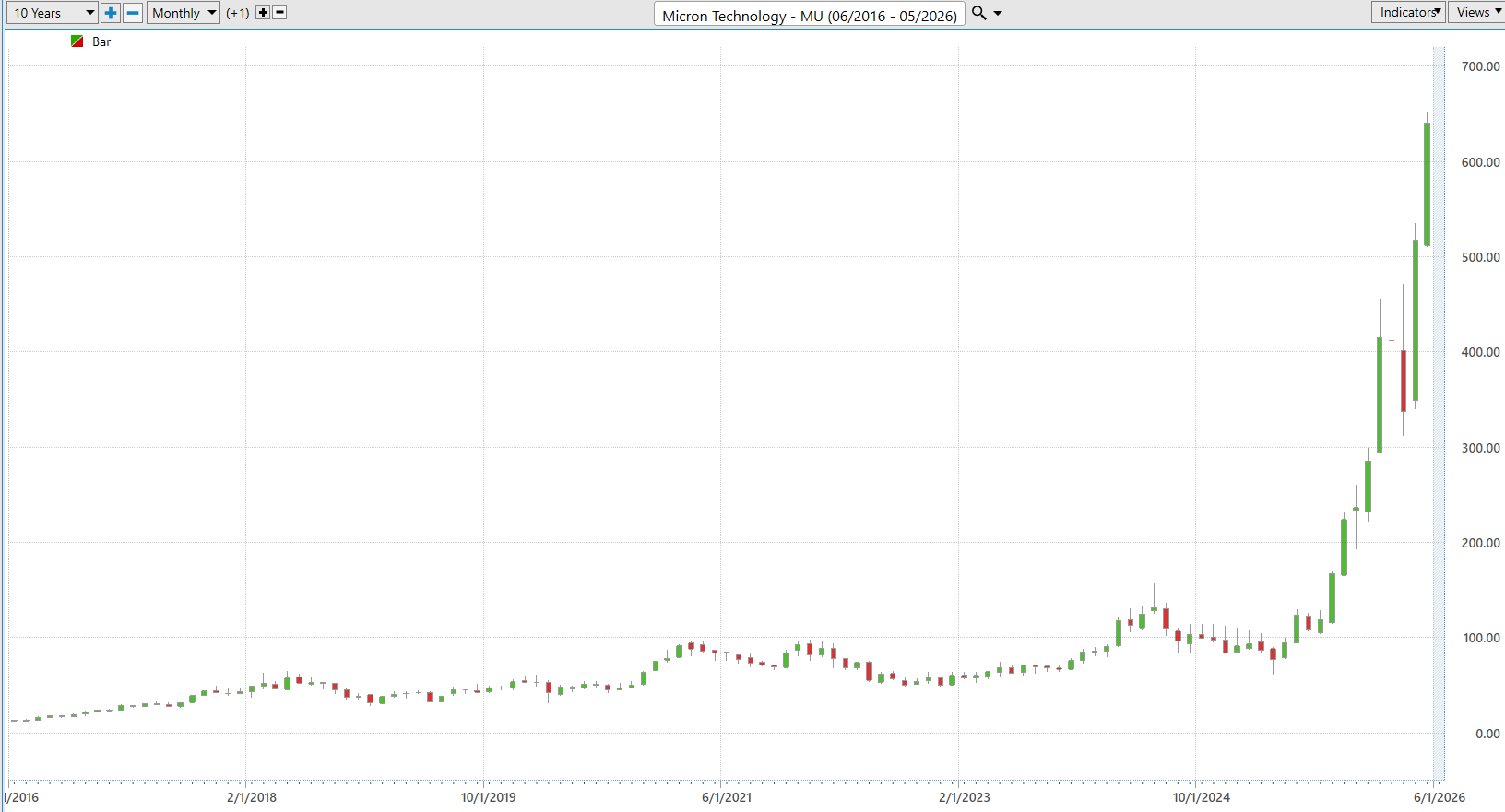
One of our all-time favorite trading setups is finding stocks that are making new 52-week highs and new 10-year highs at the same time. It sounds simple, but it’s incredibly powerful. When you look at Micron Technology across both timeframes, you’re not just seeing strength. You’re seeing alignment. Short-term momentum and long-term trend are both pointing in the same direction.
Why does this matter? Because when a stock is breaking out on both a 52-week and 10-year basis, it has effectively cleared every known level of resistance. There are no frustrated sellers waiting to “get back to even.” There are no overhead supply zones capping the move. This is what traders call price discovery, where the market is forced to continuously reprice the asset higher because there is no historical ceiling to anchor it.
These setups are rare, but when they show up, they tend to be explosive. The combination of institutional demand, momentum chasing, and lack of resistance can create powerful upside trends that persist longer than most expect. The takeaway is straightforward. When you find a stock doing this, you don’t fight it. You study it, respect it, and look for opportunities to align with it.
Best-Case/Worst-Case Scenario Analysis
The simplest, most practical way to understand volatility is to look at what a stock has already done. Measure the biggest rallies and the sharpest declines over the past year. If it moved like that before, it can do it again. That is not theory. That is behavior. And it gives you a clear, honest picture of the risk and reward before you put real money on the line.
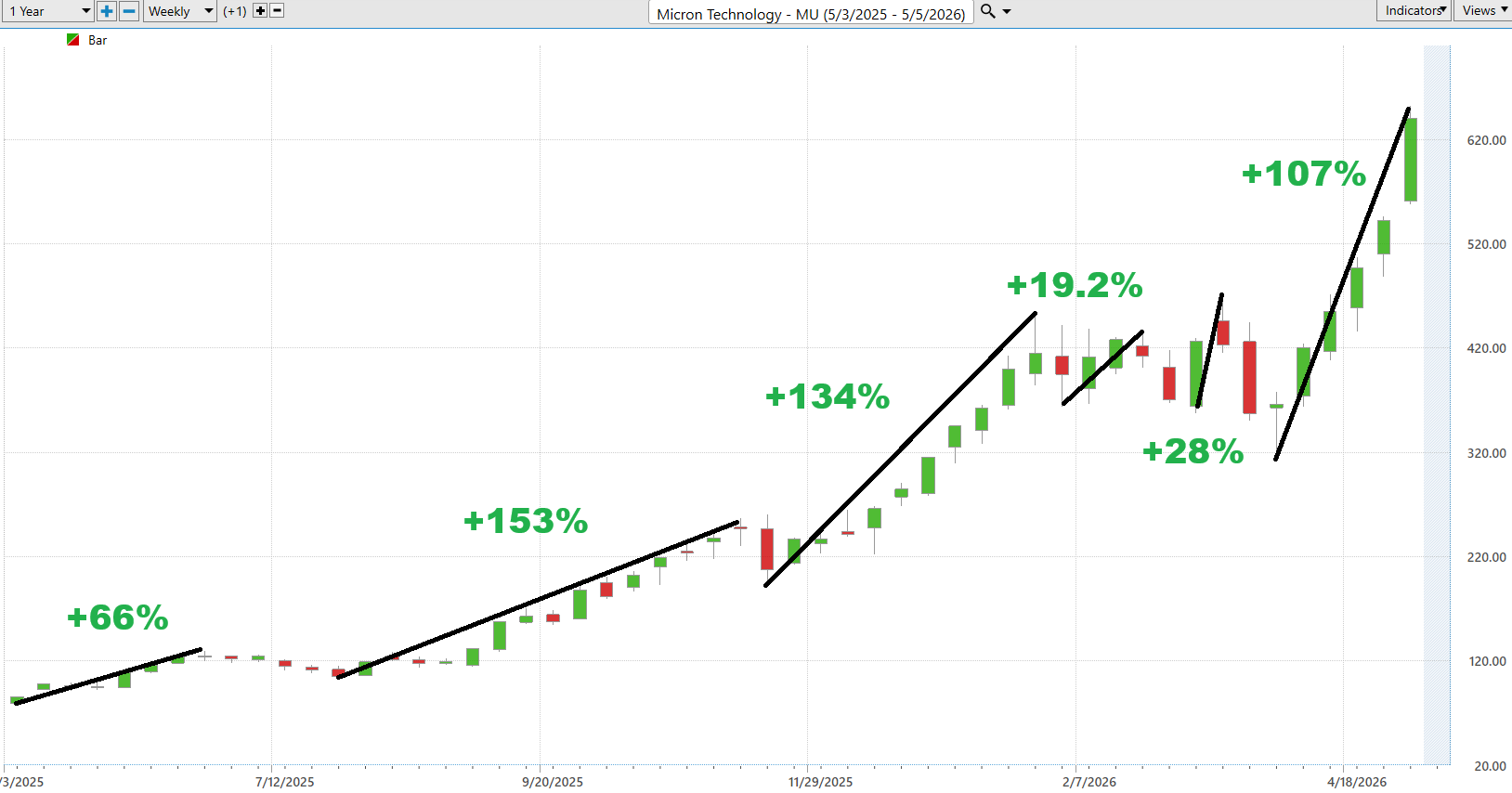
On the upside, Micron Technology has shown it can move like a rocket when conditions line up. Multiple rallies north of 50% and even 100% tell you this is not a slow grind higher. It is a momentum machine when memory pricing improves and AI demand kicks in. The pattern is consistent. Strong surge, brief pause, then another leg higher. When semiconductors are in favor, especially alongside Direxion Daily Semiconductor Bull 3X Shares (SOXL), this stock does not just participate. It tends to outperform.
On the downside, the same stock can pull the rug out just as fast. Declines of 20% to 30% are part of the deal, not an exception. These drops rarely come with polite warnings. They show up when sentiment shifts, pricing weakens, or supply starts creeping back in. The story can still sound good while the stock is already heading lower. That is how cyclical names behave. Fast up, fast down, and no apologies either way.
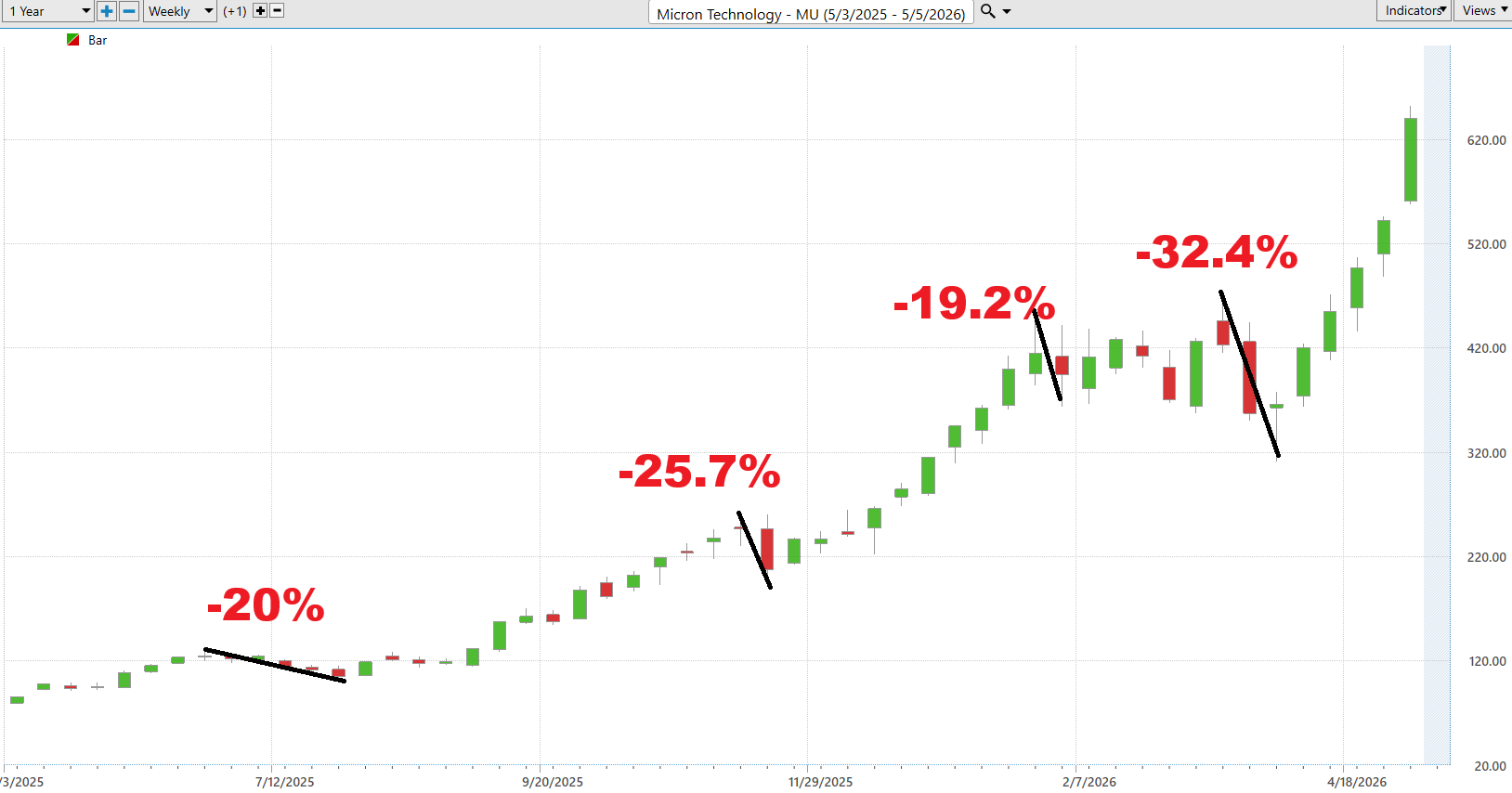
Put it together and you get a very clear profile. Big upside waves when you are right, painful drawdowns when you are not. This is a trader’s stock, not a comfort stock. If you respect the trend and manage risk, the opportunity is real. If you ignore the downside or try to outguess the cycle, it will eventually cost you.
Next we compare $MU to the broader stock market averages.

This is what domination looks like, plain and simple. Micron Technology is not just outperforming the market. It is lapping it. Over the past year, the stock is up an eye-popping 695%, while the Nasdaq Composite is up just over 43% and the S&P 500 Index sits under 30%. Even the more aggressive Russell 2000 Index cannot keep pace. That is not a rising tide lifting all boats. That is one boat with a rocket strapped to it.
Zoom in and the story does not change. Six months, Micron is up 168% while the broader indexes struggle to crack double digits. Year to date, it is up 103% versus single digit gains across the board. Monthly and weekly, the gap remains just as wide. This is what professionals call persistent relative strength. It shows up across every timeframe, which tells you this is not a fluke move or a short squeeze. This is sustained institutional accumulation.
Now here is where most traders get it wrong. They see a move like this and assume they missed it. But strength like this tends to persist because it is driven by real capital flows, not opinions. Money is rotating aggressively into semiconductors and memory, and Micron is a primary beneficiary. When a stock is beating the Dow Jones Industrial Average by this magnitude across every timeframe, it is sending a very clear message about where the market believes future earnings growth is coming from.
The takeaway is brutally simple. This is a leadership stock in a leadership sector. As long as it continues to outperform across multiple timeframes, the trend remains intact. The moment that relative strength begins to fade, especially on the shorter timeframes first, that is your early warning signal. Until then, fighting a stock with this kind of performance profile is not trading. It is arguing with the scoreboard, and the scoreboard is rarely wrong.
Vantagepoint AI Predictive Blue Line
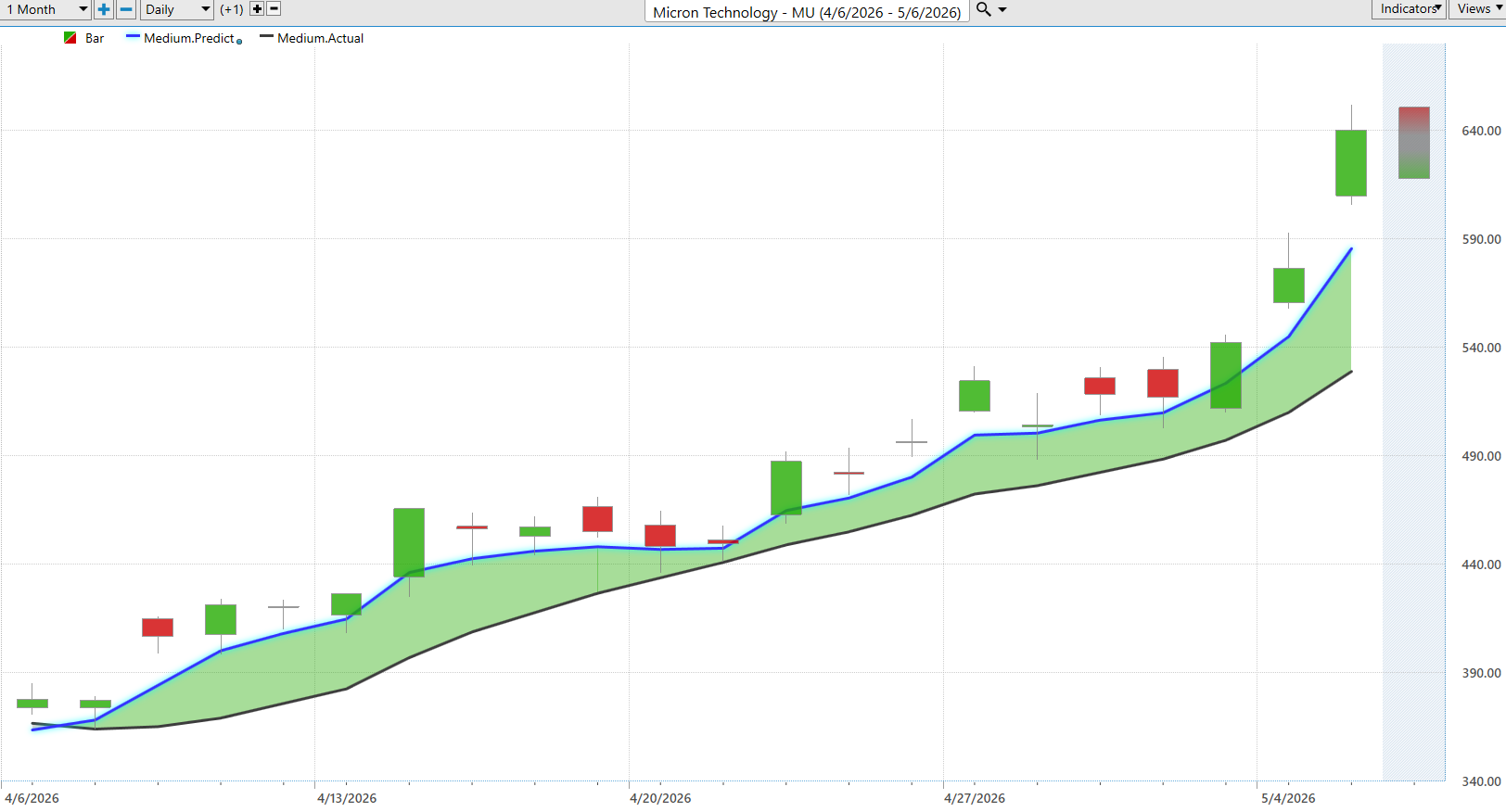
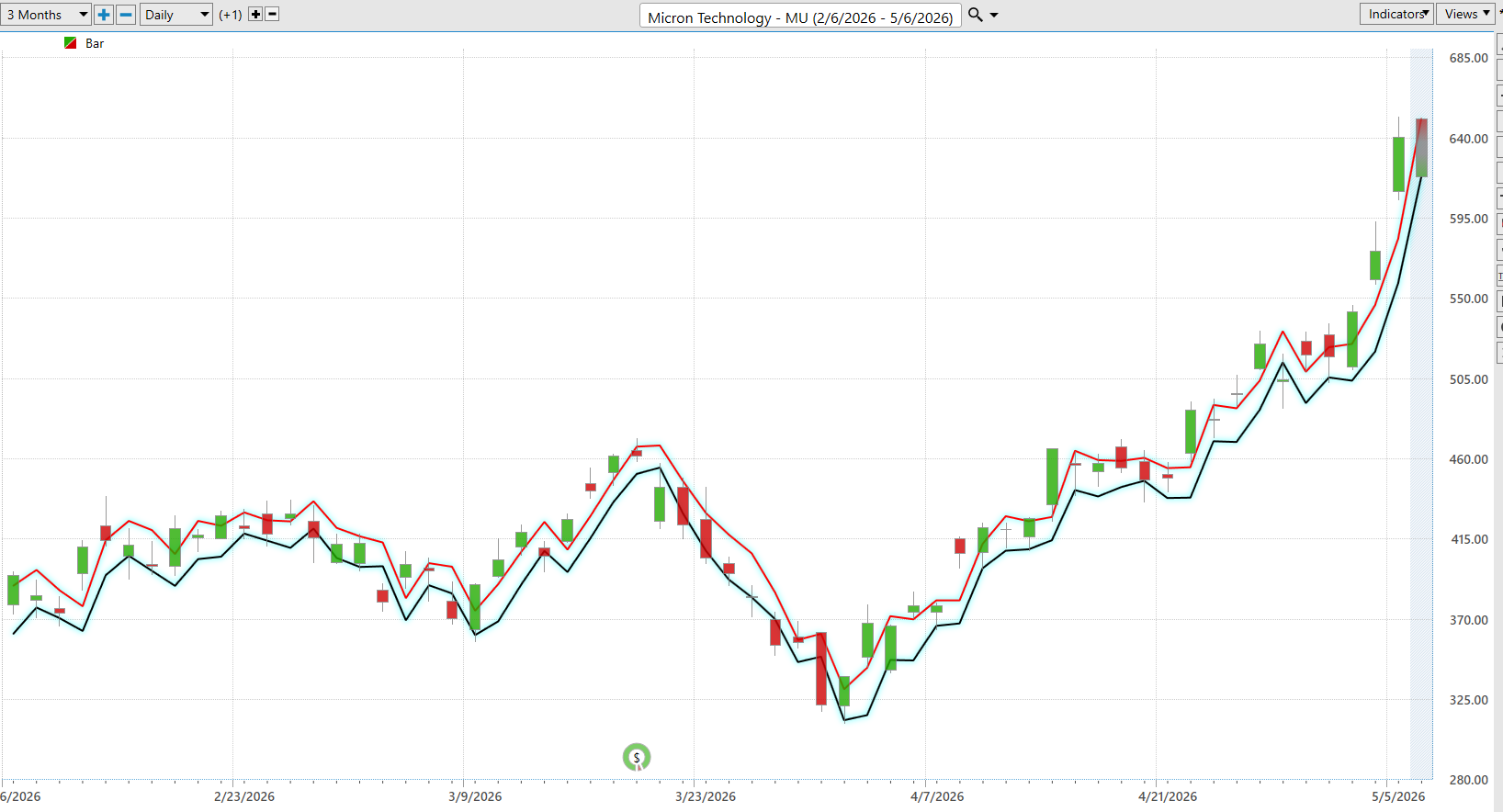
The first thing you notice on Micron Technology is that the Predictive Blue Line is not drifting sideways or rolling over. It is rising steadily, and more importantly, it is accelerating. That tells you the short term trend is firmly up. The market is not guessing here. It is trending with conviction. When that blue line slopes higher, the path of least resistance is higher prices.
Now look at the relationship between price and that blue line. Price is consistently holding above it, and when it does pull back, it respects that level as support. That green zone between the blue line and the black line is your value area. That is where professional traders look to engage the trend, not chase it. When price stretches too far above the blue line, you are paying a premium. When it comes back toward it, you are getting a better entry within the trend.
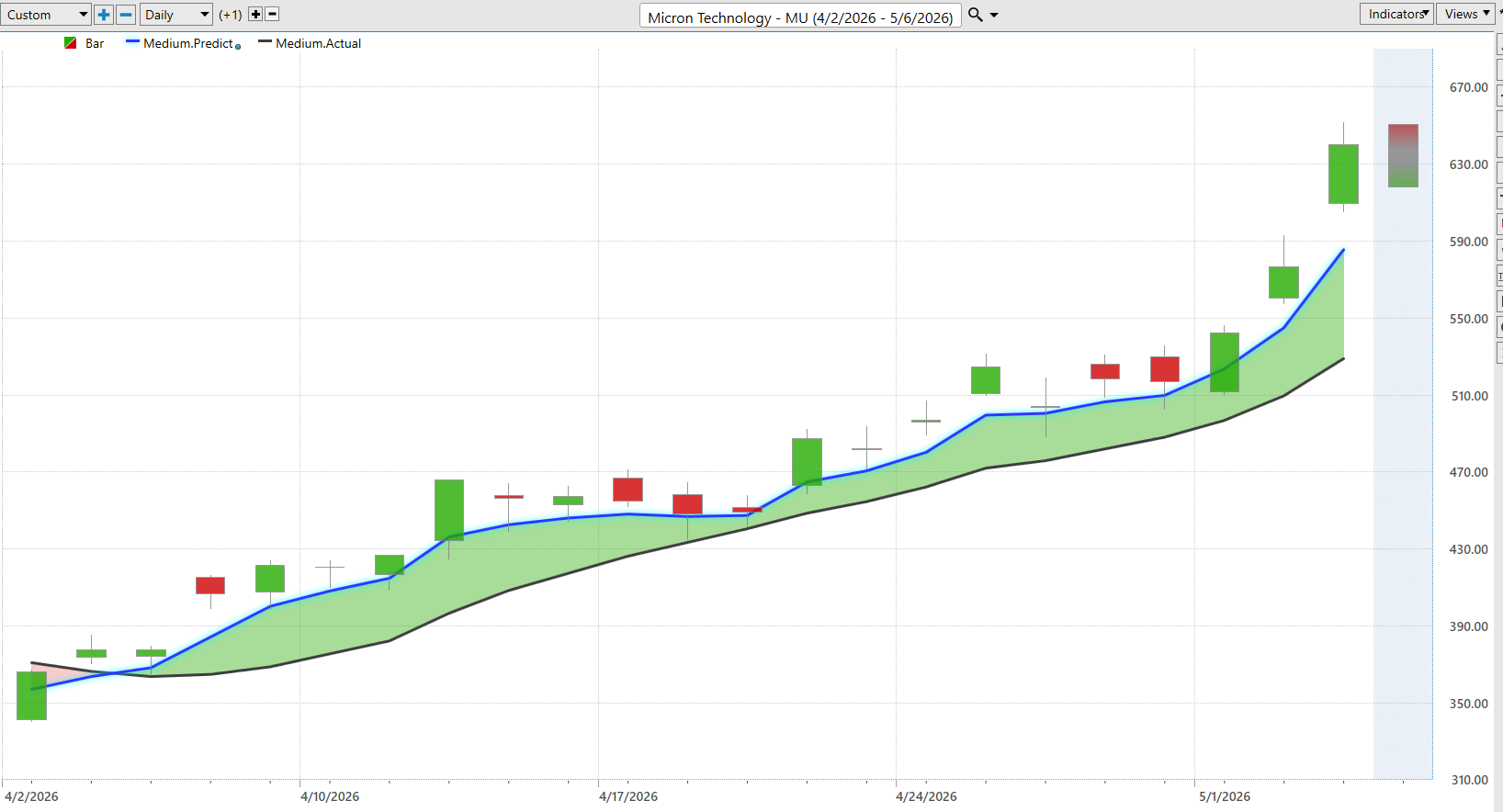
The black line, which represents the actual moving average, is trailing below and confirming the move. The key signal here is alignment. The Predictive Blue Line is above the black line and both are sloping higher. That is the textbook definition of a strong trend. As long as that relationship holds, the trend remains intact. The moment the blue line flattens or crosses below the black line, that is your early warning that momentum is fading.
The takeaway is simple. This is a strong uptrend being confirmed by forward looking data. The smartest move is not to fight it or overthink it. Respect the trend, use pullbacks toward the Predictive Blue Line as opportunities, and stay alert for any shift in slope or crossover. That is where the story changes, and in a stock like Micron Technology, it can change quickly.
VantagePoint AI Neural Index (Machine Learning)
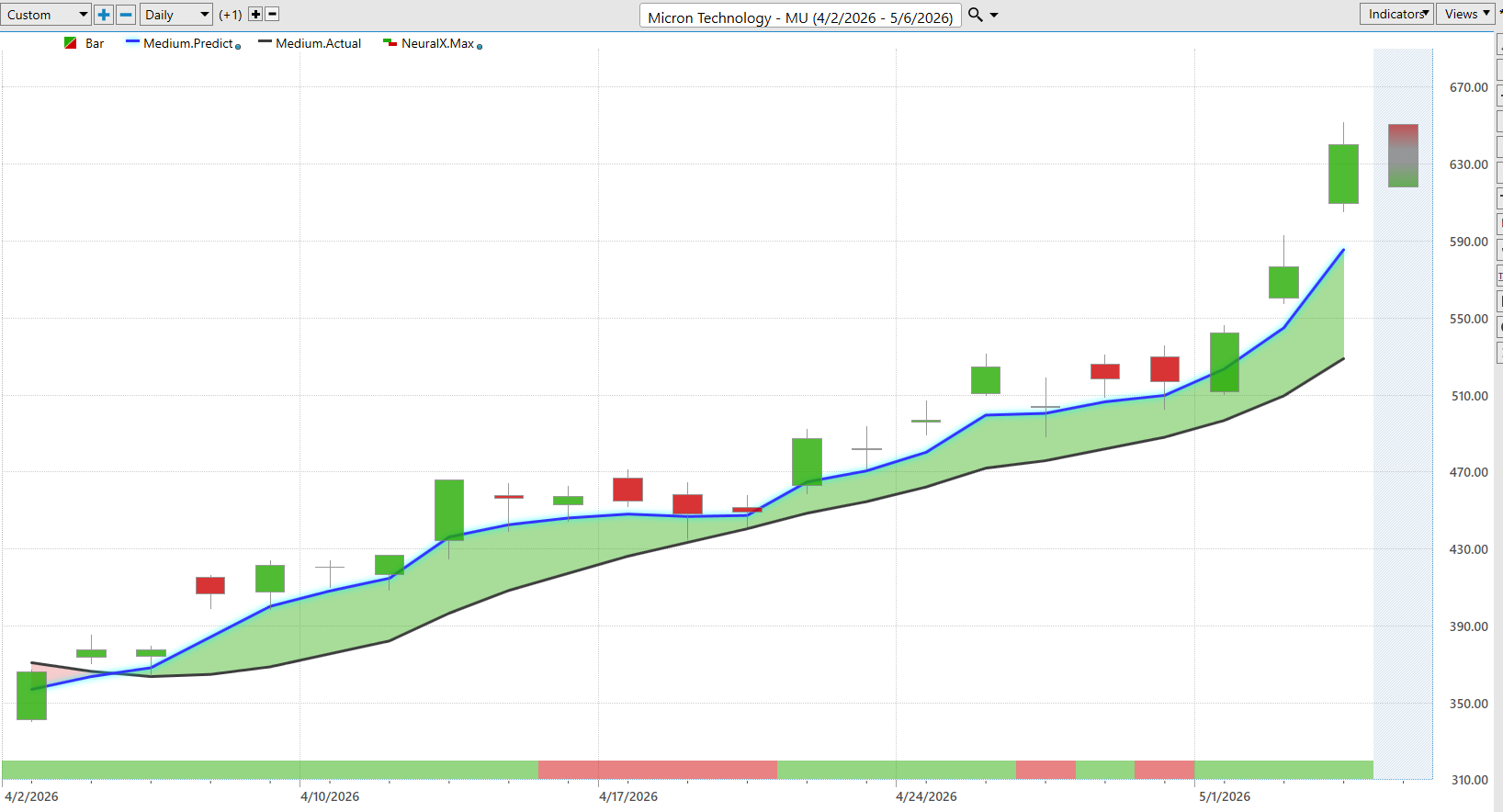
The first thing to understand about the Neural Index on Micron Technology is that it is not reacting to price. It is forecasting it. And right now, that forecast has been overwhelmingly bullish. You can see extended stretches of green signals, which tell you the next 48 to 72 hours are expected to favor higher prices. That kind of consistency is not noise. That is directional bias, and it has been firmly to the upside.
Now look at how those signals line up with actual price movement. When the Neural Index flips green, price tends to move higher or at minimum hold its ground. When it briefly turns red, you see short term pauses or minor pullbacks, not full blown reversals. That is the key insight. The bearish signals have been shallow and short lived, while the bullish signals have been persistent. That imbalance is exactly what a strong trend looks like under the surface.
The real power shows up when you combine this with trend confirmation. The Neural Index is mostly green while price remains above the rising Predictive Blue Line. That alignment is what traders look for. It means both the short term forecast and the broader trend are pointing in the same direction. In those conditions, probabilities shift. You are no longer guessing. You are stacking odds in your favor.
The takeaway is straightforward. As long as the Neural Index continues printing mostly green signals, the expectation remains for higher prices or at least stability within the trend. The first real warning sign will not be a single red print. It will be a cluster of red signals that persist. That is when momentum is shifting. Until then, the data is telling you to stay aligned with the trend, not fight it.
VantagePoint AI Daily Range Forecast
There’s a quiet but powerful story unfolding in Micron Technology, and it’s not just about direction. It’s about range.
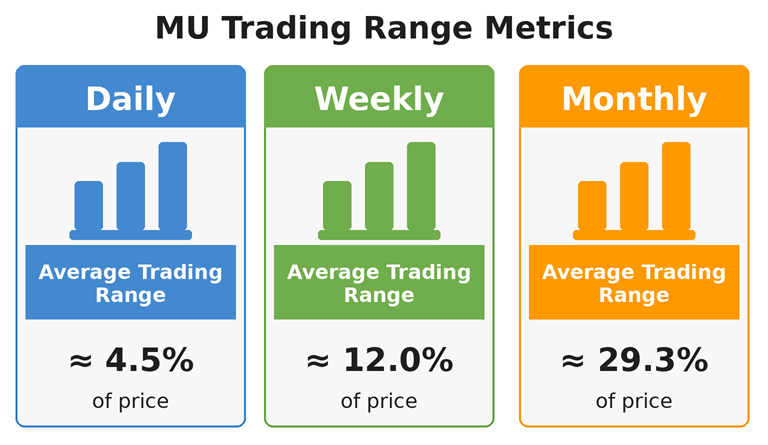
Using the latest trading range metrics as our foundation, the stock is currently operating with an approximate 4.5% daily range, a 12% weekly range, and a 29.3% monthly range. That tells you something important right away. This is not a sleepy trend. It’s an active, breathing market with enough volatility to reward precision and punish hesitation. In practical terms, that 4.5% daily range becomes your tactical battlefield. It defines how far the stock is likely to travel in a single session under normal conditions.
Now layer that onto the chart behavior. What we’re seeing is a stock that is not only trending higher, but doing so with expanding momentum into the upper end of its recent range. The daily bars are stretching, not compressing. That matters. When a stock pushes toward the top of its expected daily range consistently, it signals strong underlying demand. Institutions are not waiting for pullbacks. They are paying up. And when that behavior repeats over multiple sessions, the “normal” range often becomes a launching pad rather than a ceiling.
This is where the Daily Range Forecast becomes more than just a number. It becomes a decision framework. If the expected daily movement is roughly 4.5%, then traders can begin to map out high probability zones. Where is the stock opening relative to that range? Is it already extended? Is there room to move higher before reaching statistical exhaustion? Or is it opening near the upper boundary, where risk begins to outweigh reward? These are not academic questions. They are the difference between chasing strength and positioning intelligently within it.
The takeaway is straightforward, but not simplistic. Micron Technology is trending, and the volatility profile confirms that the trend has room to continue. But the edge comes from understanding the distance it can travel in a day. Respect the 4.5% range. Use it to frame entries, targets, and risk. Because in a stock like this, it’s not just about being right on direction. It’s about being right on timing.
VantagePoint AI Intermarket Analysis
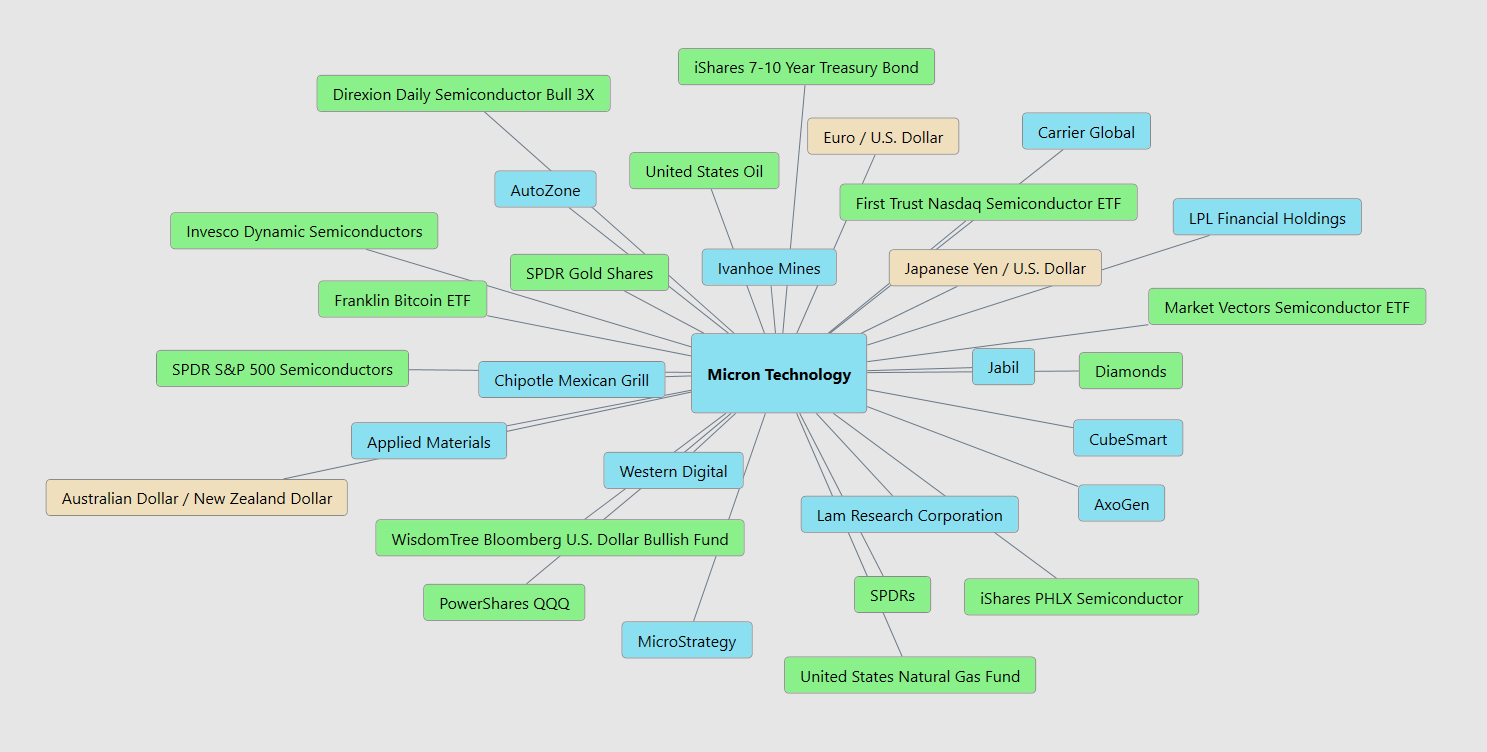
Intermarket analysis is just a smarter way of asking one question: what other markets are influencing the stock you’re trading? Instead of looking at a stock in isolation, you look at the web of relationships around it. Stocks, bonds, currencies, commodities, and sector ETFs all interact. When interest rates fall, tech stocks often rise. When the dollar strengthens, multinational earnings can get pressured. When commodities move, input costs and inflation expectations shift. For a trader, intermarket analysis turns noise into context. It helps you understand not just what is moving, but why it’s moving.
Micron Technology is not just a semiconductor company. It’s a node in a much larger financial ecosystem, and that ecosystem is speaking loudly right now.
At the center of the story is artificial intelligence demand, which has transformed Micron from a cyclical memory producer into a strategic supplier of infrastructure. Data centers are expanding aggressively, and that expansion is pulling through demand for high bandwidth memory. But what’s striking, when you step back and look at the broader landscape, is how many markets are reinforcing that narrative simultaneously. Semiconductor ETFs like iShares PHLX Semiconductor ETF and leveraged vehicles like Direxion Daily Semiconductor Bull 3X Shares are acting as confirmation mechanisms. When those instruments trend higher, they are effectively signaling institutional conviction across the entire chip complex, not just in Micron.
But the relationships go deeper. Consider the presence of PowerShares QQQ in the network. That tells you Micron is being pulled along by broader technology leadership, not operating in isolation. At the same time, bonds such as iShares 7-10 Year Treasury Bond ETF sit in the background, quietly influencing the cost of capital. When yields stabilize or decline, growth assets like semiconductors become more attractive. Currency markets add another layer. Movements in the Euro / U.S. Dollar and Japanese Yen / U.S. Dollar shape global demand conditions and purchasing power for Micron’s customers.
Then there are the less obvious connections, the ones traders often overlook. Commodities like United States Oil and gold via SPDR Gold Shares reflect macro sentiment. Risk-on environments tend to lift equities broadly, while defensive flows can signal caution. Even adjacent equities such as Lam Research, Applied Materials, and Western Digital help validate the trend. When they move in tandem, it suggests the demand story is real, not isolated.
The takeaway is this. Micron’s rally is not happening in a vacuum. It is being supported by a synchronized move across semiconductors, reinforced by favorable conditions in rates, currencies, and broader equity markets. For traders, that alignment matters. Because when multiple markets point in the same direction, the trend tends to persist. And when those relationships begin to break down, that is often the first signal that something larger is changing beneath the surface.
Our Suggestion
Micron’s last two earnings calls tell a story that should sound very familiar to traders who have been paying attention, but the tone has shifted in an important way. Management is no longer defensive. They are increasingly confident, and more importantly, specific. The conversation has moved away from inventory corrections and weak pricing and toward tight supply, strong demand, and accelerating orders tied to artificial intelligence. When executives start talking less about “stabilization” and more about “allocation,” you know the cycle has turned. That shift in language matters because it signals that Micron is no longer reacting to the market. It is beginning to participate in shaping pricing again.
Execution, at least for now, appears solid. The company has been disciplined on supply, which is historically where memory companies get themselves into trouble. Instead of flooding the market, management has emphasized constrained output and prioritizing higher value products, particularly high bandwidth memory used in AI data centers. That is where the margin story begins to change. The biggest concern management continues to flag is not demand, but the ability to meet it. Supply constraints remain real, and while that supports pricing, it also caps how quickly revenue can scale. Guidance from management and expectations from Wall Street both point toward continued revenue growth and expanding margins, but the underlying assumption is that demand remains strong and supply remains rational. That is the bet.
For traders, the takeaway is straightforward. The narrative is aligned, but narratives do not move stocks. Expectations do. The next earnings report will be critical, not because of what Micron reports, but because of what it says about forward demand, pricing, and capacity. If management continues to sound confident and confirms tight supply conditions, the trend likely stays intact. If there is any hint of demand softening or supply ramping too quickly, the stock can reprice fast.
Practice great money management on all of your trades.
This is where tools like the VantagePoint AI Daily Range Forecast become essential. In a stock with this kind of volatility profile, understanding how far it can move in a given session is not optional. It is the difference between managing risk and reacting to it.
It’s not magic.
It’s machine learning.
Disclaimer: THERE IS A HIGH DEGREE OF RISK INVOLVED IN TRADING. IT IS NOT PRUDENT OR ADVISABLE TO MAKE TRADING DECISIONS THAT ARE BEYOND YOUR FINANCIAL MEANS OR INVOLVE TRADING CAPITAL THAT YOU ARE NOT WILLING AND CAPABLE OF LOSING.
VANTAGEPOINT’S MARKETING CAMPAIGNS, OF ANY KIND, DO NOT CONSTITUTE TRADING ADVICE OR AN ENDORSEMENT OR RECOMMENDATION BY VANTAGEPOINT AI OR ANY ASSOCIATED AFFILIATES OF ANY TRADING METHODS, PROGRAMS, SYSTEMS OR ROUTINES. VANTAGEPOINT’S PERSONNEL ARE NOT LICENSED BROKERS OR ADVISORS AND DO NOT OFFER TRADING ADVICE.