



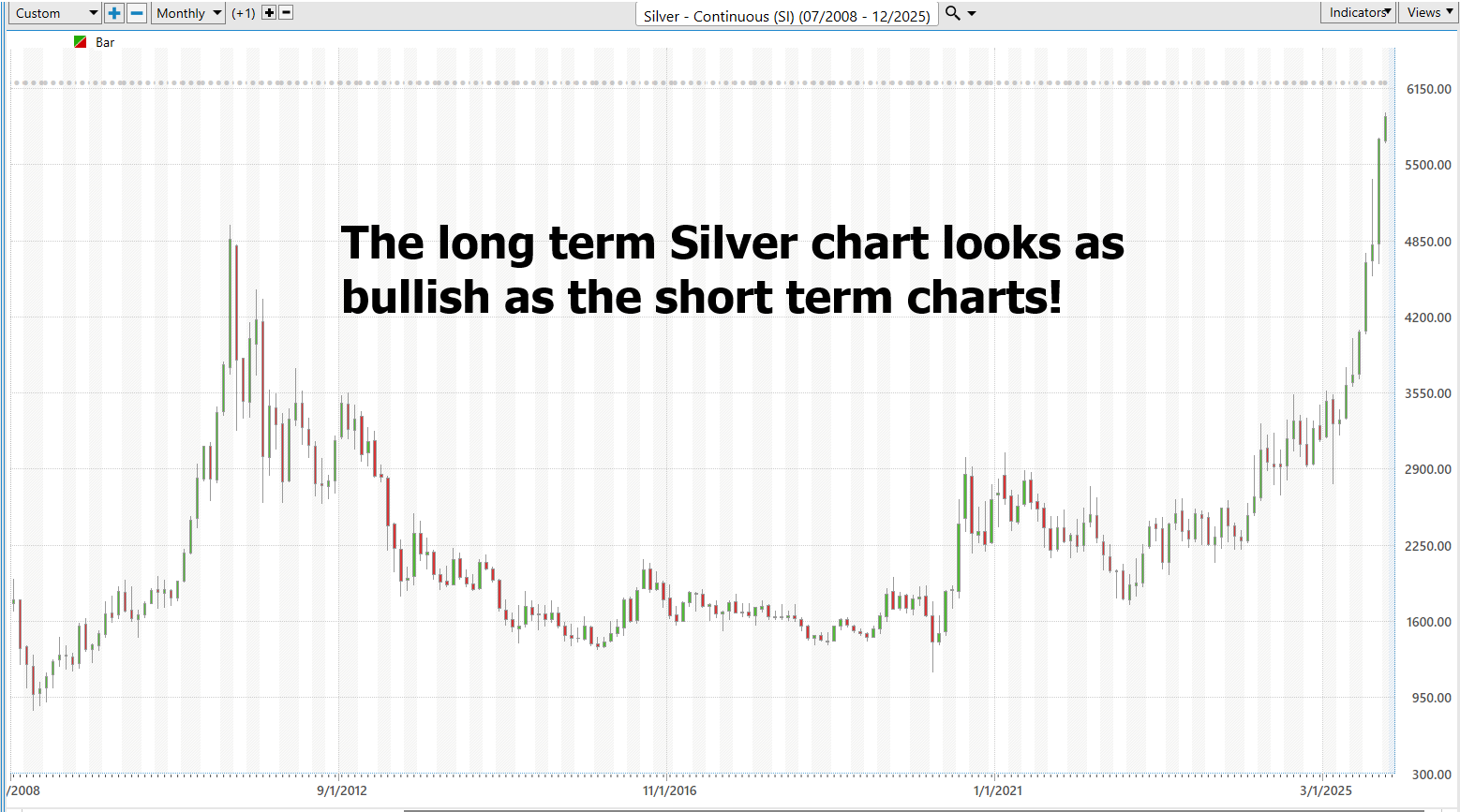
There are moments in the markets, rare, seismic moments, when a price chart doesn’t just move… it testifies. When it doesn’t just break resistance… it breaks history. Silver crossing the threshold of a 45-year trading range is one of those moments. Not a wiggle. Not a blip. A generational breakout, something so powerful, so undeniable, that even the loudest skeptics fall strangely silent.
To appreciate what this means, you must go back to the last time silver approached anything like today’s levels. Picture the year 1980. The Hunt Brothers, armed with Texas oil money and a vision of hard-money salvation, amassed a silver position large enough to make governments nervous and Wall Street sweat. The price rocketed toward $50. Then, like a plot twist designed by a screenwriter with a grudge, the COMEX changed the rules mid-game, jacking margin requirements to 100% cash. Overnight, traders could no longer buy. They could only sell.
That wasn’t a market correction. That was a guillotine. Silver absorbed a blow so orchestrated and severe it would have killed a lesser asset for centuries.
Yet here we are. Fifty years of mockery later, silver stands at new all-time highs.
And still, the familiar refrains echo:
“Silver is dead money.”
“Industrial demand will fade.”
“It’s too volatile, too manipulated, too old-world to matter.”
The bears cling to these lines like they’re reading from a script they no longer believe.
But let’s be brutally honest:
To remain bearish on silver at all-time highs, you must have clandestine briefings from the Treasury Secretary himself.
Because when a market survives a half-century of ridicule, government interference, engineered collapses, and institutional disdain — and still breaks to fresh highs — it’s no longer whispering. It’s shouting.
And the savvy traders, the ones who recognize a once-in-a-generation signal when it roars through the noise…
They act.
And that brings us to the real purpose of this article. Because while the headlines will obsess over the spot price of silver — breathlessly reporting each new high like a meteorologist tracking a storm, savvy traders know the real opportunities live in the tiers beneath the metal itself.
Silver doesn’t just move. It multiplies through the miners. And those miners exist in a hierarchy, distinct layers of leverage, each one amplifying the price action of silver in its own explosive way.
In the pages ahead, I’ll walk you through these tiers with the precision of a jeweler examining a rare stone:
The senior producers with billion-dollar balance sheets that surge when silver rips higher…
The mid-tier operators whose margins widen dramatically on every $1 move…
And the most electrifying group of all, the junior silver explorers and developers, the tiny speculative rockets who live and die by every twist in the silver chart.
When silver moves 10%, these juniors can move 50%, 100%, sometimes more, simply because their entire business model is leveraged to discovery, momentum, and the psychological fever that always accompanies a true silver breakout.
So, if you’ve ever wondered where the highest-octane opportunities hide when a precious metal enters a generational bull run…
If you’ve ever wanted a framework for separating the disciplined speculation from the casino table…
If you want to understand which miners benefit first, which benefit most, and which can change your financial statement the fastest…
This article will give you that map.
A layered blueprint for navigating the silver universe, from the giants… to the contenders… to the wildcards capable of turning a normal bull market into a wealth event.
Because when silver breaks a 45-year range, you don’t just watch.
You position.
If you want to understand the silver market there’s no better place to start than the silver mining ETFs. These things are like the encyclopedias of underground treasure hunting, except with fewer Indiana Jones hats and more balance-sheet stress.
The big dogs in the yard are:
· SIL — Global X Silver Miners ETF
· SILJ — Amplify Junior Silver Miners ETF
· SLVP — iShares MSCI Global Silver & Metal Miners ETF
SIL is your global grown-ups table, producers with real operations and real output. SILJ is the kiddie table where the junior miners sit: promising, speculative, excitable, and capable of sending your portfolio soaring or sobbing before lunch. SLVP is a broader metals blend, the sampler platter for people who don’t trust themselves to pick just one shiny thing.
Now one of the best things you can do is actually visit these ETFs’ websites. Yes, I know: shocking. A world filled with A.I. tools, algorithms, and 900-page Fed minutes, and here I am telling you to click on a simple holdings tab.
But once you’re there? Magic. Enlightenment. A slap across the face from the invisible hand itself.
Because when you look at an ETF’s holdings and then measure the performance of each component, you’re doing what smart traders have done since the first caveman noticed one rock rolled faster downhill than another: you’re identifying strength and weakness.
This simple discipline, this five-minute ritual of scrolling through names like Pan American Silver, Hecla Mining, First Majestic, Wheaton Precious Metals, MAG Silver, and the rest of the merry band, teaches you more than a semester of “Financial Market Theory.” You see who’s breaking out. Who’s falling apart. Who’s pretending to be a silver miner but just mining shareholder patience.
Because at the end of the day, the bottom line really is the bottom line.
And long-time readers know we practice a simple philosophy: Always know what’s strong. Always know what’s weak.
It applies to the S&P 500, to sectors, to currencies, to commodities, and yes, to the wonderfully chaotic nuthouse that is the silver mining ETF universe.
The whole mess with modern finance starts with this dirty little secret: you’re forced, by law, no less, to wheel and deal in glorified Monopoly money. Legal tender laws make sure every transaction begins in fiat, ends in fiat, and chains you to fiat like some broke extra in a prison movie.
Then came the moment the geniuses in charge chucked Bretton Woods into the nearest dumpster. That’s when gold and silver finally got sprung from their cages and let loose to trade like real, living markets. And ever since, the gold-to-silver ratio has wandered around like a drunk looking for his car keys — 25:1 one decade, 120:1 the next, swaying, stumbling, and making bad decisions.
Right now, it’s about 73:1 and dropping like a shot glass at last call, because silver is sprinting ahead faster than a frat boy running up a bar tab with no adult supervision.
And here’s the part that should make your eyebrows crawl off your forehead: gold — the ancient heavyweight champ of money itself, has been ripping higher all year. Yet somehow, silver, the scrappy, overlooked sidekick that everyone forgets until it starts throwing elbows, has launched a jailbreak of its own and is blasting through the yard like it stole something.
Silver, for all its mystique and monetary lore, usually shows up in the mining world like an unexpected party guest, technically welcome, rarely invited, and mostly riding in on someone else’s ticket. Only about a quarter of global silver comes from mines that intend to dig up silver. The other 70 – 80% is scraped off the side of gold, copper, lead, and zinc operations like leftover frosting from a badly cut cake. And because of that, silver supply depends less on silver demand and more on whether gold miners feel optimistic, copper miners feel solvent, or zinc miners feel like getting out of bed. In other words, silver’s fate is dictated by a supporting cast that didn’t ask for the job.
As for how much silver a gold mine coughs up, there’s no simple rule — though global production statistics do roughly land around an 8:1 ratio. But that’s an average, not a promise. Some gold mines produce silver by the bucketful; others couldn’t find an ounce of silver if you handed them a metal detector and a treasure map. Geologists say the Earth holds something closer to 20 ounces of silver for every ounce of gold, but good luck getting that out of the ground in evenly distributed portions. Silver, as usual, behaves like silver: wonderfully valuable, annoyingly inconsistent, and always dependent on someone else’s business plan.
With the gold-to-silver ratio parked around 73:1, the market is effectively saying, “Gold is the aristocrat, silver is the scrappy street kid, and don’t expect them to trade places anytime soon.” But let’s imagine a world where silver decides it’s tired of being the sidekick and wants to reclaim a historical relationship, say 20:1, or even the geological fever dream of 8:1, all while gold stays frozen at $4,250.
Here’s where the numbers get loud:
If the ratio shrinks to 20:1:
Silver must trade at 1/20 of gold.
· At $4,250 gold → Silver = $212.50/oz.
· That’s not a rally—that’s silver stealing the keys to a Ferrari.
If the ratio shrinks to 8:1:
Silver becomes 1/8 of gold’s price.
· At $4,250 gold → Silver = $531.25/oz.
At that point, silver isn’t a precious metal, it’s a national emergency for bullion dealers.
So, even with gold sitting perfectly still, sipping tea at $4,250, silver would need to launch itself several hundred percent higher just to return to ratios that used to be considered normal.
This is why silver bugs grin like they know a secret, gold bugs grind their teeth, and every central banker quietly hopes no one does this math on camera.
In the architecture of the modern silver market, there’s a three-tiered framework that every serious trader should probably have etched somewhere they can’t ignore. Tier One is dominated by the diversified giants, the companies for whom silver is often a beneficial by-product rather than a central mission. These operators move with the deliberateness of oil tankers: slow, steady, and highly sensitive to macroeconomic currents. Tier Two consists of the primary silver producers, the firms whose fortunes hinge directly on the metal’s day-to-day price action. They are more volatile, more reactive, and, for traders, far more revealing. And then there is Tier Three, the juniors, the speculative frontier of the industry. These are the companies built on drill rigs, capital raises, and conviction. They can triple on a discovery or unravel overnight after a financing. Each tier has its own tempo and its own risk signature, and traders who ignore those distinctions do so at their peril. Understand the structure, and silver stops being an enigma and starts behaving like a system.
If you want to understand where the silver market derives its gravitational pull, don’t start with price charts. You start with the mines large enough to be seen from orbit. Consider Juanicipio in Mexico, the joint venture between Pan American Silver ($PAAS) and Fresnillo ($FNLPF), an operation that often behaves like the commodity-market equivalent of a high-yield bond: steady, predictable, and built on the implicit assumption that tomorrow will look roughly like today. Fresnillo ($FNLPF) also operates Saucito and San Julián, two properties that collectively produce enough silver annually to keep the American consumer supplied with shiny household goods well into the next celestial event. In Russia, Polymetal’s ($AUCOY) Dukat mine continues to function through geopolitical turbulence that would send a typical risk committee spiraling. Due to the Russia Sanctions $AUCOY is no longer available to traders outside of Russia.
And in Australia, Cannington remains one of the world’s most productive deposits — the Outback’s industrial answer to a wholesale warehouse, except the inventory is buried hundreds of meters below ground.
What ties these massive operations together — and what makes them indispensable to traders — is not their mystique, but their weight. Any operational hiccup at Juanicipio can reverberate through Pan American Silver ($PAAS) and Fresnillo ($FNLPF) like a policy shift at a central bank. A revised production outlook from Dukat can force recalibrations on risk desks an ocean away. A cost surge at Cannington is a reminder that mining, unlike trading software, still involves geology, diesel, and human beings. In a marketplace increasingly defined by derivative structures and digital abstractions, these mines remain the physical foundation beneath the silver price. To ignore them is to rely on a map without acknowledging the terrain.
For those looking for a more precise, more immediate read on silver’s direction, attention inevitably turns to the mid-tier primary producers — the companies that live and die by the metal’s fluctuations. Pan American Silver ($PAAS), First Majestic ($AG), Hecla Mining ($HL), and Silvercorp Metals ($SVM) anchor this category. They lack the diversified income streams of the global majors, which is precisely why their earnings, forecasts, and cost disclosures offer unusually clean signals. Their quarterly filings often act as early indicators of market shifts long before the spot price makes those changes obvious. They react to Federal Reserve policy, dollar strength, and interest-rate expectations with a sensitivity that frequently creates sharper, more tradeable opportunities than the metal itself.
For traders, these companies offer something rare in commodity markets: transparency. They publish detailed production metrics, ore grades, and all-in sustaining cost data that reveal the industry’s margin trends in real time. When silver rallies, these producers often accelerate first. When silver plateaus, they show the compression before the broader market recognizes it. In other words, they provide the “tells”, the signals that matter when you’re trading ahead of the curve.
And then there are the juniors — the experimental edge of the industry — the miners that behave less like traditional companies and more like high-beta options on geological optimism. Aya Gold & Silver ($AYA.TO), Vizsla Silver ($VZLA), Dolly Varden Silver ($DV.V), AbraSilver ($ABRA.TO), and Silver Tiger Metals ($SLVR.V) populate a landscape fueled by assays, drill results, and PowerPoint decks promising imminent transformation. Tracking them can feel like deciphering a treasure map sketched under duress: the “X” is theoretically present, but its meaning, and its probability, is open to interpretation.
What they lack in stability, they compensate for in torque. A positive drill intercept can send shares soaring 40% before noon. A disappointing assay can erase months of gains in a single session. But this volatility is precisely their appeal. In a rising silver market, juniors are often the first to surge, amplifying every bullish impulse. They are, in effect, the market’s leverage — unruly, unfiltered, and occasionally spectacular. For traders who understand the risks, they represent pure optionality: the possibility of dramatic upside when the underlying metal begins to move.
If you’re going to approach the silver-mining sector with the discipline of an institutional investor rather than the enthusiasm of a weekend tourist wandering through the commodities aisle, you need a watchlist with actual strategic value. Not an assortment of symbols collected from social media chatter, but a curated, functional framework built around how each company behaves — and, in some cases, how aggressively it can move against you. The first step is segmentation.
The Green Zone houses the large, diversified producers — the operators that move with the deliberateness of Sunday traffic and rarely surprise anyone. Think $S32 and $FRES: dependable, orderly, and unlikely to ignite your portfolio.
The Orange Zone is where the primary silver producers sit, including $PAAS, $HL, $AG, and $SVM. These are the companies whose earnings and strategic posture hinge directly on the price of silver, and when the metal enters a real trend, they have a long track record of rewarding investors who were paying attention.
And then there is the Red Zone, the high-volatility frontier populated by the juniors — $AYA, $VZLA, $DV, $ABRA, $SLVR — firms where the distance between discovery and disappointment can be measured in hours, and where capital can multiply or evaporate with equal velocity.
Once you’ve sorted these companies into the appropriate categories, the real work begins. Tracking them requires vigilance — the kind more often associated with risk desks than retail brokerage apps. Monitor earnings calendars the way a coastal city monitors hurricane forecasts. Watch insider transactions closely; few signals are more informative than a CEO unloading shares on the eve of a drilling update. And pay attention to volume — juniors rarely tiptoe; they stampede.
A watchlist, in this context, isn’t decorative. It’s an early-warning system — a real-time radar screen. Ignore it, and you’re effectively trading in the dark. Use it with discipline, and you’ll often spot the move long before the rest of the market realizes something’s shifting.
Let’s look at their performance year to date. You can quickly see the variance of the returns.
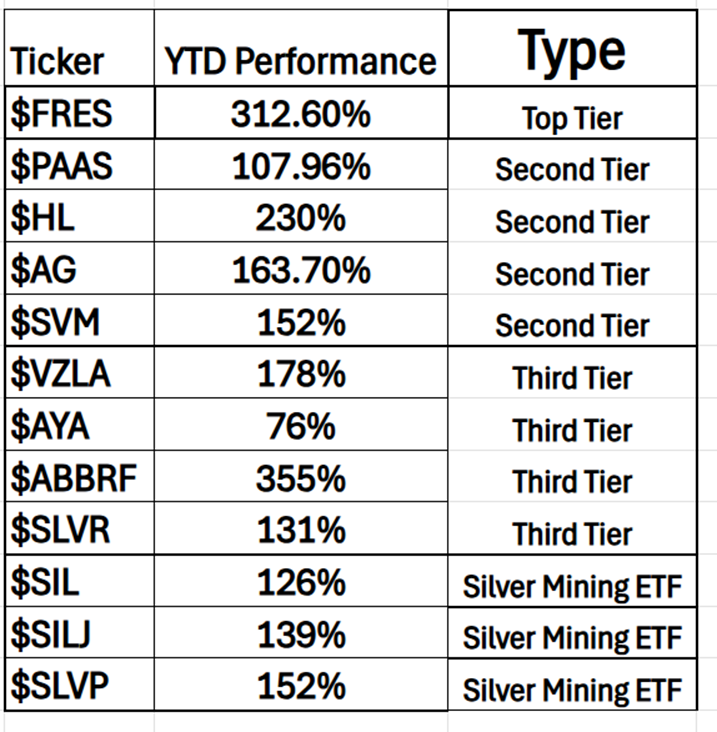
As you study those results keep in mind that this snapshot was done when the S&P 500 was up 16% and the Nasdaq up 20%. Even the worst laggard on the chart above is running laps around the broader stock market averages.
Trading silver miners isn’t so much an investment strategy as it is a guided tour through a three-story saloon where every floor has its own rowdy temperament. The big producers downstairs play it straight — slow, sober, and generally the first to signal whether silver itself is finally waking up. One flight up, the primary silver producers move with more enthusiasm; once margins start expanding, they behave like they’ve just been handed the aux cord. And at the top of the stairs live the juniors — the high-beta daredevils who wait until everyone’s convinced the trend is real, then bolt off the balcony to see how much higher gravity will let them climb. Smart traders ride this sequence on purpose: majors for confirmation, mid-tiers for acceleration, juniors for fireworks… or burns.
But none of this circus operates on its own. Silver miners dance to whatever tune the U.S. dollar, Treasury yields, and global nerves are playing that week. A softer dollar or easing yields? The whole sector inhales confidence. Rising rates? Suddenly everyone’s calculating how long a cash-strapped junior can tread water. Mean-reversion hunters go bargain-shopping during macro-driven selloffs, scooping up what’s been unfairly beaten. ETF traders lean on SIL or SILJ to bet on stability or all-out speculation. The trick is remembering that these miners live at the crossroads of commodities, capital flows, and geopolitics — a place where even the traffic lights look jumpy.
And if all that sounds exhilarating, that’s because trading silver miners makes bullfighting look like a yoga retreat. Juniors, especially, behave like teenagers doing donuts in a borrowed car — thrilling until you realize the insurance doesn’t cover stupidity. One bad drill result, one “brief operational pause,” and the stock is suddenly auditioning for a gravity-themed art project. Which is why position sizing isn’t optional; it’s your seatbelt, helmet, and emergency exit plan rolled into one. Walk carefully, step lightly, and assume the rope bridge can wobble at any moment — because in this corner of the market, it usually does.
If you’ve stayed with me this long, you’re already ahead of the crowd that treats silver like it’s controlled by moon phases and late-night conspiracy podcasts. The truth is far less mystical: the miners tell you everything. The majors show you the tide, the mid-tiers show you the force behind it, and the juniors are the fireworks that either light up the sky or burn your eyebrows off. But none of that matters if you aren’t reading the room. The industry drops clues every day — production updates, drill results, margin shifts, insider buys, financing drama, and the occasional geopolitical circus act — all long before the chart catches on. Pay attention, trade the strongest names in the strongest trends, guard your risk like it’s the last slice of pizza at a frat party, and silver stops looking like chaos and starts looking like opportunity. The market won’t get kinder, but you’ll get sharper — and in this racket, that’s the only edge that ever really counts.
So, let’s cut the mystique and talk about exactly how you could position yourself right now — because opportunity doesn’t send calendar invites.
First rule: find the leaders. Not the pretty charts. Not the “someday” stories. I’m talking about the miners already pounding the table with relative strength, heavy volume, and that unmistakable “get-out-of-my-way” momentum. The market always tells you who the winners are.
Next: build your positions. Start with a core position in the metal itself, your steady, dependable anchor. Then layer in the seniors for stability and the mid-tiers for torque. And sure, take a swing at the juniors if you like living dangerously, but do it with money you can emotionally detach from. You don’t marry the juniors. You date them casually.
Now let’s talk timeframes. Long-term traders? You’re sitting in a generational setup—trend, macro tailwinds, supply constraints, the whole enchilada. Short-term traders? You’ve got breakouts, pullbacks to support, and volatility sweet enough to bottle and sell.
Which brings us to the final, unbreakable rule: risk management. Tight stops in a metals breakout are like tight jeans after Thanksgiving — looks good in theory, guaranteed pain in real life. Silver and miners swing wide, so size your positions for the punch. Don’t bring ego to a volatility fight.
Bottom line? The setup is screaming. The trends are alive. The opportunity is real. Now the question becomes: Do you want to watch this move happen… or trade it?
In times like these, you have two choices. You can cling to the old ways, squint at charts, and hope your instincts outmuscle a market that doesn’t care about instincts. Or you can step into the new age… the age where intelligence is not guessed at but engineered. Silver just broke a 45-year ceiling. Miners are running like they’ve been shot out of cannons. And beneath it all, the quiet hum of currency debasement beats like a war drum in the background. This isn’t just a moment. This is a signal.
Because when currencies weaken, volatility doesn’t politely knock, it kicks down the door. And traders who try to “wing it” in an environment like this often get carried out on stretchers woven from their own assumptions. But here’s the liberating truth: you don’t have to outthink a chaotic market. You don’t have to predict what policymakers, bond traders, or central bankers are going to do next. You simply have to harness the same kind of predictive intelligence they use to avoid disaster and secure advantage. That is what A.I. brings to the table.
VantagePoint’s A.I. trading software sees what human eyes miss. Patterns too subtle, too fast, too interconnected for manual analysis. It doesn’t get rattled by headlines. It doesn’t chase FOMO. It doesn’t panic on pullbacks or freeze when volatility swings a sledgehammer. While the world is shouting, A.I. is listening — to data, to relationships, to probabilities — and guiding you through the storm with the calm precision of a lighthouse pointed directly at opportunity. In an age of debasement, where the value of your dollars is shrinking by the day, the smartest investment you can make is in the intelligence that protects your capital from the system itself.
This new world doesn’t reward bravado. It rewards clarity. It rewards adaptability. It rewards the trader who uses every tool advantage available — not tomorrow, but now, when the silver market is exploding, when the miners are screaming higher, when currencies are losing their grip on meaning. In moments like this, you don’t need more courage. You need more certainty. And certainty is the one thing A.I. delivers better than anything invented since the calculator.
The true purpose of A.I. is simple: to keep you on the right sideof the right trendat precisely the right time,without hesitation or second-guessing. While human emotions wobble, VantagePoint stands firm, quietly steering you toward strength, away from danger, and into the sweet spot where opportunity compounds. In a world full of false moves and seductive traps, VantagePoint’s A.I. becomes your unfair advantage… the disciplined partner that keeps you aligned with the winning side of the market, day after day.
So here is the invitation, simple and powerful: Learn how to trade with VantagePoint A.I. Not someday. Not eventually. Now — while the greatest metals opportunity in half a century unfolds in real time. Let A.I. handle the volatility navigation… the heavy lifting… the pattern recognition… the timing… the calm in the chaos. Let it become the ally that ensures you are not a spectator to this era of debasement, but one of its beneficiaries. Because in the markets ahead, the gap between those who use VantagePoint and those who don’t won’t just be wide. It will be decisive. Let’s make sure you are on the right side of that divide.
Let’s Be Careful Out There.
It’s not magic.
It’s machine learning.
THERE IS A SUBSTANTIAL RISK OF LOSS ASSOCIATED WITH TRADING. ONLY RISK CAPITAL SHOULD BE USED TO TRADE. TRADING STOCKS, FUTURES, OPTIONS, FOREX, AND ETFs IS NOT SUITABLE FOR EVERYONE.IMPORTANT NOTICE!
DISCLAIMER: STOCKS, FUTURES, OPTIONS, ETFs AND CURRENCY TRADING ALL HAVE LARGE POTENTIAL REWARDS, BUT THEY ALSO HAVE LARGE POTENTIAL RISK. YOU MUST BE AWARE OF THE RISKS AND BE WILLING TO ACCEPT THEM IN ORDER TO INVEST IN THESE MARKETS. DON’T TRADE WITH MONEY YOU CAN’T AFFORD TO LOSE. THIS ARTICLE AND WEBSITE IS NEITHER A SOLICITATION NOR AN OFFER TO BUY/SELL FUTURES, OPTIONS, STOCKS, OR CURRENCIES. NO REPRESENTATION IS BEING MADE THAT ANY ACCOUNT WILL OR IS LIKELY TO ACHIEVE PROFITS OR LOSSES SIMILAR TO THOSE DISCUSSED ON THIS ARTICLE OR WEBSITE. THE PAST PERFORMANCE OF ANY TRADING SYSTEM OR METHODOLOGY IS NOT NECESSARILY INDICATIVE OF FUTURE RESULTS. CFTC RULE 4.41 – HYPOTHETICAL OR SIMULATED PERFORMANCE RESULTS HAVE CERTAIN LIMITATIONS. UNLIKE AN ACTUAL PERFORMANCE RECORD, SIMULATED RESULTS DO NOT REPRESENT ACTUAL TRADING. ALSO, SINCE THE TRADES HAVE NOT BEEN EXECUTED, THE RESULTS MAY HAVE UNDER-OR-OVER COMPENSATED FOR THE IMPACT, IF ANY, OF CERTAIN MARKET FACTORS, SUCH AS LACK OF LIQUIDITY. SIMULATED TRADING PROGRAMS IN GENERAL ARE ALSO SUBJECT TO THE FACT THAT THEY ARE DESIGNED WITH THE BENEFIT OF HINDSIGHT. NO REPRESENTATION IS BEING MADE THAT ANY ACCOUNT WILL OR IS LIKELY TO ACHIEVE PROFIT OR LOSSES SIMILAR TO THOSE SHOWN.