









This week’s AI stock spotlight is Crowdstrike ($CRWD)
CrowdStrike sits at the center of one of the most consequential shifts occurring in corporate America today: the realization that cybersecurity is no longer merely an IT expense. It is becoming a permanent operating requirement of the digital economy. Founded in 2011 by George Kurtz, Dmitri Alperovitch, and Gregg Marston, the company emerged from the belief that traditional antivirus software was increasingly ineffective against sophisticated state-sponsored and criminal cyberattacks. Its original mission was straightforward but ambitious: create a cloud-native security platform capable of detecting threats in real time before damage spread through corporate networks. That vision proved remarkably well timed. The rise of cloud computing, remote work, artificial intelligence, and increasingly coordinated cyber warfare transformed cybersecurity from a niche technology category into a strategic imperative for governments, Fortune 500 companies, and investors alike. Since its 2019 IPO, CrowdStrike has evolved from a high-growth software disruptor into one of the defining cybersecurity franchises of the modern market. Today the company protects endpoints, cloud infrastructure, digital identities, and AI systems across thousands of organizations globally. Its importance to Wall Street reflects a larger truth about the current economy: data has become the new infrastructure, and protecting it has become non-negotiable.
At its core, CrowdStrike operates a subscription-driven software business built around its Falcon platform, a cloud-native cybersecurity ecosystem that uses artificial intelligence and behavioral analytics to identify and stop threats across enterprise networks. Approximately 95% of revenue comes from recurring subscriptions, a characteristic that gives the company unusually strong revenue visibility and cash flow stability for a high-growth technology business. What differentiates CrowdStrike is not simply that it sells cybersecurity software. It is that the platform becomes increasingly valuable as more customers join the ecosystem. Every attempted breach, ransomware attack, or anomalous behavior detected across the network feeds additional intelligence back into the system, creating a powerful data advantage that competitors struggle to replicate. This network effect has allowed CrowdStrike to steadily expand from endpoint protection into identity security, cloud security, threat intelligence, AI-driven security operations, and managed services. Increasingly, large enterprises are consolidating security vendors in favor of integrated platforms, a trend that strongly benefits companies with broad functionality and scalable architecture.
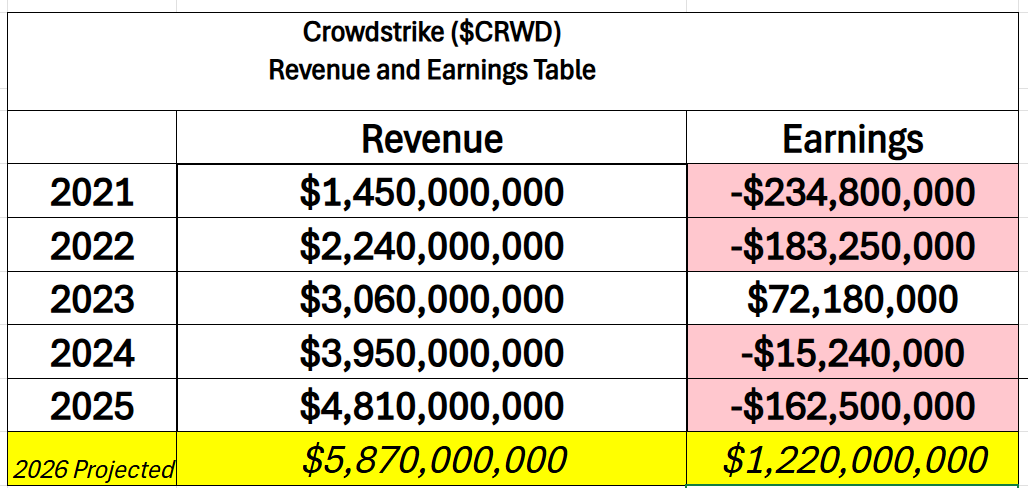
Financially, CrowdStrike has become one of the stronger performers within enterprise software. Revenue growth over the last five years has been exceptional, climbing to nearly $5 billion in 2025 and projected to hit $5.8 billion in 2026. The greater challenge has been profitability which has been elusive. The company is projecting healthy profits in 2026. Over the last 5 years the company has only been profitable one year. Cumulatively since 2021 the company has lost almost $6 billion. Debt levels remain manageable, and the company maintains a relatively healthy balance sheet compared to many earlier-stage software peers. The central debate surrounding the stock now centers on valuation and sustainability. CrowdStrike trades at premium multiples that imply investors expect continued dominance in one of the fastest-growing segments of enterprise technology. Bulls argue that cybersecurity spending remains in the early innings of a multiyear expansion cycle fueled by AI adoption, cloud migration, and geopolitical instability.
What CrowdStrike actually does is increasingly important to understand because cybersecurity itself has become far more complex than many investors appreciate. The Falcon platform continuously monitors endpoints, user identities, cloud workloads, servers, and applications to detect suspicious activity before attacks spread. Instead of relying primarily on older signature-based antivirus methods, CrowdStrike uses cloud-scale telemetry and machine learning models to identify behavioral anomalies across millions of devices globally. Its largest revenue drivers include endpoint security, identity protection, cloud security, and threat intelligence services. Increasingly, corporations are adopting additional Falcon modules over time, which drives expansion revenue and increases customer retention. This “land and expand” strategy has become one of the defining characteristics of the business model.
The company’s customer base includes large enterprises, government agencies, financial institutions, healthcare organizations, and multinational corporations that operate complex digital environments. CrowdStrike is headquartered in Austin, Texas, led by CEO George Kurtz, and employs more than 10,000 people globally. Its competitive landscape includes major players such as Palo Alto Networks, Microsoft, SentinelOne, and Fortinet. Yet CrowdStrike’s competitive position remains particularly strong because it was architected as a cloud-native platform from inception rather than adapting legacy on-premise software for modern cloud environments. That architectural advantage has resonated with large enterprises seeking speed, scalability, and centralized security management.
Over the last five years, CrowdStrike’s financial trajectory has reflected the broader expansion of cybersecurity spending globally. Revenue growth has remained consistently strong, supported by rising customer adoption and increasing average spending per client. Importantly, the company is not burdened by excessive debt, giving management flexibility to continue investing in growth initiatives, acquisitions, and platform expansion.
One of the most misunderstood aspects of CrowdStrike’s financial profile is the relationship between profitability and growth. CrowdStrike generates substantial cash flow because customers commit to long-term recurring contracts, while infrastructure costs scale more efficiently over time.
Today investors are asking three central questions about CrowdStrike. First, how large does the AI-driven cybersecurity opportunity ultimately become? As corporations deploy AI systems across workflows, customer service, coding, infrastructure management, and internal operations, entirely new security vulnerabilities are emerging. Many analysts believe this creates a durable multiyear demand cycle for cybersecurity spending. Second, can CrowdStrike continue consolidating market share as enterprises reduce the number of vendors they use? Increasingly, companies prefer integrated platforms that simplify operations rather than fragmented point solutions. Third, can the company continue growing rapidly enough to justify its valuation? That final question remains critical because CrowdStrike’s stock price already reflects extremely optimistic long-term assumptions.
Recent news surrounding CrowdStrike has largely centered on analyst optimism tied to AI security demand and enterprise platform consolidation. Several Wall Street firms have raised price targets over the last month, citing the company’s strategic positioning within AI-related cybersecurity spending trends. What is genuinely new is not simply cybersecurity demand itself, but the growing realization that AI dramatically expands the attack surface corporations must defend. AI systems create additional entry points, data risks, and automation vulnerabilities that many organizations are only beginning to understand. What is already priced into the stock is continued strong growth. Investors are not valuing CrowdStrike based on stability alone. They are valuing it based on the expectation that it becomes one of the dominant infrastructure providers of the AI era.
Wall Street may still underestimate how quickly cybersecurity could evolve into a global AI arms race. As offensive cyber capabilities become increasingly automated and AI-assisted, defensive spending could accelerate meaningfully beyond current projections. At the same time, the market may also be underestimating the risks associated with elevated expectations. Cybersecurity stocks historically experience sharp corrections when growth slows even modestly. In a market environment where valuations remain heavily dependent on future expansion, execution consistency becomes extraordinarily important.
The stock’s strong performance over the last 90 days reflects the growing AI boom across technology. Investors have poured money into both semiconductors and cybersecurity because they are deeply connected. Semiconductors provide the computing power behind AI, while cybersecurity protects the systems built around it. As chip stocks surged, enthusiasm spread across the entire AI ecosystem.
Year to date, CrowdStrike has benefited from several important narratives: AI monetization, enterprise cloud spending resilience, platform consolidation, and geopolitical concerns surrounding cyber warfare. But beneath the narratives, the data points that truly mattered were sustained subscription growth, expanding free cash flow, increasing module adoption, and improving operating leverage. Analysts are likely correct that cybersecurity spending remains structurally resilient. Where analysts have historically struggled is recognizing how quickly market sentiment can shift when expectations become excessively optimistic.
CrowdStrike’s opportunity remains enormous as AI adoption drives greater demand for cybersecurity. Large companies may continue consolidating around dominant platforms, which could strengthen CrowdStrike’s position even further. The biggest upside surprise would come from faster revenue growth combined with expanding profit margins, forcing Wall Street to raise long-term earnings expectations.
The risks are just as real. The stock carries a rich valuation, competition is increasing, and another major outage could hurt customer trust. Traders should also remember that no technology growth story expands at the same pace forever, even when momentum looks unstoppable.
Looking ahead, the next major catalyst is CrowdStrike’s earnings report in early June. Investors will focus on subscription growth, free cash flow margins, customer expansion, and management’s outlook for AI-driven demand. Guidance may matter even more than the actual numbers because high-growth technology stocks trade on future expectations.
CrowdStrike remains best suited for growth-oriented traders who understand both the opportunity and volatility tied to leading technology companies. For the trend to continue, the company must maintain strong revenue growth, expanding cash flow, and leadership in enterprise cybersecurity. Warning signs would include slowing customer growth, weaker margins, or cautious guidance.
Right now, the market views CrowdStrike as a key infrastructure player in the AI economy. Whether that belief holds over time could shape not only the future of the stock, but also how investors value cybersecurity companies for years to come.
In this analysis we will review and evaluate forecasts using the following set of indicators and tools.
Wall Street Analysts Ratings and Forecasts
52 Week High and Low Boundaries
Best-Case / Worst-Case Scenario Analysis
VantagePoint AI Predictive Blue Line
Neural Network Forecast (Machine Learning)
VantagePoint AI Daily Range Forecast
Intermarket Analysis
Our Suggestion
We use artificial intelligence to stack the odds in our favor. But here’s the part amateurs miss completely. A fancy signal means nothing if the business underneath is flawed. That’s why we dig into the fundamentals too. Revenue. Earnings. Cash flow. Competitive strength. The real story behind the ticker symbol. When fundamentals and price action move in harmony, the probabilities often shift dramatically in the trader’s favor.
Wall Street Analysts Price Forecasts
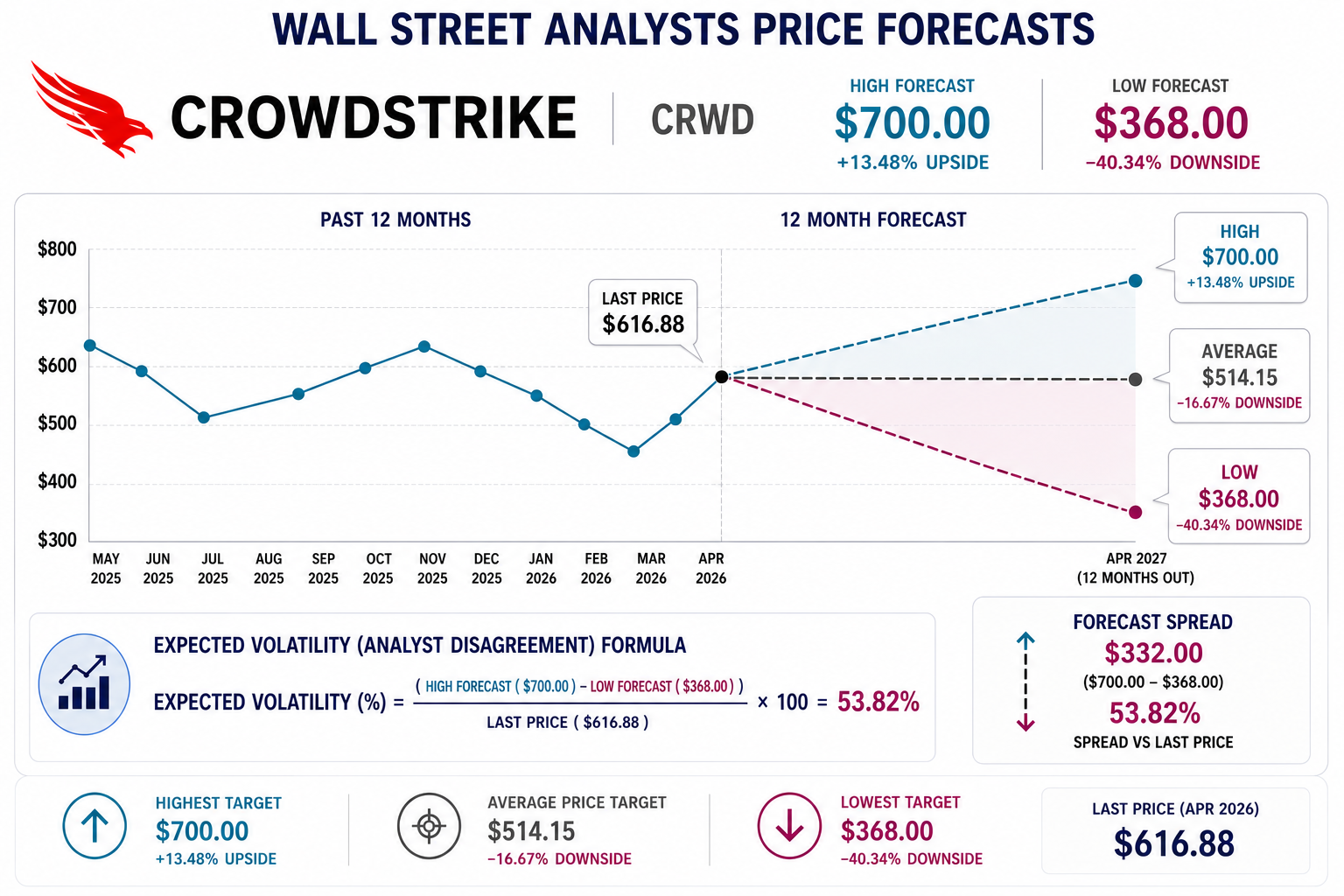
Wall Street loves to pretend price targets are scientific. They are not. They are educated guesses dressed up in expensive suits and delivered with enough confidence to move billions of dollars. But every once in a while, the spread between those guesses tells you something important about how uncertain the future really is. That is exactly what jumps off the page with CrowdStrike right now. Analysts are all over the map. The highest forecast sits at $700. The lowest forecast drops all the way to $368. The average target comes in at $514.15, which is actually below the current price of $619. That disconnect matters because it tells traders something critical: Wall Street agrees CrowdStrike is important, but it does not fully agree on how much future growth is already baked into the stock.
Now look at the expected volatility formula on the chart because this is where the real story lives. The spread between the high and low forecast is $332. Divide that by the last price of $616.88 and you get an expected volatility spread of 53.8%. That is not a sleepy blue-chip stock. That is a stock priced for major movement. Think about what that means in plain English. Analysts are essentially admitting that over the next 12 months there is an enormous range of possible outcomes depending on execution, AI demand, enterprise cybersecurity spending, and investor appetite for high-growth software names. This is not the type of stock institutions quietly park money in and forget about. This is a momentum battlefield.
What is fascinating is that despite the average target sitting below the current price, the stock keeps climbing. Why? Because markets care more about future narratives than current spreadsheets. CrowdStrike has become deeply tied to the artificial intelligence infrastructure story. Semiconductors build the brains. CrowdStrike protects the nervous system. Investors increasingly see cybersecurity as mandatory infrastructure for an AI-driven world. That thematic connection has been enormously powerful for the stock.
But here is where traders need to stay honest with themselves. When a stock trades above the average analyst target, it means investors are already anticipating something better than consensus expectations. The market is effectively saying Wall Street analysts are too conservative. Sometimes the market is right. Sometimes it is euphoric. The danger is that expectations become so elevated that even strong earnings can disappoint investors if guidance fails to exceed fantasy projections. CrowdStrike is operating in that zone right now.
The bullish case is easy to understand. AI expands the cybersecurity attack surface dramatically. Every new AI agent, workflow, cloud deployment, and automation system creates new vulnerabilities. That means cybersecurity spending could accelerate for years. CrowdStrike also benefits from platform consolidation as companies try to simplify operations by reducing the number of vendors they manage. If those trends continue, the $700 target may eventually look conservative.
The bearish case is equally straightforward. CrowdStrike trades at premium valuation multiples that leave little room for mistakes. Growth stocks that miss expectations do not decline politely. They fall out of windows. A slowdown in subscription growth, weaker guidance, margin pressure, or another operational disruption could quickly reset sentiment. That is why the volatility spread on the chart matters so much. It reflects genuine uncertainty, not just disagreement.
For traders, the message is simple. CrowdStrike is not being valued like a normal software company anymore. It is being valued like strategic infrastructure for the AI economy. As long as that narrative stays intact, momentum traders will likely continue buying pullbacks aggressively. But the second the narrative cracks, the same volatility that fueled the upside can reverse direction with astonishing speed.
This is why the chart matters. Not because analysts can predict the future perfectly. They cannot. It matters because the disagreement itself reveals how much uncertainty, opportunity, and risk is embedded inside the stock right now.
52-Week High and Low Boundaries
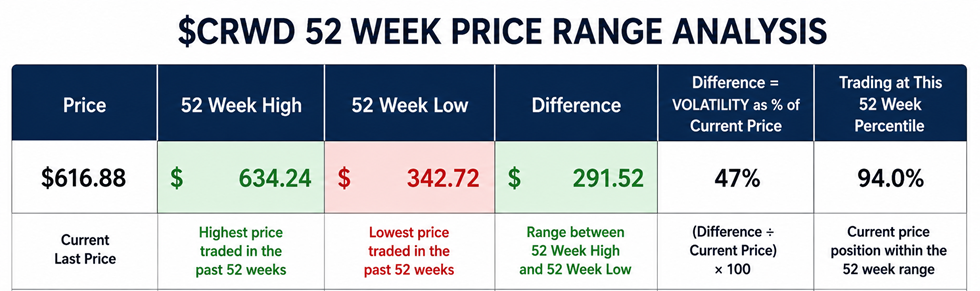
CrowdStrike is trading at 94% of its entire 52-week range. Translation? This stock is camped out near the penthouse, not wandering around the basement looking for loose change. The 52-week high sits at $634.24. The low is $342.72. And the current price of $616.88 tells you institutions have spent the better part of the year treating pullbacks like clearance sales. Weak stocks do not behave this way. Weak stocks spend their lives trapped near the middle or bleeding toward the lows while analysts invent excuses. Leaders stay near highs because buyers keep showing up. That is exactly what you are seeing here. One of the smartest shortcuts traders can use is studying the kind of range a stock covered over the past year. Why? Because it gives you a rough approximation of what the asset is capable of doing when momentum, fear, greed, and institutional money all collide at once. CrowdStrike traveled nearly $292 from low to high over the last 52 weeks. That is a stock with horsepower.
Now let’s talk about volatility because this is where traders either get paid or get emotionally steamrolled. The annual trading range between the high and low equals $291.52. Divide that by the current stock price of $616.88 and you get roughly 47%. In plain English, CrowdStrike’s annual trading range covered nearly half of its current stock price over the last year. That is a big range. This is not some sleepy utility stock that moves like a glacier on sedatives. CrowdStrike moves aggressively when momentum hits. The important thing right now is where the stock sits within that range. It is not compressing near the middle. It is expanding near the highs. That tells you buyers still have control of the steering wheel. The market keeps rewarding the story. And the story, whether traders admit it or not, is artificial intelligence infrastructure. Semiconductors build the brains. CrowdStrike protects the nervous system. Institutions have increasingly bundled cybersecurity into the broader AI trade, which explains why the stock keeps finding sponsorship near highs instead of collapsing under its own valuation.
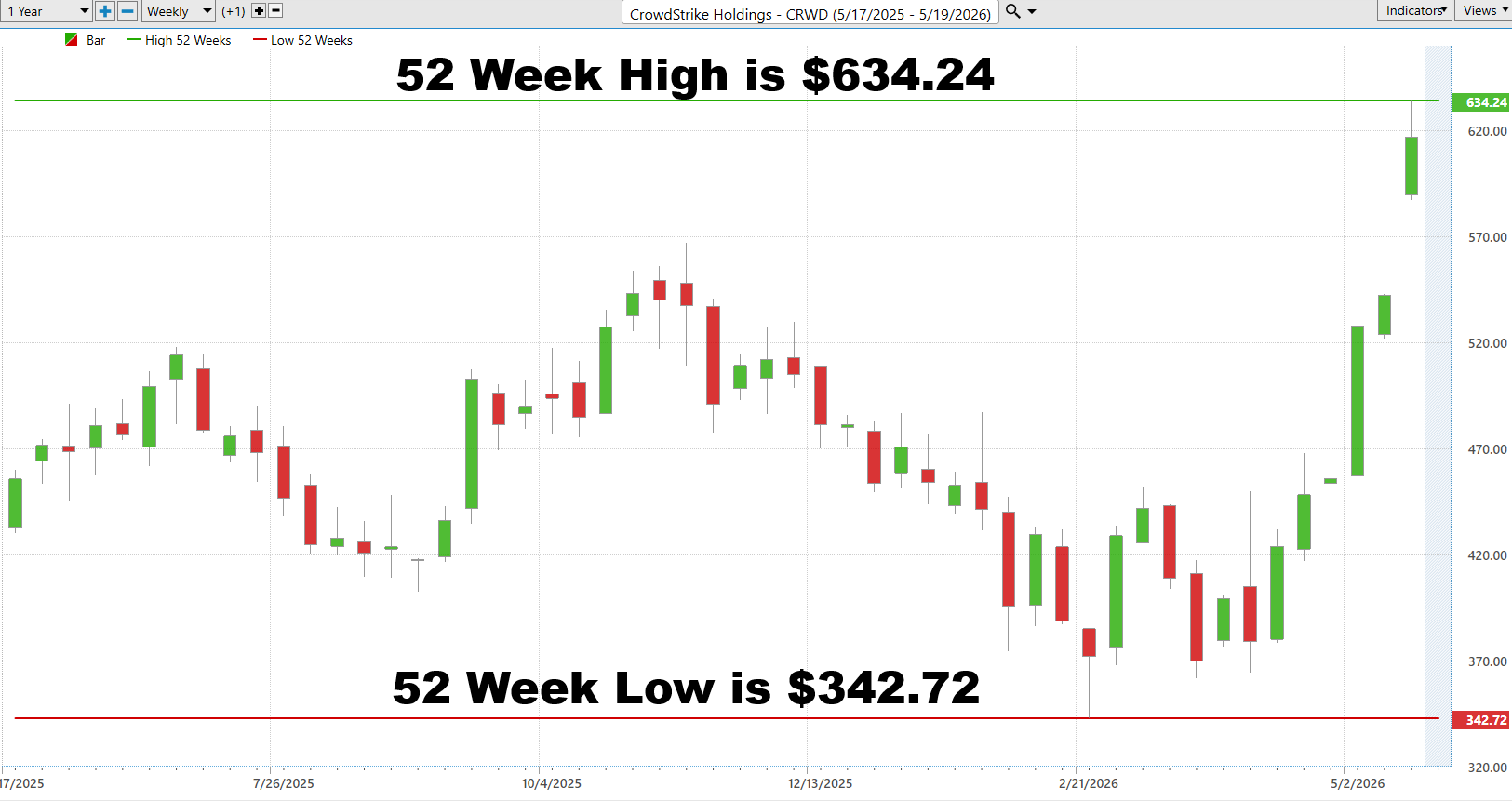
So what does this setup actually mean for traders? Right now this looks more like a stock under accumulation than a stock rolling over. Could it be extended short term? Absolutely. Stocks living near 52-week highs often become vulnerable to sharp pullbacks whenever expectations get too euphoric. But trends this strong rarely die quietly. The asymmetric opportunity still favors momentum traders as long as CrowdStrike keeps defending higher lows and stays near the upper edge of the range. A breakout through the $634 area would likely trigger another round of momentum buying because new highs tend to attract institutional trend followers like moths to a flamethrower. On the other hand, if the stock starts failing at highs and breaks key support zones with expanding selling pressure, that would be an early signal institutions are distributing shares rather than accumulating them. The big takeaway is simple: CrowdStrike is acting like a market leader, not a laggard. The trend remains intact. But because volatility is elevated, traders need discipline. This is a stock for people who can manage risk, stay flexible, and understand that leadership stocks reward conviction right up until the moment they punish complacency.
Still, the message from the market right now remains remarkably clear. CrowdStrike is not trading like a company facing skepticism. It is trading like a company Wall Street believes sits directly in the path of one of the largest technology spending cycles of the next decade. As long as that narrative remains intact, the stock will likely continue attracting institutional capital on weakness. The moment that narrative fractures, traders should expect volatility to return with equal force.
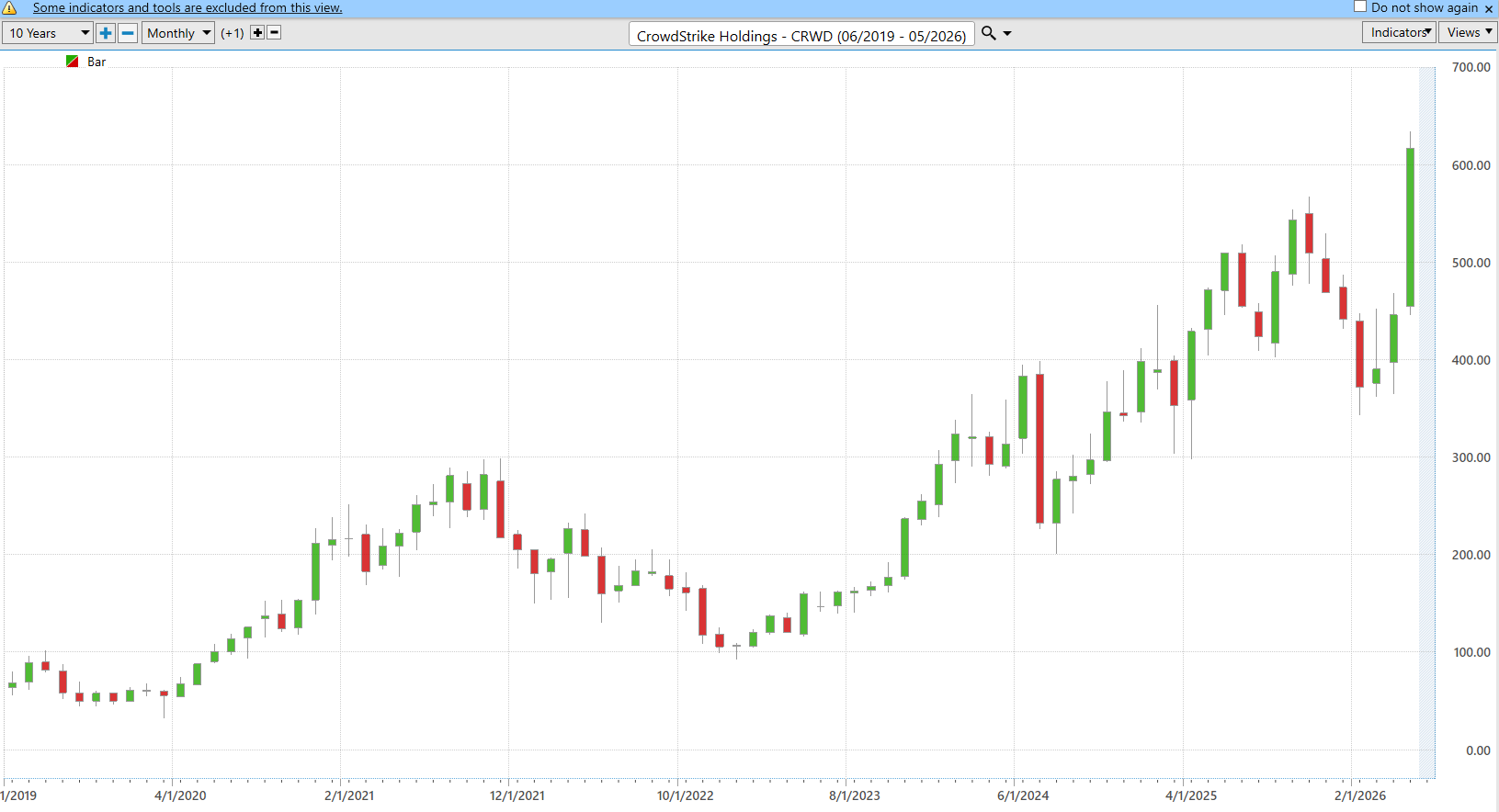
The longer term monthly chart confirms this expectation as well and illustrates the volatility this stock is capable of.
Best-Case/Worst-Case Scenario Analysis
Volatility is not theoretical. It is the admission price for opportunity. Every trader loves talking about upside when a stock is running. Almost nobody wants to study what happens when momentum snaps in reverse. That is why one of the simplest and most practical exercises a trader can do is study the largest uninterrupted rallies and declines over the past 52 weeks.
Look closely at CrowdStrike’s chart. The largest uninterrupted rally over the last year was a staggering 73.4% move. That is not fantasy. That actually happened very recently. From the current price area, a comparable move would push the stock dramatically higher and likely force Wall Street to completely reprice expectations around artificial intelligence infrastructure and cybersecurity demand. For that kind of rally to happen again, institutions would need to remain convinced that CrowdStrike sits directly in the path of one of the most important spending trends in technology. The market would also need continued strength in semiconductors, cloud software, and AI-related momentum names because CrowdStrike increasingly trades as part of that broader ecosystem. The important point is this: massive upside moves happen far more often than most traders believe once institutional momentum takes hold.
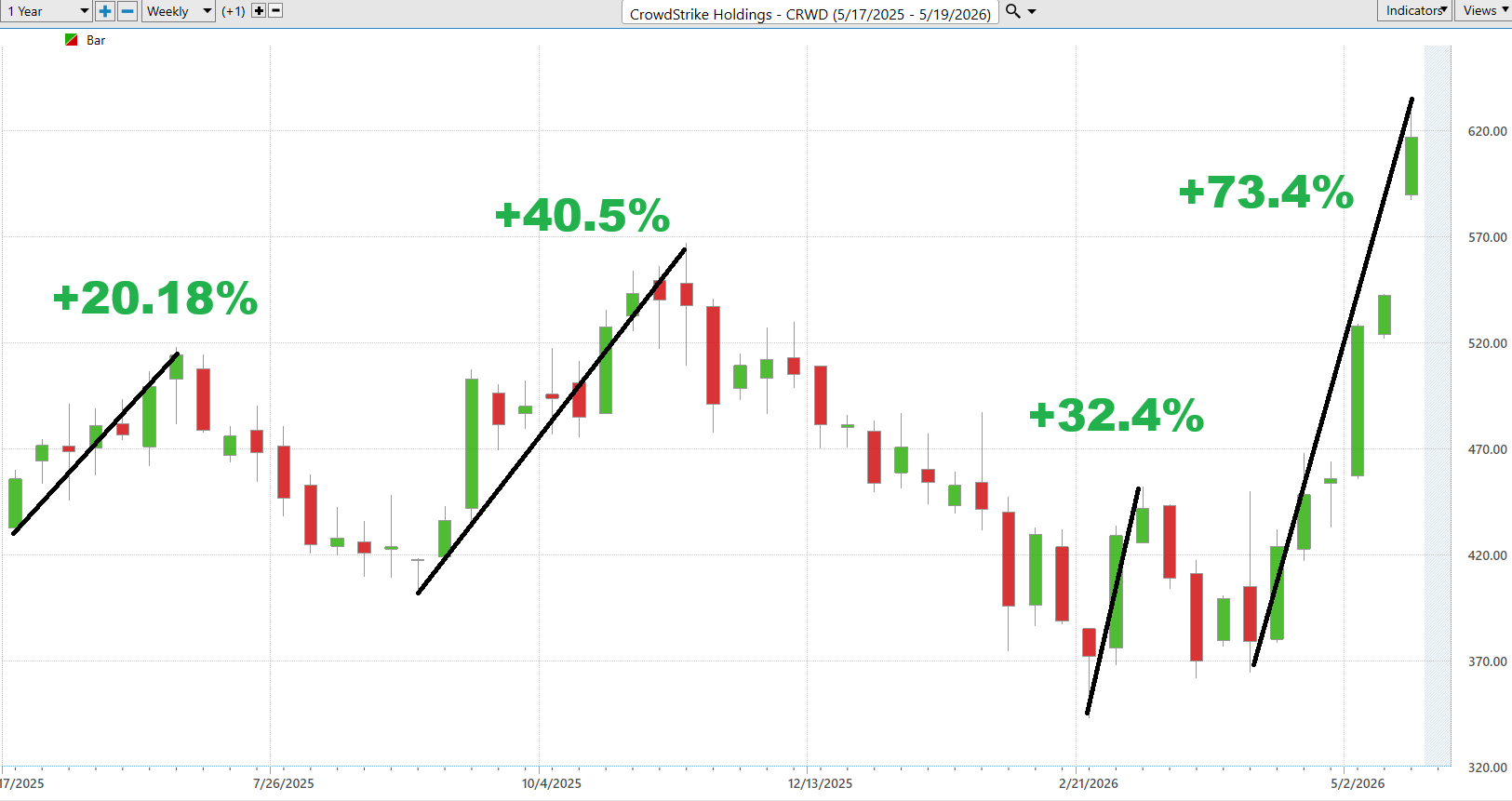
Now look at the other side of the equation because this is where reality tends to punch traders directly in the face. CrowdStrike’s largest uninterrupted decline over the last 52 weeks was roughly 39.3%. Think about what that means emotionally, not academically. Imagine watching a stock you love lose nearly 40% of its value while headlines suddenly shift from “AI revolution” to “valuation concerns” overnight. That is the kind of move that causes weak hands to panic and strong hands to question themselves. And yet this is exactly what growth stocks are capable of doing. The market has already shown you the range of emotional and financial violence this stock can deliver. CrowdStrike can rally explosively, but it can also unravel with frightening speed whenever expectations reset. There is no reason to believe that volatility magically disappears simply because the story sounds compelling today. Stocks with powerful upside potential almost always carry equally powerful downside risk attached to them.
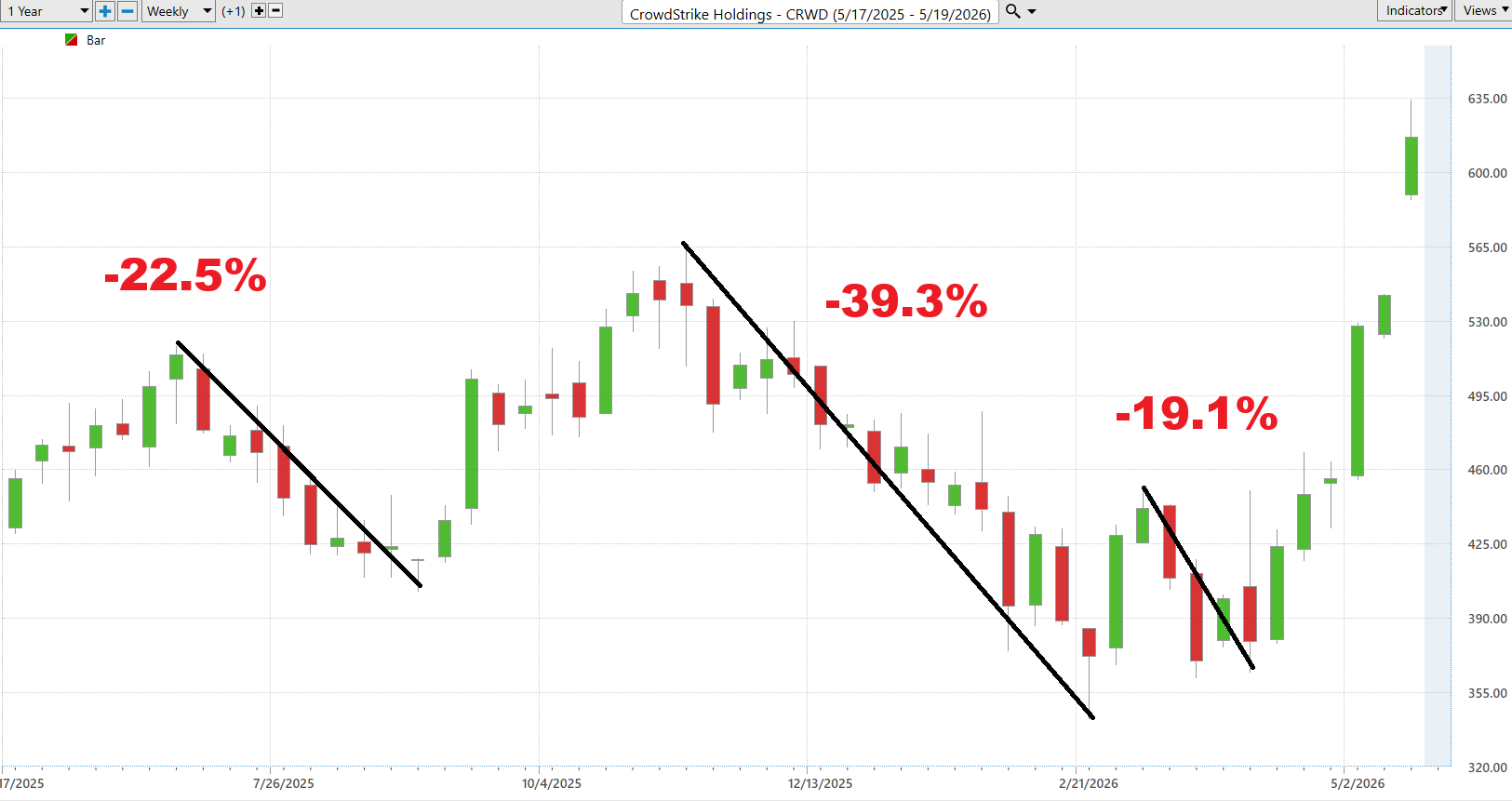
This is the trader’s reality whether people want to admit it or not. Both scenarios matter at the same time. Most traders obsess over how much money they can make while spending almost no time thinking about what happens if they are wrong. That is how people get destroyed. Proper positioning solves this problem because it forces you to confront the downside before the market does it for you. If you understand that CrowdStrike is capable of moving 70% higher and nearly 40% lower within the span of a year, you stop trading fantasies and start managing probabilities. This is not about prediction. Nobody knows exactly what happens next. This is about preparation. It is about knowing the range of outcomes before you put capital at risk. The takeaway is brutally simple: if you cannot emotionally or financially survive the worst-case scenario, then you have no business chasing the best-case outcome.
Next we compare $CRWD to the broader stock market averages.

CrowdStrike is not simply outperforming the market. It is separating itself from the field in a way that demands attention. Over the past year the stock has gained nearly 39%, beating the S&P 500, the Nasdaq Composite, the Dow Industrials, and the Russell 2000. But the real story is happening beneath the surface. Look at the shorter timeframes. Over the past month CrowdStrike surged more than 42% while the Dow actually declined. Over the past week the stock climbed another 14% while every major index slipped into negative territory. Ladies and gentlemen, that is not random strength. That is institutional money moving decisively toward leadership.
This is what a true momentum stock looks like. Capital is not flowing evenly across the market right now. It is flowing aggressively toward companies Wall Street believes are essential to the next phase of the artificial intelligence economy. CrowdStrike has become part of that conversation. Investors increasingly view cybersecurity as foundational infrastructure for AI, cloud computing, and enterprise digitization. And the numbers on this scoreboard make one thing crystal clear: when institutions want exposure to that theme, CrowdStrike is one of the names they are buying first.
The lesson for traders could not be simpler. Strong stocks tend to keep getting stronger because momentum attracts more momentum. Weak stocks require excuses. Leaders create opportunities. Right now CrowdStrike is acting like a market leader across nearly every measurable timeframe. Until that relative strength begins weakening broadly and consistently, the path of least resistance remains higher. But traders should also understand this: leadership stocks can reverse sharply once institutional momentum fades. That is why disciplined risk management matters just as much as identifying the trend itself.
Vantagepoint AI Predictive Blue Line
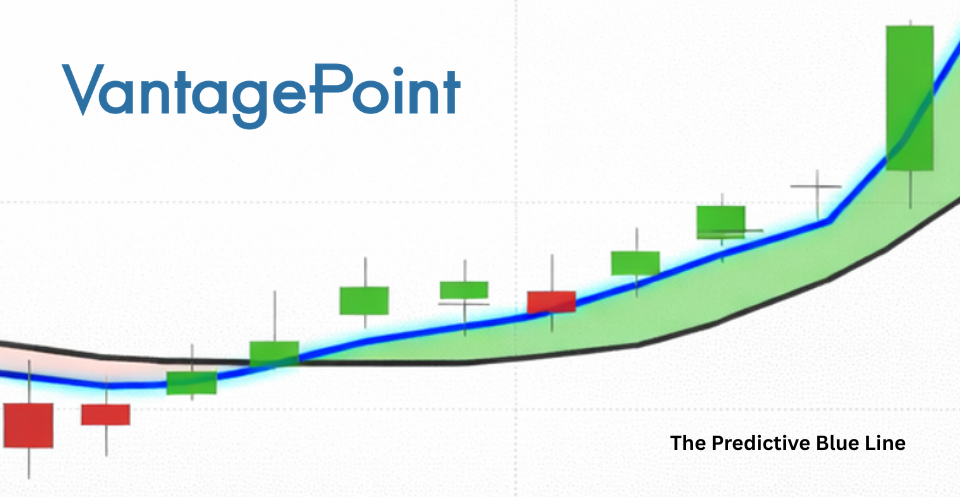
The Predictive Blue Line is rising sharply, and that matters because the slope of the blue line defines the short-term direction of the stock. Right now the slope is not flattening. It is accelerating higher. That tells traders the forecast remains strongly bullish. Even more important, the blue line is separating further from the black line, which is the 10-day moving average. That widening spread tells you momentum is strengthening, not weakening. In strong uptrends like this, traders should recognize that the Predictive Blue Line often becomes a support reference point for price. It is very common for price to pull back toward the blue line, or even slightly below it, before buyers step back in. That behavior is normal inside a healthy trend.
Now look at the relationship between the blue line and the black line. The blue line remains firmly above the 10-day moving average, and there is no sign of conflict between the two indicators. The trend is fully aligned. In simple terms, the forecast is pointing higher while the actual recent price action continues confirming it. That is exactly what traders want to see in a strong momentum stock. There has been no bearish crossover. No flattening. No warning signal yet that momentum is fading. The market continues rewarding buyers on pullbacks rather than trapping them.
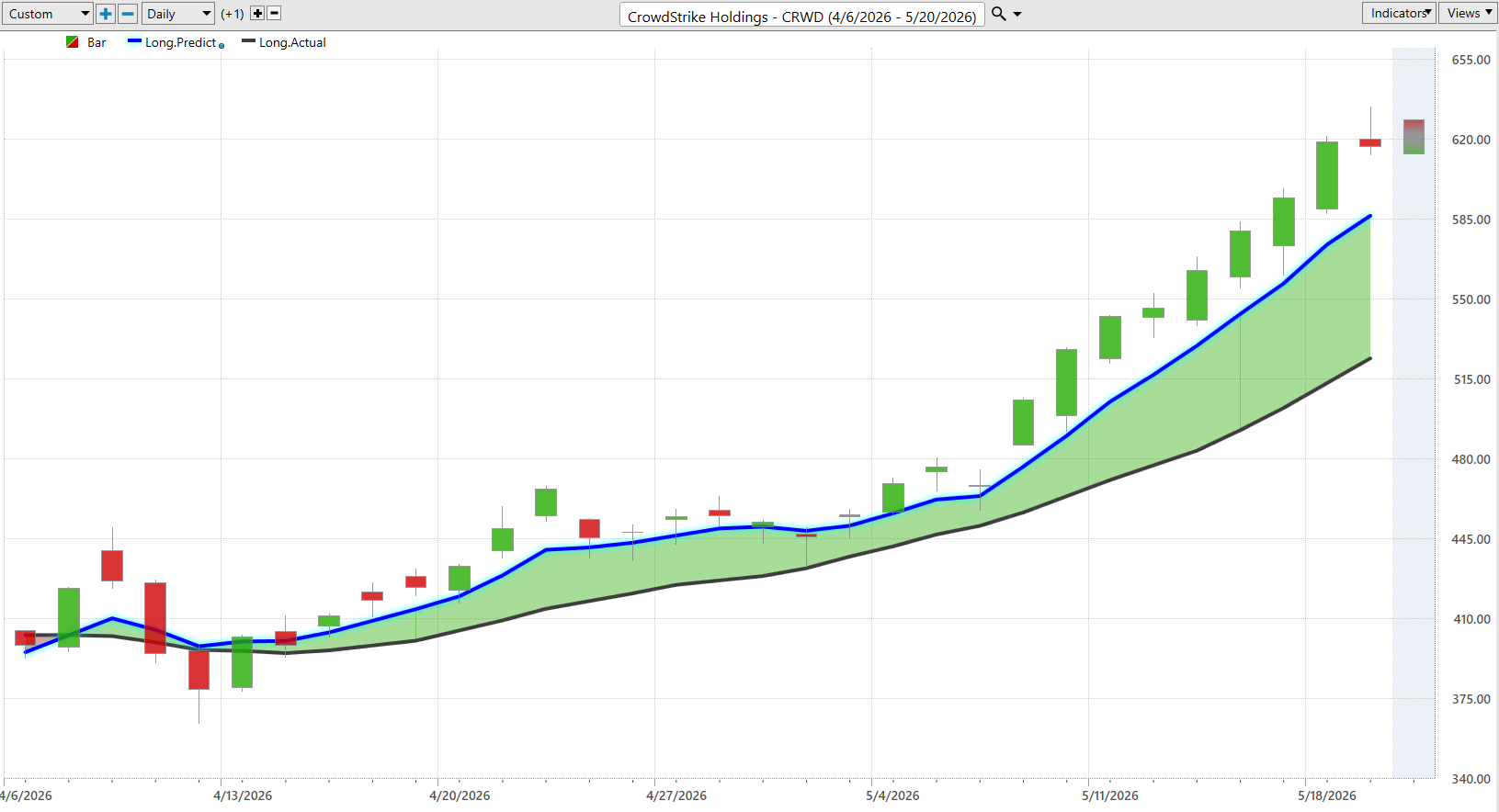
For traders, this setup favors buying pullbacks rather than chasing emotional breakouts after several large green candles. Risk lives in a breakdown of the blue line and a loss of upward slope. If the Predictive Blue Line starts flattening or crossing beneath the black line, that would signal the character of the trend may be changing. Until that happens, the path of least resistance remains higher. The key takeaway is simple: price tends to gravitate back toward the Predictive Blue Line during strong trends, and traders use those pullbacks for timing. Right now this remains a high-probability momentum setup, not a warning sign.
VantagePoint AI Neural Index (Machine Learning)
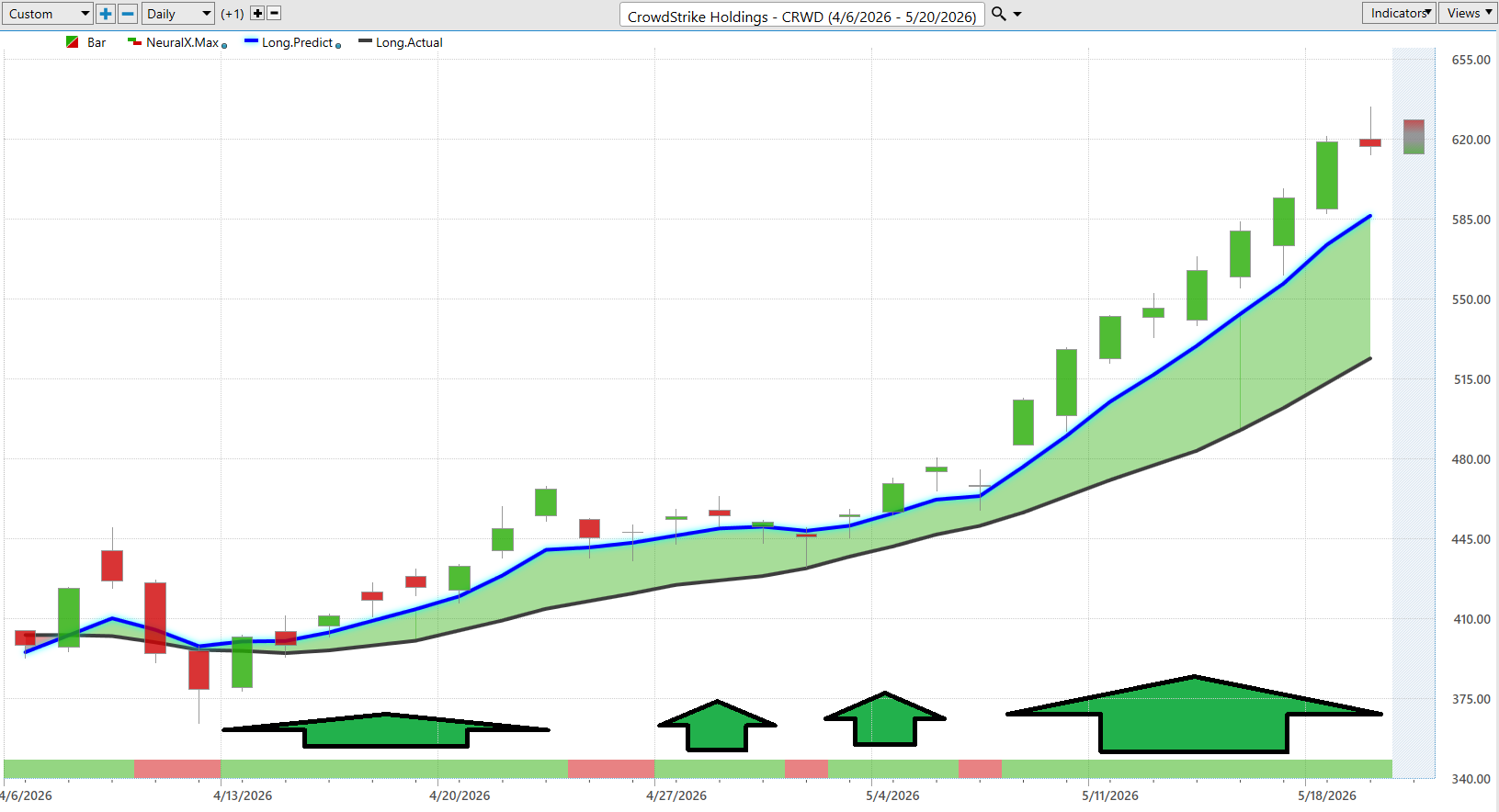
A neural network is simply a form of artificial intelligence trained to recognize patterns and relationships across enormous amounts of market data. Instead of reacting to what already happened, it attempts to anticipate where momentum is likely headed next. Right now the signal remains bullish. Momentum is strengthening, not weakening. More importantly, the Neural Index has stayed green through most of this advance, which tells traders buyers continue controlling the short-term direction of the stock.
Now look at how the Neural Index aligns with the Predictive Blue Line. This is where probability improves dramatically. The Predictive Blue Line is rising sharply above the black 10-day moving average, confirming the trend remains firmly higher. The Neural Index is supporting that move rather than fighting it. That alignment is important because when both indicators agree, traders view it as a higher-probability setup. But there is another important behavior traders should recognize. When the Neural Index briefly turns red during a strong uptrend, it often signals short-term weakness over the next 48 to 72 hours. Notice what happens when that occurs. Price typically pulls back modestly toward the Predictive Blue Line, offering traders better entries before momentum resumes higher. That behavior is visible multiple times on the chart.
For traders, this setup still favors buying controlled pullbacks rather than fighting the trend. Risk increases if the Neural Index turns persistently red while the Predictive Blue Line begins flattening or crossing beneath the black line. That would signal momentum is weakening and the character of the trend may be changing. But that is not what is happening right now. The market continues rewarding buyers on temporary weakness. The key takeaway is simple: traders use the Neural Index to anticipate short-term momentum shifts before they become obvious. Right now the signal remains supportive of higher prices, and brief periods of weakness are acting more like opportunity than warning.
VantagePoint AI Daily Range Forecast
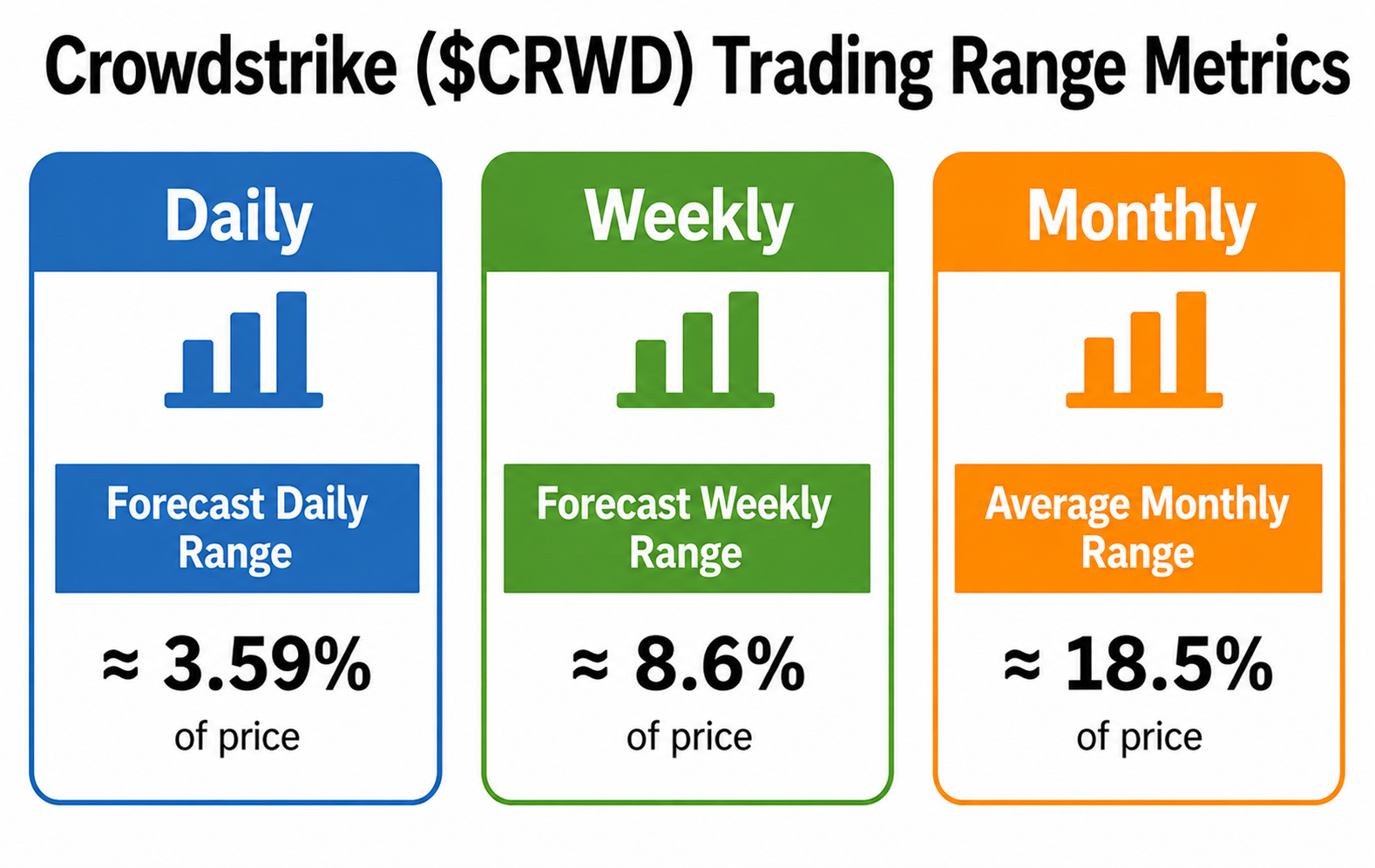
The Daily Range Forecast helps traders estimate where opportunity and risk are likely to live each day. But the first graphic is measuring something different. Those numbers represent the average trading ranges CrowdStrike has historically covered on a daily, weekly, and monthly basis. In other words, this is not a prediction about the future. It is a measurement of how the stock typically behaves. Right now CrowdStrike averages roughly 3.59% daily movement, 8.6% weekly movement, and 18.5% monthly movement. Those are very large ranges, especially for a company of this size. This stock moves.
That matters because volatility is the raw material traders work with. A stock that barely moves offers limited opportunity. CrowdStrike is the opposite. Over time the stock has demonstrated an ability to expand aggressively once momentum takes hold. The average daily range tells traders what kind of movement is normal noise. The weekly and monthly ranges help define what the stock is realistically capable of doing over larger timeframes. Traders who understand those ranges stop getting emotionally shaken out by ordinary movement.
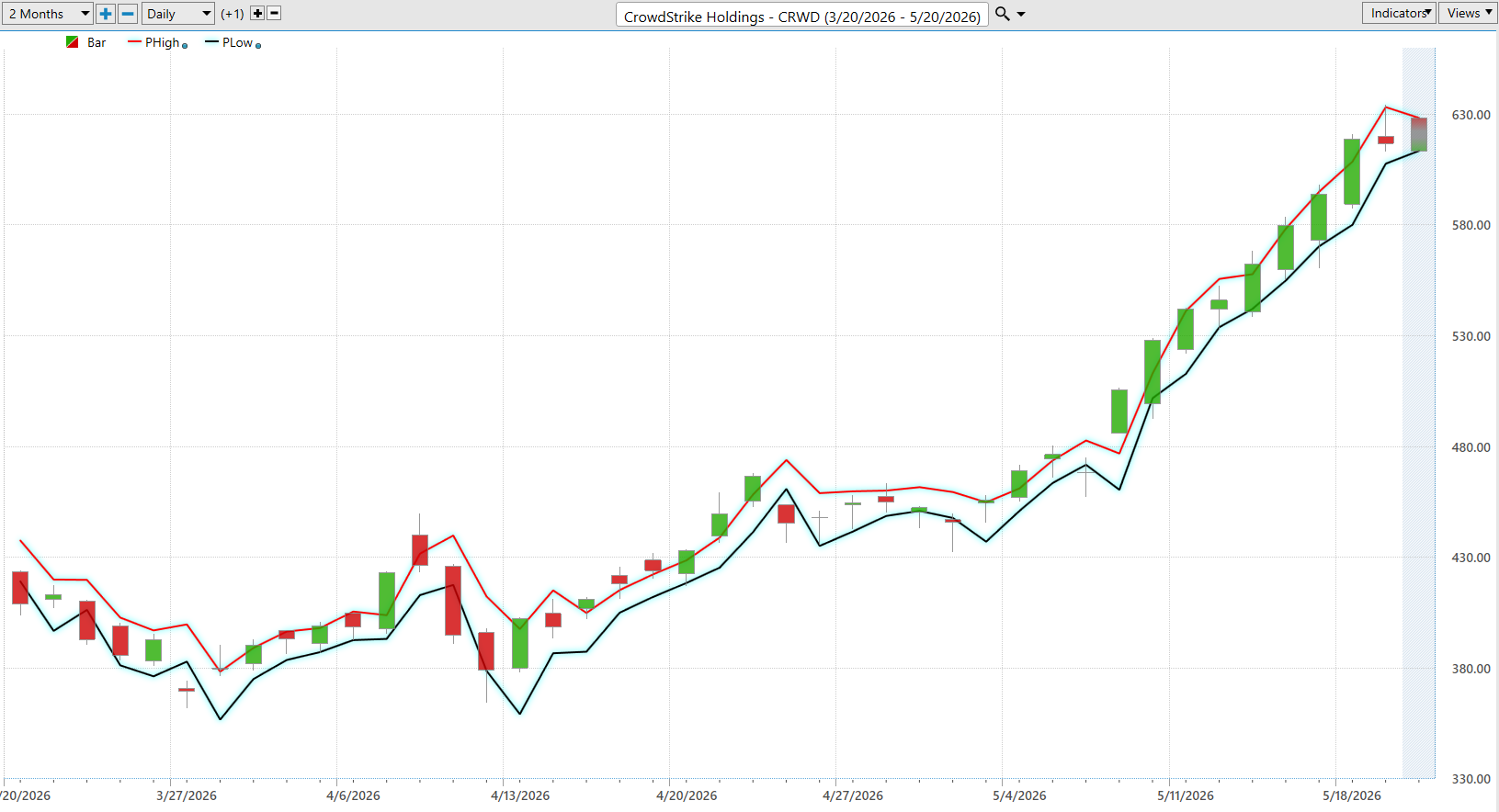
Now what all traders want to know is what are the statistical expectations for the range today. That is exactly what the VantagePoint Daily Range Forecast delivers. Observe how beautifully the forecast has navigate the volatility over the past two months. The projected upper and lower boundaries continue trending higher together, confirming that volatility is currently expanding in the direction of the uptrend. That is an important distinction. The average trading range tells you how CrowdStrike typically behaves over time. The Daily Range Forecast helps traders estimate where price is likely to move within that day. Right now both are telling the same story: CrowdStrike remains a high-volatility momentum stock where disciplined traders are using pullbacks as opportunity while respecting that large swings are part of the game.
VantagePoint AI Intermarket Analysis
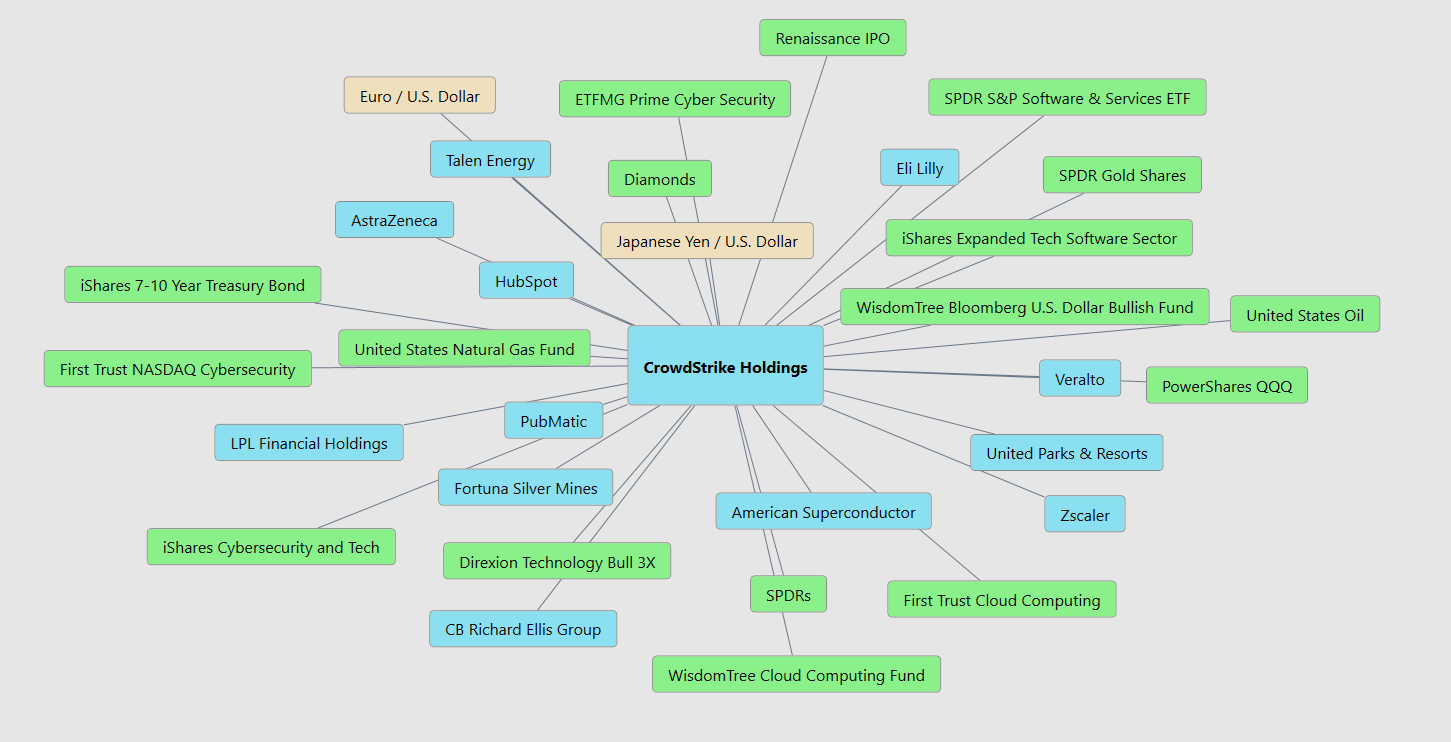
Intermarket analysis is the study of how different markets influence one another. Think of it like checking the weather before flying a plane. A pilot does not just look outside the cockpit window. They look at wind, storms, pressure, and visibility because everything is connected. Stocks work the same way. Strong trends usually have support from many areas of the financial system. Weak trends often stand alone. The attached graphic shows that CrowdStrike Holdings is connected to software, cloud computing, cybersecurity ETFs, the QQQ, currencies, Treasury bonds, oil, and even other strong growth stocks like Zscaler and American Superconductor. That matters because it shows where money is flowing. It also reveals hidden opportunities. Many times intermarket analysis uncovers other strong stocks and sectors connected to the same trend before Wall Street fully notices them.
Right now, most of these intermarket forces are supporting the move higher in CRWD. Technology and software remain leadership groups. Cybersecurity continues attracting money because companies are spending heavily to defend against growing AI-driven cyber threats. The links to cloud computing ETFs and the QQQ confirm that traders are still rewarding growth and momentum stocks. The chart also shows connections to the U.S. dollar, Treasury bonds, and commodities like oil and natural gas. These markets help traders judge fear, inflation, and confidence levels. At the moment, there are very few major warning signs in this network. The trend appears broad and supported instead of isolated and fragile.
For traders, the message is simple. This is a trend that currently deserves respect, not skepticism. Strong trends usually move with help from other markets, sectors, and leading stocks. That is exactly what this graphic shows. But traders should still monitor interest rates, the U.S. dollar, and weakness inside technology leadership groups because those areas could signal changing conditions first. If the QQQ, cloud software, and cybersecurity stocks begin breaking down together, risk would increase quickly. For now, however, the intermarket picture suggests this is a high-confidence move with strong confirmation across multiple parts of the market.
The chart reveals that CRWD is connected to some of the strongest trends in today’s market. Notice the links to the QQQ, cybersecurity ETFs, cloud computing funds, software indexes, and AI-related growth stocks. When money flows into technology and growth stocks, CRWD tends to benefit because it sits in the middle of those trends.
The big takeaway is simple.
CrowdStrike is not trading in isolation. The stock is connected to larger trends across technology, cybersecurity, artificial intelligence, currencies, and investor risk appetite. That is why intermarket analysis matters. It helps traders understand where money is flowing and why leadership is forming.
Our Suggestion
If you study CrowdStrike’s last two earnings calls carefully, one thing becomes very clear. Management believes cybersecurity is becoming one of the most important infrastructure markets in the world. CEO George Kurtz continues positioning CrowdStrike at the center of AI-driven security, cloud protection, and enterprise platform consolidation.
Revenue growth remains strong, annual recurring revenue continues climbing, and free cash flow generation remains impressive. More importantly, management sounds confident. This does not feel like a company struggling to maintain momentum. It feels like a company aggressively expanding its footprint while demand for cybersecurity continues rising globally.
Wall Street clearly understands the story. Analysts continue rewarding CrowdStrike with premium valuations because investors increasingly see cybersecurity as essential infrastructure instead of optional software spending. Expectations remain high heading into the company’s next earnings report, which is expected around June 3, 2026. Traders will closely monitor customer growth, annual recurring revenue, margins, and management guidance for the rest of fiscal 2027. The company is executing extremely well, but that also creates pressure. When expectations rise this much, investors demand near-perfect execution quarter after quarter. Any slowdown in growth, softer guidance, or signs of weakening enterprise spending could quickly pressure the stock.
For the current trend to continue, technology leadership must remain intact across the broader market. Right now, the intermarket picture still supports that outcome. Software, cloud computing, artificial intelligence, and cybersecurity continue attracting institutional money flows. CrowdStrike remains connected to many of the market’s strongest leadership groups, which strengthens the durability of the trend. However, traders should continue monitoring interest rates, Treasury yields, and broader weakness inside growth stocks because those areas usually crack first when risk appetite begins fading. If software and cybersecurity ETFs begin rolling over together, risk would increase quickly.
At the moment, CrowdStrike still appears to be a high-confidence institutional trend rather than a fragile speculative trade. The company continues executing at a very high level while operating directly in the center of two of the market’s strongest themes: artificial intelligence and cybersecurity. That combination continues attracting capital from large institutions searching for durable growth. But traders should remain realistic. The higher expectations climb, the less room management has for disappointment. That is why discipline matters just as much as conviction.
Use the VantagePoint AI Daily Range Forecast to isolate short term trading opportunities. Practice great money management on all of your trades. Position sizing is critical if you choose to trade $CRWD due to its massive volatility.
It’s not magic.
It’s machine learning.
Disclaimer: THERE IS A HIGH DEGREE OF RISK INVOLVED IN TRADING. IT IS NOT PRUDENT OR ADVISABLE TO MAKE TRADING DECISIONS THAT ARE BEYOND YOUR FINANCIAL MEANS OR INVOLVE TRADING CAPITAL THAT YOU ARE NOT WILLING AND CAPABLE OF LOSING.
VANTAGEPOINT’S MARKETING CAMPAIGNS, OF ANY KIND, DO NOT CONSTITUTE TRADING ADVICE OR AN ENDORSEMENT OR RECOMMENDATION BY VANTAGEPOINT AI OR ANY ASSOCIATED AFFILIATES OF ANY TRADING METHODS, PROGRAMS, SYSTEMS OR ROUTINES. VANTAGEPOINT’S PERSONNEL ARE NOT LICENSED BROKERS OR ADVISORS AND DO NOT OFFER TRADING ADVICE.