




For investors and traders accustomed to parsing earnings transcripts and Fed minutes, the past several weeks have delivered a different kind of disclosure. This one speaks less to quarterly performance and more to the durability of the system itself. The steady drip of revelations tied to the Epstein files has revived uncomfortable questions about elite networks, influence, and accountability. At the same time, the Supreme Court’s decision to strike down the Trump era tariffs abruptly invalidated a pillar of trade policy that companies, supply chains, and investors had spent more than a year attempting to price in. Layer onto this the growing prospect of a potential military conflict with Iran, a scenario the public views with deep skepticism, and the result is a convergence of legal, political, and geopolitical uncertainty that extends far beyond the news cycle.
Each development alone might be manageable. Together, they deliver a clear message. The reliability of the institutional framework underpinning financial markets is no longer being assumed. It is being questioned.
The tariff ruling in particular highlights how quickly regulatory foundations can shift. Supply chains were adjusted. Corporate guidance was recalibrated. Sector positioning reflected a year’s worth of assumptions. Then, in a single decision, the premise changed. This is not a political or partisan observation. It is recognition that legal reversals now function as macroeconomic variables, influencing capital flows and risk premiums in real time.
Meanwhile, the dollar’s purchasing power continues its quiet erosion even as official statistics project stability. Inflation is declared manageable until it embeds. Foreign conflicts expand with open ended fiscal commitments. This is not episodic turbulence. It is a pattern of currency debasement, policy reflex, and narrative management that traders must incorporate into their models. Increasingly, markets are pricing not just earnings and interest rates, but institutional credibility itself.
Markets do not price morality. They price risk.
When institutional credibility weakens, capital does not disappear. It adapts. It demands higher premiums. It rotates. It seeks insulation. The institutional backdrop has shifted, and that shift carries consequences.
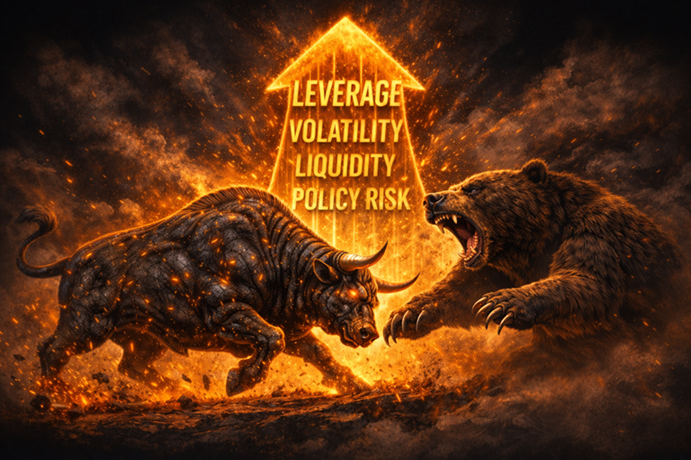
Risk in financial markets does not rise in a straight line. It compounds. Leverage, volatility, and liquidity act as amplifiers. When leverage is elevated, small price movements create large financial consequences. When volatility expands, price swings accelerate. When liquidity disappears, exits that appeared orderly become disorderly. Add forced liquidations, and losses cascade. These forces do not announce themselves in advance. They arrive suddenly, and when they do, manageable situations become defining financial events.
This is the environment markets now inhabit. Years of easy money, rising debt, and concentrated positioning have created a system where risk multipliers remain ever present beneath the surface. Markets can appear calm, but that calm can break without warning. The participants who survive are not those who predict every move. They are those who respect the existence of risk multipliers and manage exposure accordingly.
Trust, once lost, changes behavior. Capital begins searching for insulation from policy error, from debasement, from instability. Markets adapt to their environment, and the environment has changed.
For the better part of three years, mega cap technology stocks dominated both narrative and returns. Their scale, cash flow, and artificial intelligence tailwinds created a gravitational pull on capital. Index performance increasingly reflected concentration in a small number of companies. Tickers like $AAPL, $MSFT, $NVDA, $AMZN, $GOOGL, $META, and $TSLA carried disproportionate weight in the S&P 500 Index and the Nasdaq 100. Passive capital flows reinforced that dominance, funneling more money into the same leaders.
This concentration created strength, but it also created vulnerability. Leadership in markets is never permanent. Capital rotates. Crowded trades eventually encounter diminishing marginal returns. Valuations expand faster than underlying growth can sustain indefinitely. Gravity reasserts itself.
At the same time, the macroeconomic environment began shifting. Trade fragmentation increased costs. Supply chains were reshored at higher expense. Fiscal deficits expanded. The default policy response remained consistent. More liquidity. More accommodation. A weaker currency to support a heavily indebted system. The effect is gradual but undeniable. Purchasing power erodes while asset prices adjust upward in nominal terms.
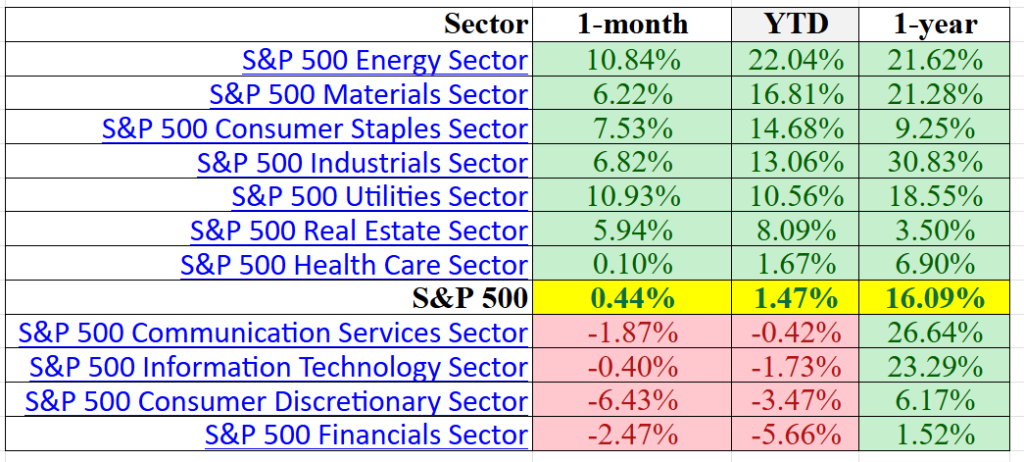
Hard assets have historically thrived in these environments. Energy. Metals. Materials. Scarcity strengthens as currency weakens. If inflationary pressures persist, leadership will not remain confined to yesterday’s winners. Capital will seek sectors tied to tangible value and physical constraint.
Markets reveal this transition through relative strength. Leadership does not collapse overnight. It fades through underperformance while new leadership emerges quietly. When sectors such as Energy and Materials begin consistently outperforming the S&P 500 Index over rolling timeframes, it signals institutional allocation shifting beneath the surface. Price alone can mislead. Relative performance reveals capital’s true preferences.
Positioning capital in this environment requires adaptability. Investors anchored to prior leadership risk mistaking familiarity for opportunity. The center of gravity shifts gradually, then suddenly. Those who recognize the shift early position themselves ahead of consensus.
This shift reflects a broader reality. Currency debasement, policy uncertainty, and institutional instability compress time horizons. Capital becomes more cautious. Long term assumptions become less reliable. Flexibility becomes more valuable than conviction.
The Supreme Court tariff ruling provided a clear example. Markets had spent a year adjusting to the existence of those tariffs. Supply chains, earnings models, and sector exposures reflected their impact. With one ruling, that assumption disappeared. This was not a theoretical event. It was a repricing event. It demonstrated how quickly foundational assumptions can change.
Success in modern markets is no longer defined solely by identifying opportunity. It is defined by managing risk within an unstable institutional framework. Survival becomes the prerequisite for compounding.
When risk multipliers rise, the appropriate response becomes clear. Reduce exposure. Respect risk. Favor strength. Maintain flexibility. Preserve capital so that opportunity can be seized when conditions improve.
This environment introduces another reality. The volume of data, speed of information, and complexity of intermarket relationships exceed the capacity of unaided human judgment. Emotional decision-making increases precisely when clarity becomes most valuable.
Systematic analysis provides an advantage in such conditions. VantagePoint’s artificial intelligence does not react emotionally to headlines. It does not rely on narrative. It evaluates relationships, probability, and trend persistence objectively. It detects shifts in capital flows before they become widely recognized.
In markets defined by instability and distortion, clarity becomes a competitive advantage.
And the VantagePoint A.I. was built for precisely this environment. It was designed to forecast trend direction, identify emerging leadership, and quantify risk in real time. Traders can evaluate their assumptions, monitor capital rotation, and make decisions based on measurable evidence rather than speculation.
Risk multipliers are no longer theoretical. They are everpresent. They are active. And they are reshaping the landscape in which capital operates.
The investors and traders who recognize this shift early, who respect risk, and who adapt accordingly, will not merely survive the next cycle.
They will define it.
Every day, our software studies the financial scoreboard with zero emotion and zero excuses. It measures what is winning, what is losing, and where capital is flowing. Our mission is simple. Empower traders daily with the truth, not opinions, not predictions, not hope.
Because what is happening right now is not normal.
The forces moving markets today cannot be understood through textbooks, earnings ratios, or traditional fundamental analysis alone. No classroom prepares you for currency debasement, policy reversals, and capital stampedes happening in real time. Classical thinking assumes a stable system. This system is not stable. Traders who continue relying on outdated frameworks are operating with a map that no longer matches the terrain.
Our job is to help you see the scoreboard clearly, every single day, so you can align yourself with reality instead of reacting to it after the fact.
If you are serious about improving your trading results, I invite you to attend our upcoming complimentary live online Learn How to Trade with VantagePoint A.I. Masterclass.
During this session, you will see with your own eyes how professional traders use VantagePoint artificial intelligence to identify high probability opportunities, manage risk with precision, and align themselves with the strongest trends while they are still emerging. This is not theory. It is a live demonstration of how intelligent analysis can replace uncertainty with measurable evidence.
Most traders operate from opinion. They follow headlines. They react emotionally. They enter late. They exit late. And they never fully understand why.
Professionals operate differently. They rely on objective tools that reveal where institutional capital is flowing. They measure strength instead of guessing at it. They act on evidence instead of hope.
Here is the critical distinction.
VantagePoint A.I. shows you where strength is building before it becomes obvious. It reveals which markets are gaining momentum and which ones are losing it. It gives you the ability to make decisions based on probability rather than opinion.
Whether you use it or not, trends will form. Capital will rotate. Opportunities will emerge and disappear.
The only question is whether you will recognize them in time to act.
This FREE masterclass gives you the opportunity to see exactly how VantagePoint works, how traders use it, and how it can help you approach the markets with greater clarity, confidence, and control.
There is a profound difference between guessing and knowing.
I invite you to experience that difference for yourself.
It’s not magic.
It’s machine learning.
THERE IS A SUBSTANTIAL RISK OF LOSS ASSOCIATED WITH TRADING. ONLY RISK CAPITAL SHOULD BE USED TO TRADE. TRADING STOCKS, FUTURES, OPTIONS, FOREX, AND ETFs IS NOT SUITABLE FOR EVERYONE.IMPORTANT NOTICE!
DISCLAIMER: STOCKS, FUTURES, OPTIONS, ETFs AND CURRENCY TRADING ALL HAVE LARGE POTENTIAL REWARDS, BUT THEY ALSO HAVE LARGE POTENTIAL RISK. YOU MUST BE AWARE OF THE RISKS AND BE WILLING TO ACCEPT THEM IN ORDER TO INVEST IN THESE MARKETS. DON’T TRADE WITH MONEY YOU CAN’T AFFORD TO LOSE. THIS ARTICLE AND WEBSITE IS NEITHER A SOLICITATION NOR AN OFFER TO BUY/SELL FUTURES, OPTIONS, STOCKS, OR CURRENCIES. NO REPRESENTATION IS BEING MADE THAT ANY ACCOUNT WILL OR IS LIKELY TO ACHIEVE PROFITS OR LOSSES SIMILAR TO THOSE DISCUSSED ON THIS ARTICLE OR WEBSITE. THE PAST PERFORMANCE OF ANY TRADING SYSTEM OR METHODOLOGY IS NOT NECESSARILY INDICATIVE OF FUTURE RESULTS. CFTC RULE 4.41 – HYPOTHETICAL OR SIMULATED PERFORMANCE RESULTS HAVE CERTAIN LIMITATIONS. UNLIKE AN ACTUAL PERFORMANCE RECORD, SIMULATED RESULTS DO NOT REPRESENT ACTUAL TRADING. ALSO, SINCE THE TRADES HAVE NOT BEEN EXECUTED, THE RESULTS MAY HAVE UNDER-OR-OVER COMPENSATED FOR THE IMPACT, IF ANY, OF CERTAIN MARKET FACTORS, SUCH AS LACK OF LIQUIDITY. SIMULATED TRADING PROGRAMS IN GENERAL ARE ALSO SUBJECT TO THE FACT THAT THEY ARE DESIGNED WITH THE BENEFIT OF HINDSIGHT. NO REPRESENTATION IS BEING MADE THAT ANY ACCOUNT WILL OR IS LIKELY TO ACHIEVE PROFIT OR LOSSES SIMILAR TO THOSE SHOWN.