







This week’s AI stock spotlight is Alphabet Inc ($GOOGL)
Google did not spring fully formed from the forehead of Zeus regardless of what origin story you might hear while visiting Silicon Valley. It crawled out of a Stanford dorm room, armed with math and an unhealthy interest in organizing the world’s information. Founded in 1998 by Larry Page and Sergey Brin, who thought search engines should actually work. Built around a simple mission, organize the world’s information and make it useful, which sounds noble until you realize it also means monetizing your curiosity. Alphabet Inc hit major turning points with AdWords, YouTube, Android, and cloud computing, each one another way to print money from human behavior. Today it operates at planetary scale, touching billions of users daily across search, video, maps, and mobile software. And it still matters because when people want something, they “Google it,” which is less a brand and more a verb that prints cash.
Now let’s talk about what this machine actually does, because underneath the friendly search bar is one of the most efficient revenue extraction engines ever built. Google makes money by selling attention. You search for something, they show you ads. You watch a video, they show you ads. You check your email, navigate a map, scroll a website, or use an app on Android, there is a good chance Google is somewhere in the background collecting data and selling access to your eyeballs.
The core business is still advertising, specifically search advertising, which is the crown jewel. High intent, high margin, and about as close to legal insider trading as the business world allows. When someone searches “best running shoes,” advertisers are practically throwing money at Google to be first in line. That is the engine.
Then you have YouTube, which is television for people who hate television. Ads, subscriptions, creators, and an endless stream of content that keeps users glued to screens. It is less predictable than search but still wildly profitable.
Cloud computing is the growth story. Google Cloud sells infrastructure and AI services to enterprises. It is competing with Amazon and Microsoft, and while it is smaller, it is growing fast and becoming a legitimate profit contributor instead of just a science experiment.
Other bets exist, but let’s be honest, most of them are expensive hobbies with occasional upside optionality.
Headquartered in Mountain View, California, run by CEO Sundar Pichai, with well over 180,000 employees, Alphabet Inc is less a company and more a digital ecosystem. Its competitors are serious. Microsoft is coming for search with AI. Amazon dominates cloud. Meta competes for ad dollars. Apple controls mobile distribution. But Google still has the best real estate on the internet. The search box.
Financially, this thing is a fortress dressed like a growth stock. Revenue keeps climbing, not in a straight line but with enough consistency to make traders comfortable. Advertising is still the bulk, but cloud is gaining ground and improving margins.
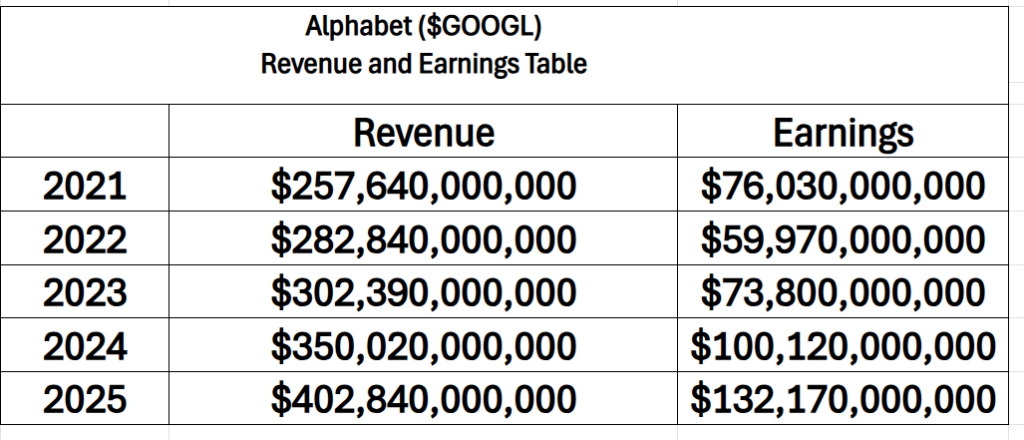
Over the past five years, Alphabet has quietly built one of the most efficient growth engines in the market. Revenue has climbed from roughly $257 billion to over $402 billion, a 56% increase, while earnings have surged from about $76 billion to more than $132 billion, a 74% gain. That gap matters. Earnings are growing faster than revenue, which tells you the company is not just getting bigger, it is getting better. Margins are improving. Operations are tightening. This is what efficiency looks like at scale, and it is exactly the kind of performance long-term trend traders want to see.
Margins are strong, especially in search. This is not a capital heavy business like manufacturing. Once the infrastructure is built, incremental revenue drops nicely to the bottom line. That is why this company throws off cash like a broken ATM.
Cash position is enormous. Tens of billions sitting around, giving management flexibility to invest, buy back stock, or fund the next moonshot. Debt exists but is not a concern. This is not a company that wakes up at night worrying about interest payments.
Capital intensity is moderate. Data centers cost money, but not enough to crush returns. Traders often misunderstand this. They see big cap tech and assume bloated costs. In reality, Google scales incredibly well. The more people use it, the more profitable it becomes.
What traders are asking right now is not philosophical. It is tactical.
First, is AI going to help or hurt Google’s core search business. This is the big one. If users shift from traditional search to AI-driven answers, does Google lose its grip or tighten it. Traders want to know if AI is a tailwind or a disruption.
Second, can Google Cloud close the gap with Amazon and Microsoft. This matters because cloud is the diversification story. If cloud accelerates, the market gives Google a higher multiple.
Third, are regulators going to break something important. Antitrust pressure has been building for years. The question is not whether regulators are annoyed. It is whether they can actually do anything that dents revenue.
Recent news has been dominated by AI integration across Alphabet’s products. Search is evolving. AI-generated summaries are becoming more common. Gemini, Google’s AI model, is being pushed into everything from search to productivity tools.
What is actually new is not that Google is doing AI. It is that they are aggressively embedding it into the core user experience. This is a defensive and offensive move at the same time.
What is already priced in is the idea that Google will remain a dominant player in AI. The market is not surprised that they are investing heavily. That is expected.
What Wall Street may be missing is how messy this transition could be. AI answers reduce clicks. Fewer clicks could mean fewer ads. That is a risk nobody wants to fully price yet.
Expectations could be wrong in both directions. If AI enhances engagement and keeps users inside Google’s ecosystem longer, revenue could accelerate. If it disrupts ad economics, margins could compress.
Now let’s address the only thing traders really care about. Why the stock is up.
Over the past 90 days, the rally has been driven by a combination of AI optimism, improving cloud profitability, and the simple reality that big tech has rebounded sharply after the U.S. government decided that the entire semi-conductor industry is a national security issue. Google benefits from that. even though Google does not manufacture semi-conductors it requires semiconductors for everything it does.
Year to date, the narrative has been consistent. AI is the future, and Alphabet Inc is one of the few companies with the data, infrastructure, and distribution to compete at scale. That narrative matters, but the data matters more. Cloud margins improving. Ad revenue holding up better than feared. Cost discipline showing up in earnings.
Now here is where it gets interesting. The semiconductor trade has been on fire, and that has spilled over into everything AI-related.
The strength in $SOXL reflects massive demand for chips powering AI models. SOXL is a leveraged ETF designed to deliver 3 times the daily performance of a semiconductor stock index, which means it amplifies both gains and losses in chip stocks. It has surged because money has flooded into semiconductors as the backbone of the AI boom, with massive demand for chips powering data centers, models, and infrastructure.
Layer on top of that the leverage effect and short covering, and you get explosive upside when the sector trends strongly in one direction. That demand does not exist in a vacuum. It feeds directly into companies like Google that are building and deploying AI at scale.
In plain English, when chips are booming, it means AI infrastructure is expanding. When AI infrastructure expands, Google has more ways to monetize data, search, and cloud services. The tide lifts the ship.
Analysts mostly agree on the bullish case, but they have a habit of extrapolating trends as if nothing ever changes. They assume ad revenue will remain stable, cloud will keep growing, and AI will be seamlessly integrated. History says otherwise. Transitions are rarely smooth.
Opportunities here are obvious. AI integration could supercharge engagement and create entirely new revenue streams. Cloud could become a much larger piece of the business. YouTube monetization still has room to grow.
The biggest upside surprise would be AI actually increasing ad effectiveness instead of cannibalizing it. If Google figures out how to monetize AI answers at scale, the market will reprice this stock higher very quickly.
Risks are just as real. The biggest blind spot is the assumption that Google’s dominance in search is unbreakable. Technology shifts have a way of rewriting the rules. Ask anyone who used to dominate desktop software or mobile phones.
Regulation is another risk. Not because it will destroy the company, but because it can create uncertainty and limit strategic flexibility.
And then there is competition. Microsoft is not playing around. OpenAI partnerships are real. Apple could shift default search behavior. These are not hypothetical risks.
Catalysts are straightforward. Any major AI product announcements, especially around search monetization. And regulatory updates, particularly any rulings or settlements that affect distribution deals.
These matter because they directly impact revenue visibility, growth expectations, and risk perception. Traders do not need a PhD to understand that.
The final takeaway is simple. This is a stock for trend followers and momentum traders who understand big tech leadership. It is not a sleepy value play. It moves when narratives align with data.
For the trend to continue, AI must remain a tailwind, not a disruption. Cloud must keep improving. Ad revenue must stay resilient.
Early warning signs would be declining search engagement, margin compression in ads, or any indication that AI is reducing monetization efficiency.
Google is still one of the most powerful businesses on earth. But power in markets is not permanent. It is rented, and the rent is due every quarter.
In this weekly stock study, we will look at an analysis of the following indicators and metrics, which serve as our guidelines in determining whether to buy, sell, or stand aside on a particular stock:
Wall Street Analysts Ratings and Forecasts
52 Week High and Low Boundaries
Best-Case/Worst-Case Analysis
VantagePoint AI Predictive Blue Line
Neural Network Forecast (Machine Learning)
VantagePoint AI Daily Range Forecast
Intermarket Analysis
Our Suggestion
While our decisions are ultimately guided by artificial intelligence forecasts, we still take a brief look at the fundamentals to understand the financial landscape in which $GOOGL is operating.
Wall Street Analysts Price Forecasts
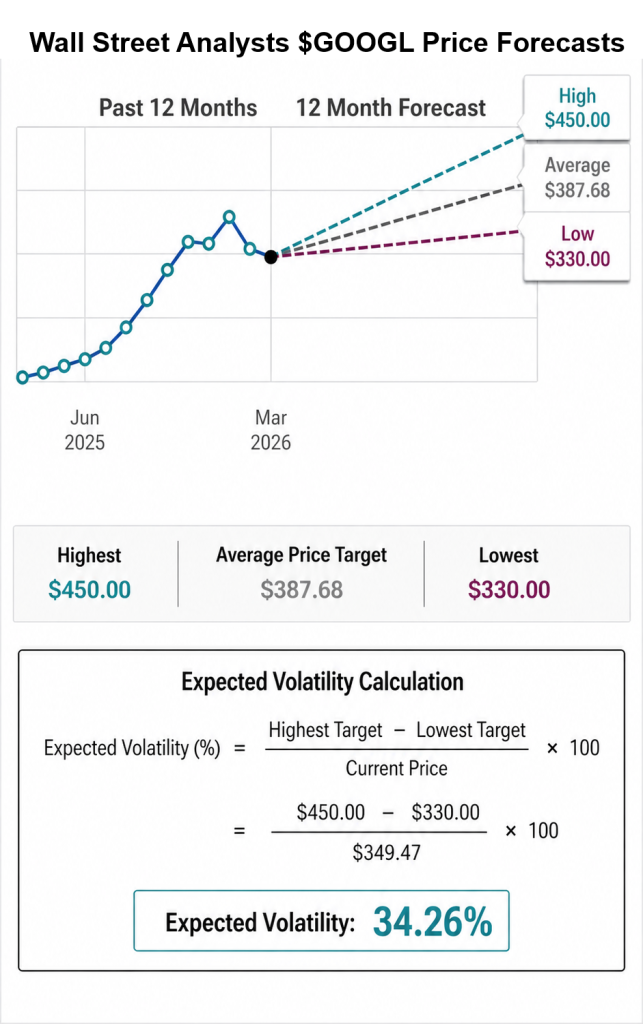
Wall Street is not confused about GOOGL. But it is not exactly in agreement either. The highest target sits up at $450, the lowest down at $330, and the stock parked somewhere in the middle around $349. That is not a tight little consensus. That is a $120 spread, which tells you something important right away. Analysts are not speaking with one voice. Some see a dominant AI winner with expanding margins. Others see disruption risk creeping into the core search business. In plain English, this is not certainty. This is educated guesswork with a wide range of outcomes .
Now translate that into price behavior. That spread implies real movement. Not the slow, polite kind. The kind that trends hard when it wants to and snaps back when expectations shift. Analysts are already behind parts of this move. The stock has pushed higher while many targets still lag below potential upside scenarios. That usually means one thing. If momentum continues, upgrades follow. If the story cracks, those same analysts will scramble the other direction just as fast. This is not a smooth glide path stock. This is a stock that can trend strongly but demands respect when sentiment shifts.
So where is the opportunity. It is in the gap between perception and reality. If Google continues to prove that AI strengthens its ecosystem instead of weakening it, the high-end targets start to look conservative. That is your upside pressure. But if AI eats into ad economics or shifts user behavior in ways that reduce monetization, the low-end targets suddenly look very reasonable. That is your risk. This setup favors momentum traders who understand trend strength and are willing to act when price confirms the story. It punishes anyone guessing. The message is simple. This is not about who is right. It is about who adjusts fastest.
52 Week High and Low Boundaries

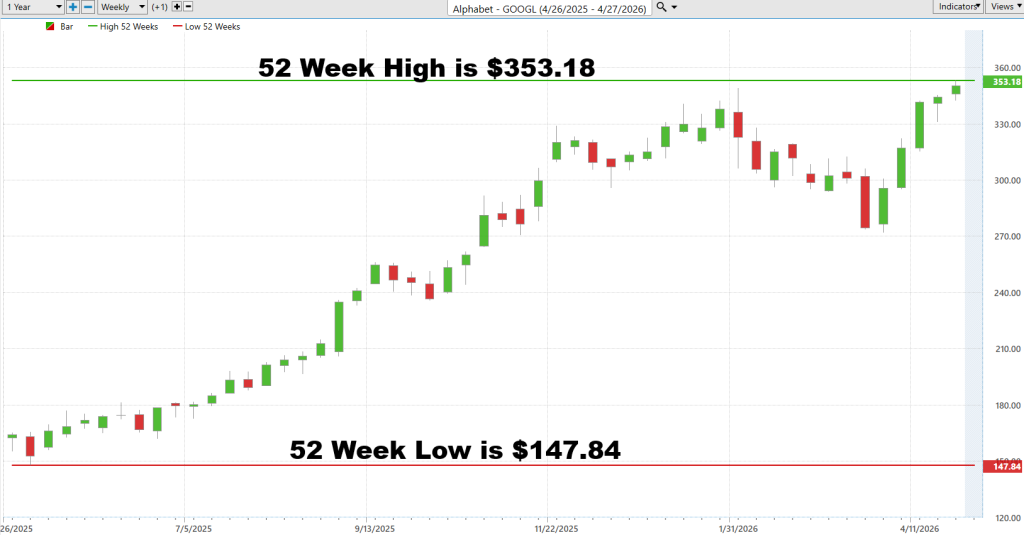
Alphabet Inc is not hiding. It is sitting right at the top of its range like a house on a hill with all the lights on. At roughly $349.86, with a 52-week high near $353 and a low down at $147.84, this stock is trading in the top 1 percent of its yearly range. That is not neutral. That is leadership. Smart traders do not guess what a stock might do. They look at what it has already done. Over the past year, GOOGL has shown you its full playbook, from the lows in the 140s to the highs in the 350s. That range is your reality check. It tells you what the stock is capable of. And right now, price is pressing against the ceiling, not wandering in the basement.
Now look at the size of that move. The difference between the high and the low is about $204.68. Divide that by the current price and you get roughly 59 percent. That is your range-based volatility. In plain English, this stock has covered nearly 60 percent of its current value over the past year. That is not a sleepy blue chip. That is a stock that moves with purpose. It trends, it pulls back, and then it trends again. What you are seeing now is not compression. It is expansion followed by continuation. Traders should expect movement, not stability. The mistake is thinking a strong stock becomes safe. It does not. It becomes active.
So what does this mean right now. The stock is extended. That is the truth. When you are sitting at the top of a 52-week range, the easy money has already been made. But strong stocks tend to stay strong longer than most traders expect. The opportunity is not in chasing blindly. It is in waiting for controlled pullbacks or clear breakouts above the high. If price breaks above that $353 area with conviction, you are looking at a continuation move. If it fails and slips back into the range, that is your early warning. This setup favors disciplined trend traders, not gamblers. The risk is buying strength without a plan. The reward is aligning with a proven leader while respecting the fact that gravity still exists.
Best-Case/Worst-Case Scenario Analysis
Volatility is not a theory. It is a fact printed on the chart. Look at the past 52 weeks and ask a simple question.
What is the largest uninterrupted rally?
You are staring at it.
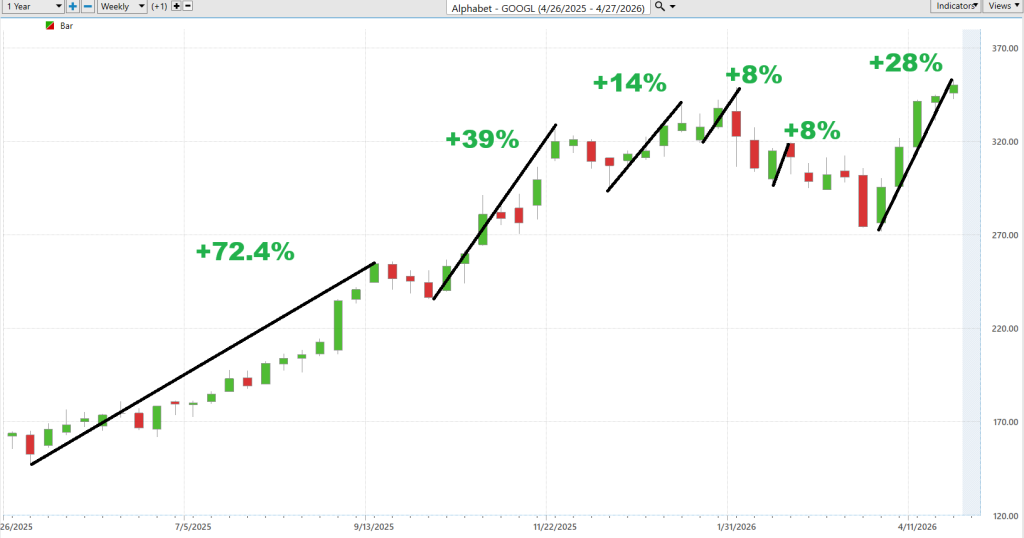
A move of roughly seventy two percent plus from the lows to the highs. That is not a fantasy scenario. That already happened. Now bring that forward. If GOOGL were to even approach a move like that again from the current level near $350, you are looking at a powerful upside expansion that could carry price well into the mid $500s over time. What would it take? Continued strength in AI, steady ad revenue, and no major disruption to its core business. Not perfection. Just momentum staying intact. Strong stocks tend to keep doing what they have already proven they can do.
Now flip the coin. What is the largest uninterrupted decline? You can see multiple pullbacks, but the standout move is a sharp drop in the twenty percent range. That is your reality check. This stock is capable of falling fast when sentiment shifts. From $350, a twenty percent decline takes you down toward the high $270s in a hurry. That is not a crash. That is normal behavior for this asset. And it does not need a disaster to get there. All it takes is disappointment. Slower growth. Pressure on margins. Or a shift in the AI narrative. The point is simple. The same stock that can rally hard can also drop hard. That volatility is not going away.
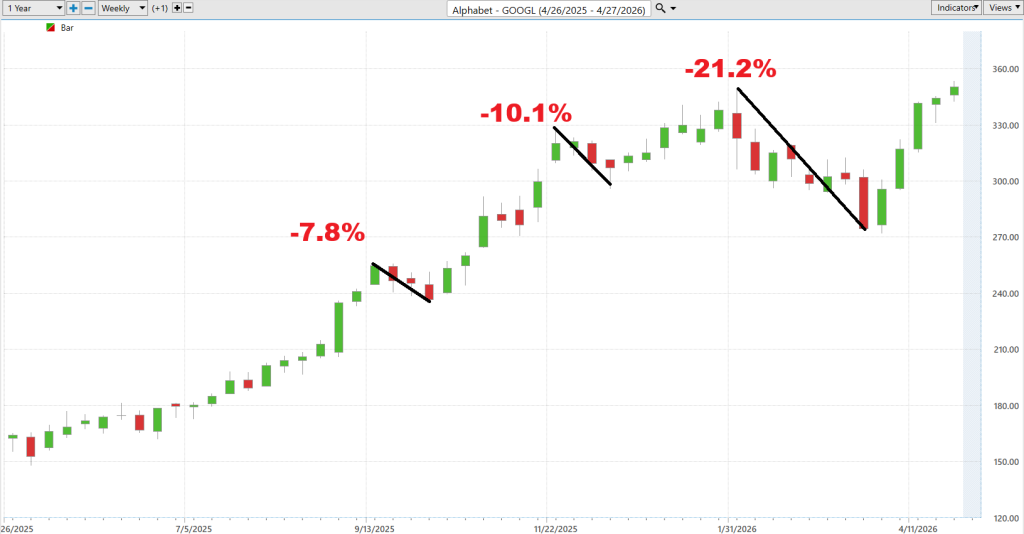
This is where most traders get it wrong. They focus on the upside and ignore the downside. They dream about the seventy percent move but forget about the twenty percent drawdown that comes along the way. This is not about prediction. It is about preparation. If you size your position correctly, both scenarios can exist without destroying you. If you ignore risk, the market will remind you very quickly. The takeaway is clear. Respect what the stock has already done. That is your roadmap. If you cannot handle the downside that history clearly shows you, then you have no business chasing the upside it promises.
Next we compare $GOOGL to the broader stock market averages.
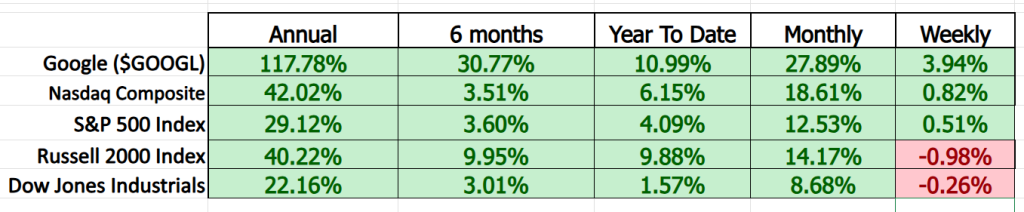
GOOGL is not just outperforming the market. It is lapping it. Over the past year, GOOGL is up roughly 118 percent while the S&P 500 sits near 29% and the Nasdaq around 42%. That is not a small edge. That is about four times the S&P and nearly three times the Nasdaq. Even over shorter timeframes, the pattern holds. Six months, monthly, weekly. GOOGL consistently beats the averages. This is not noise. This is sustained relative strength. The answer is clear. Yes, this stock is outperforming the broader market.
Now look at where that strength is coming from. Technology has been strong, and the AI narrative has lifted many names. But GOOGL is not just riding the wave. It is pushing ahead of it. The magnitude of its gains tells you this is not passive participation. This is leadership. When a stock consistently outpaces both the broad market and major indexes across multiple timeframes, it is not borrowing strength. It is attracting capital. That means institutions are choosing it, not just defaulting into it. This is what true leadership looks like.
So what should traders do with that information. You lean into strength, not away from it. This belongs on a watchlist, not an avoid list. But you do not chase blindly. Strong stocks still pull back, and those pullbacks are where opportunity lives. The edge is not in guessing. It is in aligning with proven leadership and managing risk while doing it. You do not get paid for average. You get paid for being right about strength. GOOGL is not a passenger in this market. It is one of the drivers.
Vantagepoint AI Predictive Blue Line
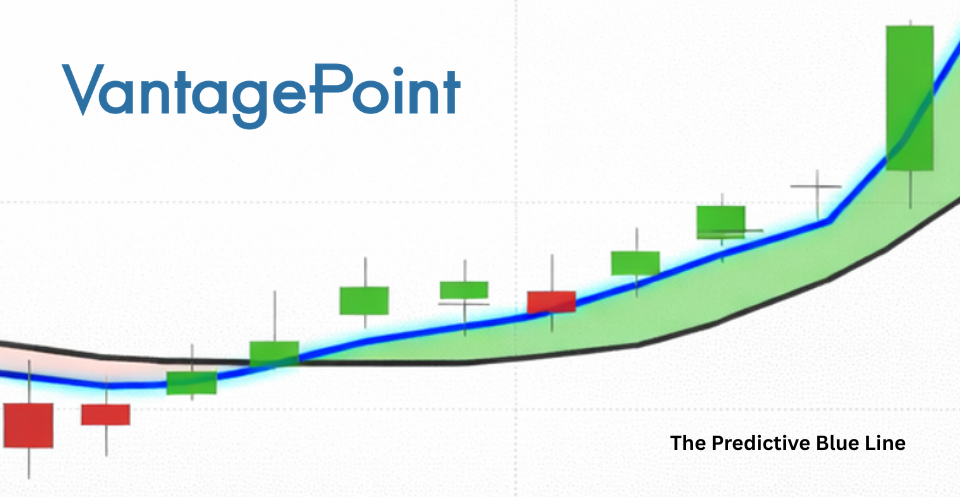
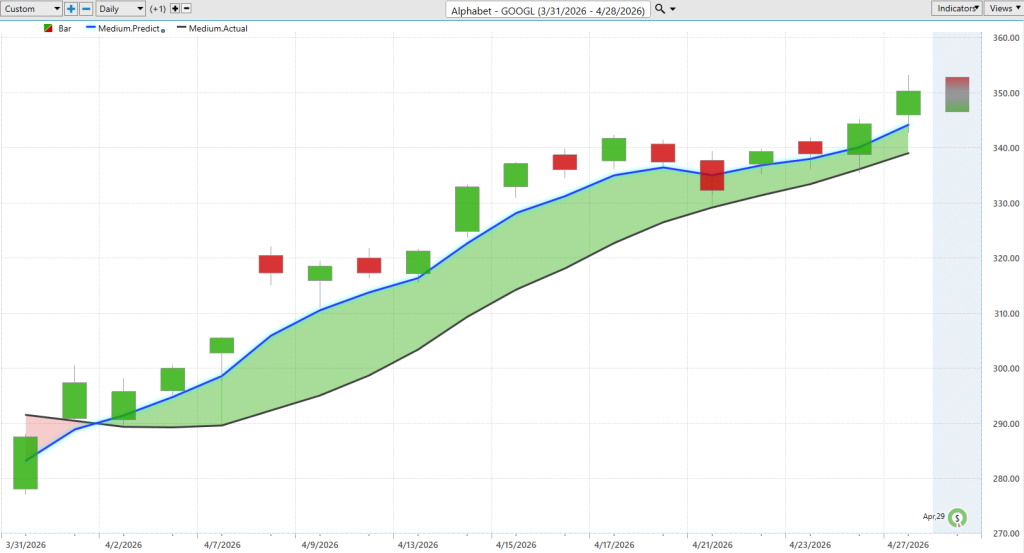
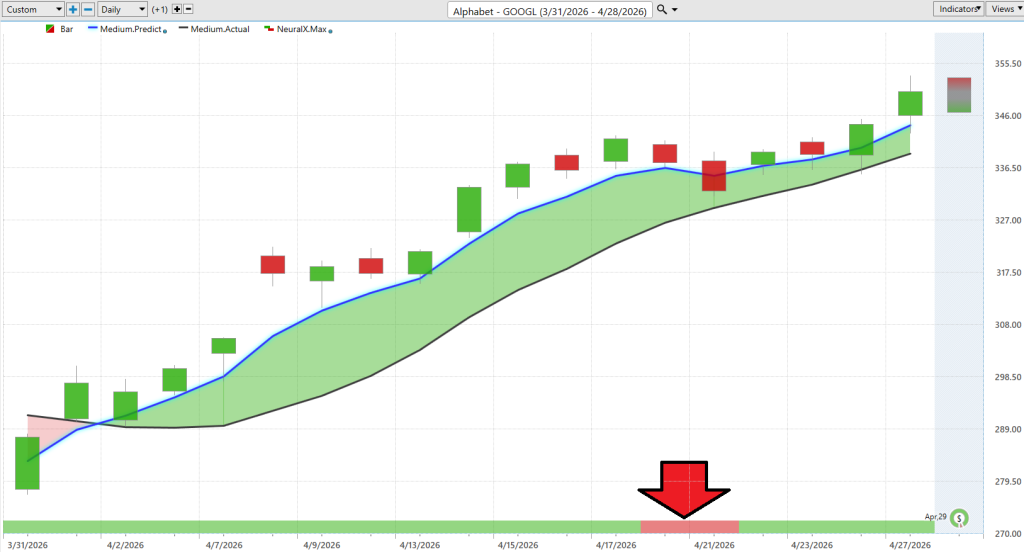
The Predictive Blue Line is doing exactly what traders want to see. It is rising. Not drifting. Not flattening. Rising with purpose. That slope is your short-term direction. Up. More important, it is beginning to separate from the black line. That tells you the forecast is strengthening, not weakening. In strong trends, the blue line becomes more than a signal. It becomes a guide. A support reference. Price pulls back to it, tests it, and then moves higher again. Look at the chart. That behavior is already happening. This is what a healthy uptrend looks like.
Now look at the relationship between the blue line and the black line. The blue line is above the black line. That is confirmation. Not speculation. There has been no recent bearish crossover. No confusion. No mixed signals. The trend is aligned. The black line is following price. The blue line is leading it. That is exactly what you want. When the forecast leads and the average follows, momentum is intact. This is not a transition phase. This is a confirmed trend that is still in motion.
So what should traders do with this. You do not chase blindly. You buy intelligently. Pullbacks toward the Predictive Blue Line are where opportunity lives. That is where risk is defined. That is where entries make sense. If price starts closing below the blue line and the slope begins to flatten, that is your warning. That is when conditions are changing. Until then, the play is simple. Respect the trend. Use the blue line as your timing tool. Price will gravitate back to it again and again. This is a high-probability setup for traders who wait for their pitch and act with discipline.
VantagePoint AI Neural Index (Machine Learning)
The Neural Index is a short-term forecasting tool built on neural networks, the same kind of systems used in speech recognition, fraud detection, and self-driving cars. It processes market relationships and turns them into a simple timing signal. Green means short-term strength is expected. Red means short-term weakness is expected. Right now, the Neural Index remains green. That tells traders the short-term forecast is still supportive over the next 48 to 72 hours. It is measuring probability with up to 87.4% accuracy.
Now step back and look at the bigger trend. The broader trend is also bullish. The Predictive Blue Line is rising. Price is trading above the 10-day moving average. That means the Neural Index is confirming the larger trend, not fighting it. This is what traders want to see. The short-term signal and the broader trend are aligned. That does not guarantee anything, but it improves the odds. When the Neural Index turns red you see price pull back to the price level of the predictive blue line or below.
So how should traders use this. This is a green light, but not a license to chase. The smarter play is to look for pullbacks, controlled entries, and clean setups where risk is defined. The Neural Index is a timing tool, not a complete trading system. Used with the Predictive Blue Line, it says momentum still favors the upside. The takeaway is simple. GOOGL remains in a bullish setup, and traders should stay constructive while respecting risk.
VantagePoint AI Daily Range Forecast
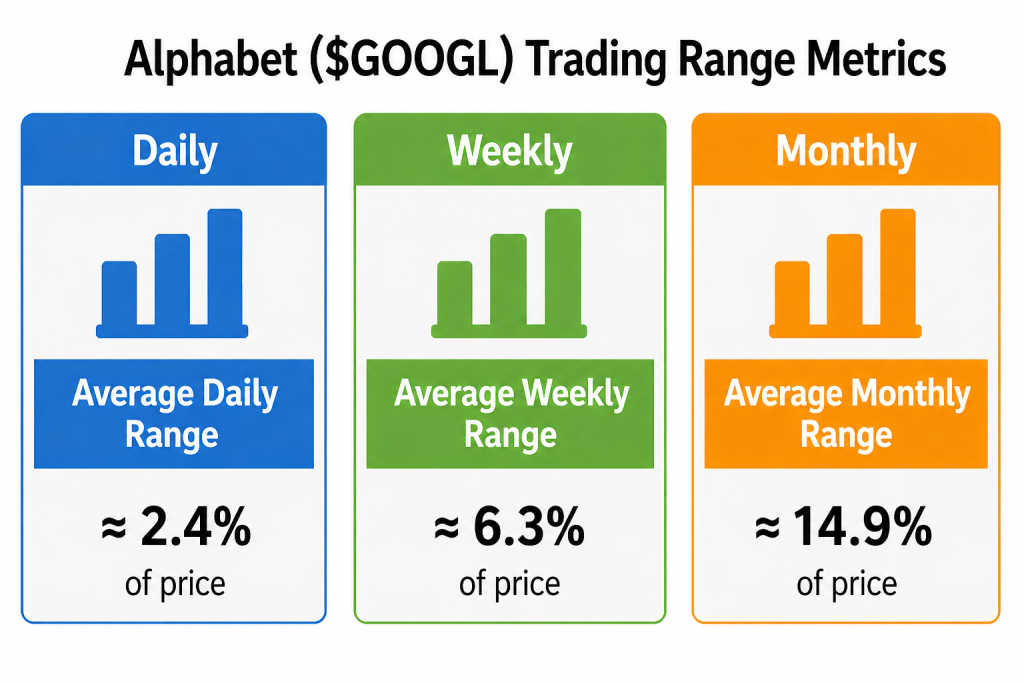
Traders already understand the averages. They know how a stock like Alphabet tends to behave over time. A couple percent in a day. A broader move over the week. Expansion over the month. But that knowledge, while useful, is backward-looking. It explains what has happened, not what matters most in the moment. And that is where the real gap exists. Alphabet’s recent profile reinforces this point. Daily movement around 2.4 percent suggests a stock with meaningful activity but not chaos. Weekly and monthly ranges build on that, showing a pattern of expansion that reflects a trending asset, not a random one. But none of that tells a trader where price is likely to go today. It provides context, not direction.
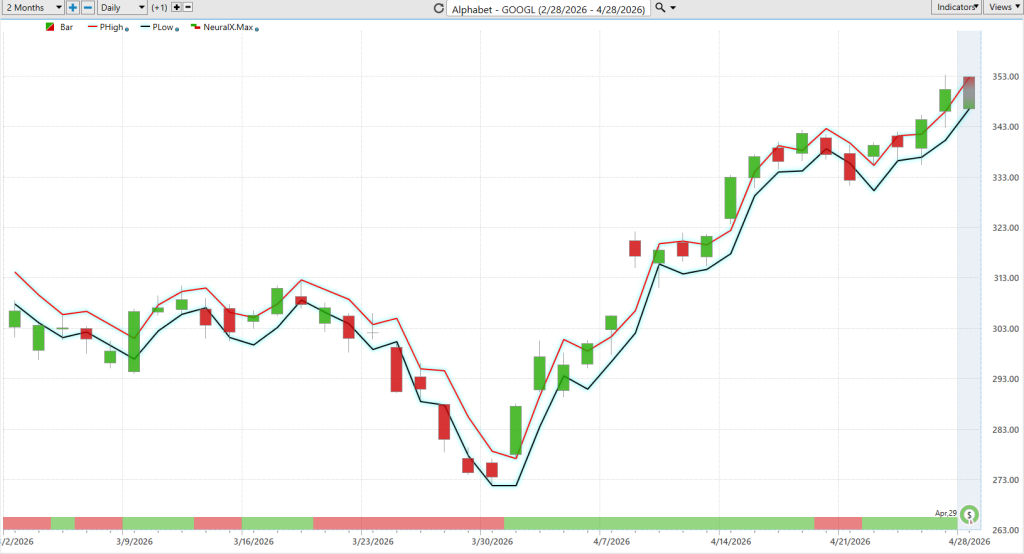
That is precisely the problem the VantagePoint AI Daily Range Forecast is designed to solve. Every trader, whether they admit it or not, is trying to answer the same question each morning. Where does opportunity live today, and where does risk begin. The Daily Range Forecast offers a forward-looking answer. It projects the high and low boundaries for the current session using predictive analytics, artificial intelligence, machine learning, and intermarket relationships. Volatility, as always, cuts both ways. Markets rise and fall, but the need to define the range remains constant. Study the chart and the distinction becomes clear. This is not a tool for reacting. It is a framework for anticipating.
What emerges is not just information, but structure. When traders understand the expected range, they stop treating normal price movement as a surprise. They size positions with intention. They set targets within reality. And they avoid the costly mistake of chasing price outside of its probable boundaries. This is why VantagePoint AI users consistently point to the Daily Range Forecast as a core part of their process. It turns volatility into something usable. Not something to fear. The takeaway is simple but critical. If you do not know where the range is today, you are guessing. And in a market like this, disciplined traders are not guessing. They are executing with precision.
VantagePoint AI Intermarket Analysis
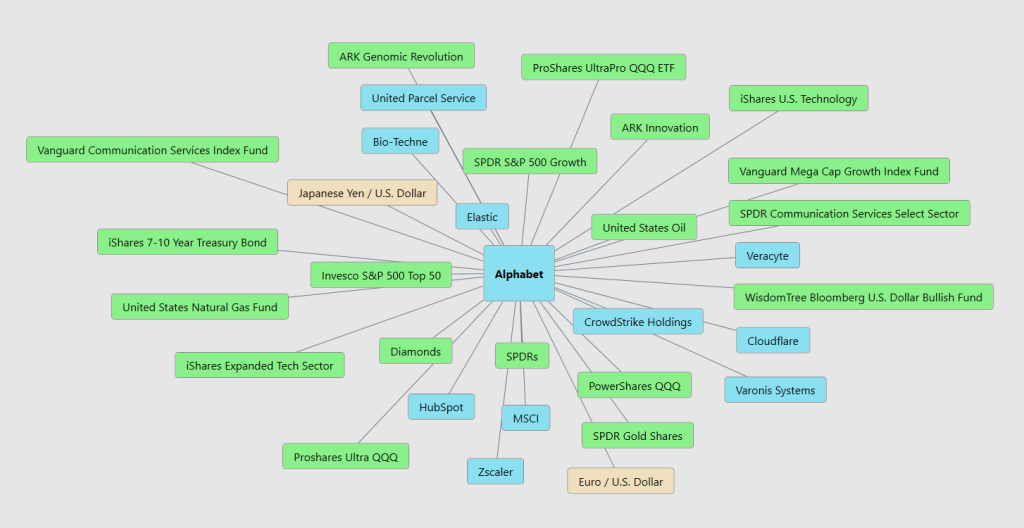
Intermarket analysis is simply the idea that no stock moves alone. Think of it like a team sport. If the quarterback is playing well but the rest of the team is falling apart, the outcome is shaky. But when everyone is moving in the same direction, the result is much stronger. GOOGL is being influenced by several key forces right now. Interest rates have stabilized, which supports higher valuations for growth stocks. The U.S. dollar is not surging, which removes pressure on multinational earnings. Commodities are not signaling stress, which keeps inflation fears contained. Most important, the technology and semiconductor space continues to trend higher, fueled by demand for artificial intelligence infrastructure. That matters because GOOGL sits right in the middle of that ecosystem. When chips, cloud, and AI spending rise, GOOGL benefits. And within this web of relationships, traders often uncover other names moving quietly in the same direction. Those are the hidden opportunities.
Right now, these forces are largely in agreement. That is what makes the trend in GOOGL more durable. The broader market is supportive. Technology is strong. Semiconductor momentum is reinforcing the AI narrative. There are no major signals pushing against the move. That does not mean risk disappears. It means the weight of evidence is on one side. This is confirmation, not conflict. When interest rates spike, the dollar surges, or tech leadership breaks down, that is when cracks begin to form. At the moment, those cracks are not obvious.
So what should traders do with this. You trust the trend, but you respect the environment. When intermarket forces are aligned, trends tend to persist longer than expected. That is where opportunity lives. But when those relationships begin to shift, risk increases quickly. The key is to watch the supporting players, not just the stock itself. If semiconductors weaken, if rates move sharply higher, or if capital rotates out of technology, that is your early warning. Strong trends are supported across markets. Weak ones stand alone. Right now, GOOGL looks like a high-confidence move, but only as long as the broader system continues to support it.
Here are the 31 key price drivers of $GOOGL.
Our Suggestion
Alphabet’s last two earnings calls show a management team that sounds confident, but not casual. In Q3, CEO Sundar Pichai said AI was already driving “real business results,” and Alphabet delivered its first $100 billion quarter. In Q4, management kept the same message, highlighting Gemini momentum, Cloud strength, and annual revenue above $400 billion for the first time.
The company appears to be hitting its main objectives. Search is still holding up. YouTube remains strong. Cloud is growing fast and becoming more important to the earnings story. The concern is not whether Alphabet has a real business. Of course it does. The concern is whether its massive AI spending can keep producing growth without squeezing margins or disappointing investors. That is the pressure point Wall Street is watching.
Management has provided enough guidance for investors to understand the direction: keep investing in AI, keep scaling Cloud, and keep defending the core advertising business. Wall Street expects Q1 revenue around $107 billion, with EPS estimates generally in the $2.63 to $2.73 range. Alphabet’s next earnings call is scheduled for April 29, 2026, after the close. We expect that all pullbacks and declines will be opportunities for institutions to purchase.
For traders, the takeaway is simple. Management sounds confident, but the stock still has to prove the AI spending is worth it. The trend remains attractive as long as Cloud growth, Search resilience, and AI monetization stay intact.
Practice great money management on every trade, and use the VantagePoint AI Daily Range Forecast to focus on short-term trading opportunities where risk is clearly defined.
Disclaimer: THERE IS A HIGH DEGREE OF RISK INVOLVED IN TRADING. IT IS NOT PRUDENT OR ADVISABLE TO MAKE TRADING DECISIONS THAT ARE BEYOND YOUR FINANCIAL MEANS OR INVOLVE TRADING CAPITAL THAT YOU ARE NOT WILLING AND CAPABLE OF LOSING.
VANTAGEPOINT’S MARKETING CAMPAIGNS, OF ANY KIND, DO NOT CONSTITUTE TRADING ADVICE OR AN ENDORSEMENT OR RECOMMENDATION BY VANTAGEPOINT AI OR ANY ASSOCIATED AFFILIATES OF ANY TRADING METHODS, PROGRAMS, SYSTEMS OR ROUTINES. VANTAGEPOINT’S PERSONNEL ARE NOT LICENSED BROKERS OR ADVISORS AND DO NOT OFFER TRADING ADVICE.